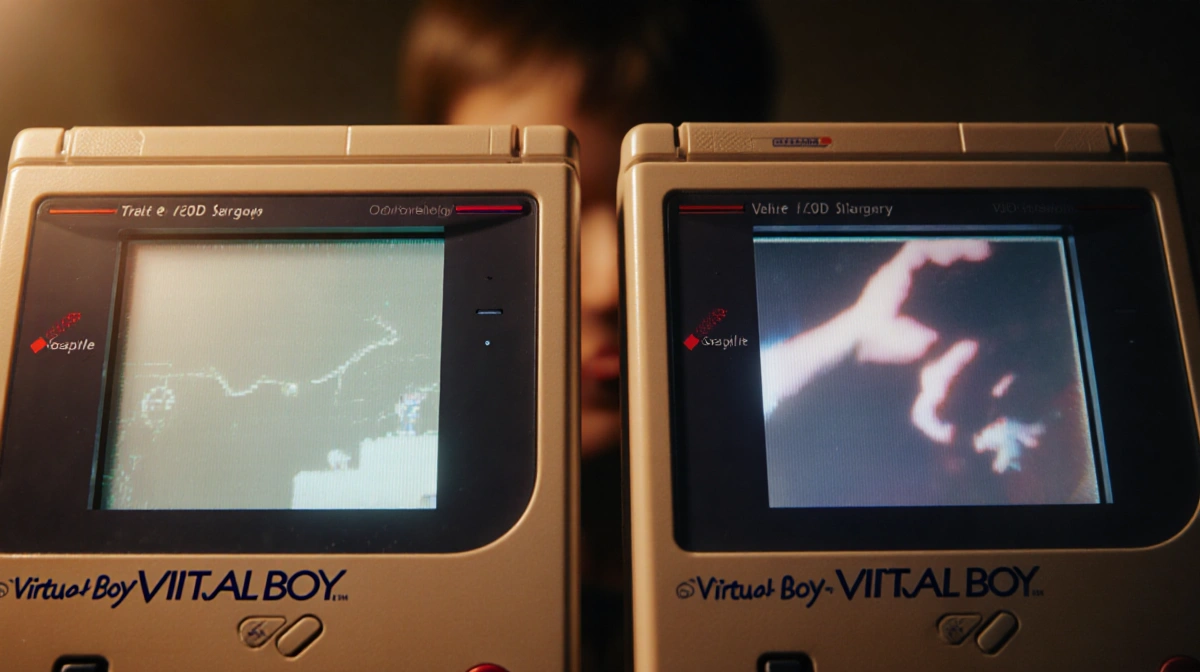
At a Glance
- Virtual Boy was Nintendo’s first attempt at a consumer VR system, released in 1995.
- The device used two one-pixel displays and fast-moving mirrors to create a 3-D illusion.
- It sold poorly, was discontinued after a year, and only 22 games were released.
The Virtual Boy was Nintendo’s bold entry into virtual reality, a technology that has become mainstream only in the past decade. Though it never captured the market, the system’s inventive use of optics and motion-scan techniques offers a fascinating glimpse into early VR design.
What Was the Virtual Boy?
Unlike modern headsets, the Virtual Boy was a table-mounted unit that users peered into, similar to a kaleidoscope. It was not a headset, but rather a small, portable display that relied on the user’s eye movements to generate depth. The device’s novelty lay in its use of two displays, one for each eye, and a pair of mirrors that rapidly oscillated to create the perception of motion.
How It Worked
The core of the system’s illusion came from its two displays and mirrors:
- Displays: Each screen was only 1 x 224 pixels, literally one pixel wide and 224 pixels tall.
- Size: The displays were about 0.4 inches high.
- Magnification: Large lenses amplified the tiny images for the viewer.
- Mirrors: Two mirrors angled at roughly 45° redirected the light.
- Motion: The mirrors oscillated 50 times a second, creating a rapid back-and-forth sweep that mimicked the scanning of a cathode-ray tube.
- Stereo: By showing slightly different images to each eye, the system produced a 3-D effect similar to modern headsets.
The design forced the brain to fill in the gaps between the single-pixel columns, a trick that reduced the processing burden but required the viewer’s visual system to do most of the work.
Technical Specs
| Feature | Detail |
|---|---|
| Release Year | 1995 |
| Display Resolution | 1 x 224 per eye |
| Display Size | 0.4 inches high |
| Mirror Angle | ~45° |
| Mirror Oscillation | 50 Hz |
| Color | Monochrome (red LEDs) |
| Color Capability | Would have required blue LEDs, a newer technology |
| Discontinuation | After 1 year |
| Game Library | 22 titles |
Limitations & Failure
Despite its clever engineering, the Virtual Boy faced several obstacles that doomed it commercially:
- Monochrome Display: The use of only red LEDs limited visual fidelity and made the experience less engaging.
- Eye Strain: Reviewers reported discomfort and dizziness, a common complaint with early VR.
- Processing Power: The system avoided complex rendering, but the trade-off was a less immersive visual experience.
- Market Readiness: In 1995, consumers were not yet ready for a headset-style VR product.
- Short Lifespan: The console was discontinued in 1996, just a year after launch.
Legacy & Lessons
The Virtual Boy remains a case study in how hardware constraints can drive creative solutions. Its use of mirrors and motion-scan techniques foreshadowed later VR technologies that also rely on optical tricks to reduce processing demands. While the product failed, it demonstrated that early VR could be achieved with relatively simple components-an insight that continues to influence modern design.
Key Takeaways
- The Virtual Boy was Nintendo’s first consumer VR attempt, released in 1995.
- It used one-pixel displays and fast-moving mirrors to create a 3-D illusion.
- The system’s monochrome output and eye-strain issues limited its appeal.
- Despite its failure, the device offered valuable lessons for future VR development.