At a Glance
- The Sun-like star J0705+0612 dimmed 40 times from September 2024 to May 2025.
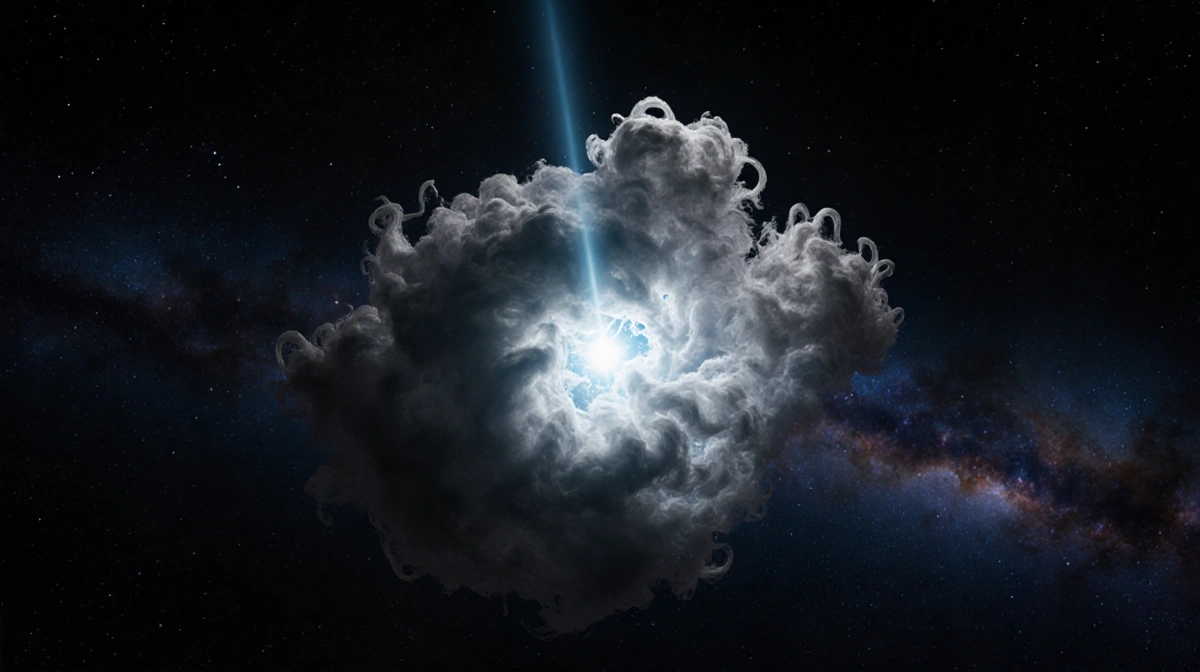
- Researchers identified a 120-million-mile (200 million km) wide dust and gas cloud orbiting the star.
- The cloud’s motion suggests it is bound by a massive unseen companion.
Why it matters: Even mature stars can be obscured by large circumstellar disks, hinting at unseen planets or low-mass stars.
The dimming of a distant star was first noticed by astronomers monitoring stellar brightness over time. From September 2024 to May 2025, the Sun-like star J0705+0612 became 40 times dimmer, a change that is exceptionally rare for stars like our Sun.
The Sudden Dimming
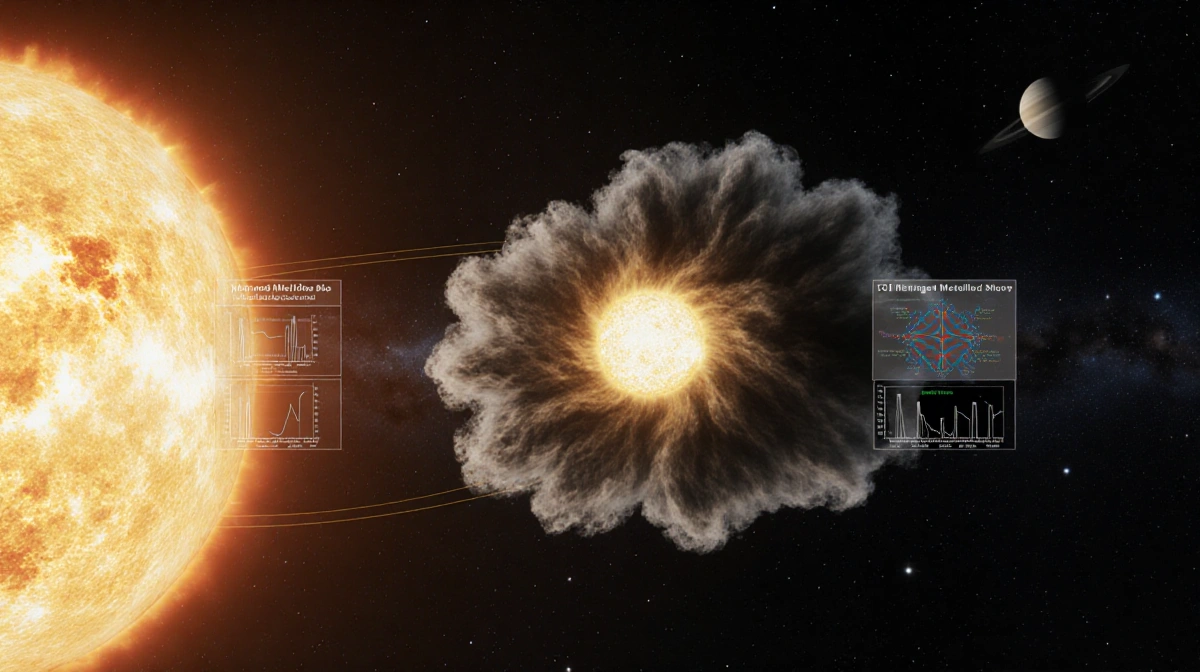
Researchers combined new telescopic data with the star’s archival records. They found that the star’s light was blocked by a slowly orbiting giant cloud of dust and gas. The cloud is roughly 120 million miles (200 million km) wide, a size comparable to the distance from the Sun to Saturn.
The star sits 3 000 light-years from Earth. Over the 8-month period of dimming, the cloud moved across the star’s face, reducing its brightness dramatically.
Uncovering the Dust Cloud
The team used the Gemini High-resolution Optical SpecTrograph (GHOST) to analyze the cloud’s composition and motion. GHOST’s sensitivity allowed the researchers to detect the gas and measure its three-dimensional movement.
The cloud is about 1.2 billion miles (2 billion km) from the star, far enough to orbit in the outer reaches of the planetary system. Its winds contain gaseous metals such as calcium and iron, indicating a dynamic environment.
Key Findings
- Size: 120 million miles wide.
- Distance from star: 1.2 billion miles.
- Composition: Metals (calcium, iron) and dust.
- Movement: Independent of the star’s motion.
The Mysterious Companion
The cloud’s stability implies a gravitational tether to another body at the edge of the system. Researchers estimate the unseen companion must have a mass of at least a few Jupiter masses. Possible identities include a very large exoplanet, a brown dwarf, or a very low-mass star.
If the companion is a star, the cloud would be a circumsecondary disk-debris orbiting the less massive companion in a binary system. If it is a planet, the cloud would be a circumplanetary disk.
Such direct observations of a star being obscured by a secondary object’s disk are extremely rare.
Chemical Secrets Inside the Cloud
When the team began spectroscopic observations, they hoped to learn about the cloud’s chemical makeup. Instead, they discovered a surprising abundance of heavy elements.
“When I started observing the occultation with spectroscopy, I was hoping to unveil something about the chemical composition of the cloud, as no such measurements had been done before. But the result exceeded all my expectations,” said Nadia Zakamska, a Johns Hopkins University professor of astrophysics and co-author of the study.
The presence of metals heavier than helium-what astronomers call “metals”-provides clues about the cloud’s origin and the processes that formed it.
How It Formed
The researchers detected an infrared excess-an overabundance of infrared light-which usually signals a protoplanetary disk around a young star. However, J0705+0612 is over two billion years old, making a primordial disk unlikely.
Instead, the cloud may have formed from a collision between two planets at the fringes of the system. Such an impact would eject debris, dust, and rocks, creating a large, slowly orbiting cloud.
“Even in mature planetary systems, dramatic, large-scale collisions can still occur,” Zakamska said. “It’s a vivid reminder that the Universe is far from static-it’s an ongoing story of creation, destruction, and transformation.”
Implications for Planetary Systems
This discovery shows that large, dusty disks can persist around older stars, potentially hiding unseen companions. It also highlights the importance of high-resolution spectroscopy in revealing the composition and dynamics of circumstellar material.
Future observations with instruments like GHOST may uncover more such systems, helping astronomers understand how planetary systems evolve long after their stars have formed.
Key Takeaways
- A 120-million-mile dust cloud dimmed the star J0705+0612 40 times from Sep 2024 to May 2025.
- The cloud is held together by a massive companion of at least a few Jupiter masses.
- Spectroscopy revealed metals and dynamic winds, indicating a complex environment.
- The cloud likely formed from a collision between two planets, not from a primordial disk.
- The findings underscore that even mature stars can host large, obscuring disks, hinting at unseen planets or low-mass stars.
—
Timeline of Events
| Date | Event |
|---|---|
| Sep 2024 | First signs of dimming detected |
| Sep 2024 – May 2025 | Star dimmed 40 times |
| Publication day | Study released in The Astronomical Journal |