

At a Glance
- Spectrum Slit turns invisible WiFi traffic into a living light show.
- It maps the 2.4 GHz-5 GHz band into 64 LED strips that pulse with signal strength.
- The device also emits a hum that rises and falls with data bursts, turning noise into an audible pattern.
Why it matters: It makes the hidden electromagnetic storm around us visible, giving insight into everyday wireless noise.
Rootkid, a YouTuber known for playful tech projects, has built a wall-mounted visualizer that turns the invisible chatter of our WiFi, Bluetooth, and microwave ovens into a glowing, humming display. The device, called Spectrum Slit, captures signals within a 30-meter radius and translates them into 64 sections of warm yellow LEDs that light up as traffic rises and falls. In a short video, Rootkid demonstrates how the device turns the quiet hum of the home into a living, breathing light show.
How Spectrum Slit Works
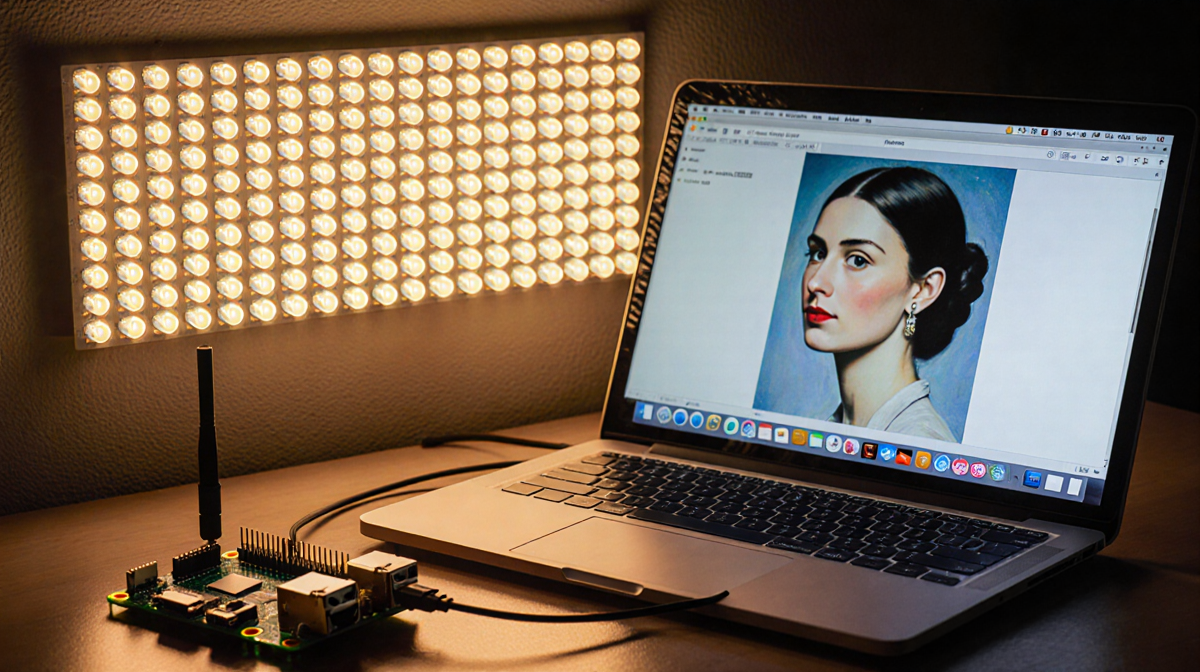
Rootkid began with a HackRF 1, a software-controlled radio that can monitor a wide range of radio and microwave frequencies. The HackRF 1 is paired with a Raspberry Pi, which runs custom software written by Rootkid on a laptop that sports a full-screen picture of Françoise Hardy as its wallpaper. The software listens to the 2.4 GHz-5 GHz band and splits it into 64 equal sections. Each section controls the brightness of a strip of warm yellow LEDs mounted on the wall.
When a signal in a particular frequency slice is strong, the corresponding LED strip glows brighter. The result resembles a supersized graphic equalizer from a fancy stereo, but instead of audio, it visualizes wireless data traffic. The Raspberry Pi’s processing also drives a small coil that vibrates slightly for each LED row. The vibration produces an audible hum, and the pitch of the hum rises and falls with the LED brightness.
Rootkid notes that the hum is “pretty disturbing actually,” because when the device is running you can hear each burst of data as a distinct tone. In the video, the hum shifts in real time, turning the wall into a living, breathing instrument that mirrors the invisible electromagnetic storm outside.
The Visual and Audible Experience
During the demonstration, the wall lights up in a sequence that follows the ebb and flow of daily life. Early in the morning, the LEDs glow dimly as the house is quiet. As people return from work, the lights flare, and the hum rises, indicating a surge in WiFi and Bluetooth traffic. At lunch time, the microwave oven’s signal spikes, producing a bright burst on the corresponding LED strip.
The video captures this dynamic over the course of a full day, showing how the device responds to the presence of neighbors, the opening of doors, and even the simple act of turning on a phone. Rootkid stands in the middle of the glowing wall, surrounded by warm yellow light, and muses, “We live surrounded, by ghosts of our own making.” This line underscores how everyday devices emit invisible electromagnetic radiation that fills our homes.
The hum that accompanies the lights is not merely a side effect; it is an intentional design choice that gives the device an audible dimension. The pitch of the hum changes with the LED brightness, so a sudden spike in traffic produces a higher tone. Rootkid’s comment that the hum is “pretty disturbing actually” hints at how the invisible noise can become noticeable when visualized.
What It Reveals About Our Wireless World
The 2.4 GHz-5 GHz band is where most consumer wireless devices operate. WiFi routers, cordless phones, Bluetooth headsets, and even microwave ovens emit signals in this range. Because these signals are omnipresent, they create a background electromagnetic “storm” that is usually invisible to the naked eye.
By converting that storm into a visible and audible form, Spectrum Slit offers a tangible glimpse into the hidden traffic that surrounds us. The device shows that our homes are constantly humming with data, and that even the most mundane devices contribute to a complex web of signals.
Rootkid’s final reflection, “We live surrounded, by ghosts of our own making,” invites viewers to consider the cumulative effect of our devices. The visualizer turns an abstract concept-electromagnetic radiation-into a concrete experience, making the invisible visible.
Conclusion
Spectrum Slit is more than a piece of wall art; it is a window into the electromagnetic environment of modern homes. By mapping the 2.4 GHz-5 GHz band onto 64 LED strips and pairing the visual display with an audible hum, Rootkid has created a device that turns invisible wireless traffic into a living, breathing light show. The project invites viewers to notice the invisible signals that fill their rooms and to reflect on the invisible “storm” created by everyday technology.
The device’s ability to capture and display signals within a 30-meter radius demonstrates that even a single wall-mounted unit can reveal the complex tapestry of wireless communication that surrounds us. As Rootkid’s video shows, the invisible becomes visible, the hum becomes audible, and the everyday chatter of our devices becomes an artful display that reminds us of the unseen world we inhabit.
Key Takeaways
- Spectrum Slit visualizes WiFi, Bluetooth, and microwave traffic as shifting yellow lights.
- The device uses a HackRF 1, Raspberry Pi, and custom software to split the 2.4 GHz-5 GHz band into 64 sections.
- An audible hum accompanies the lights, with pitch changes that mirror data bursts.
- The project turns the invisible electromagnetic storm around us into a tangible, artistic experience.