
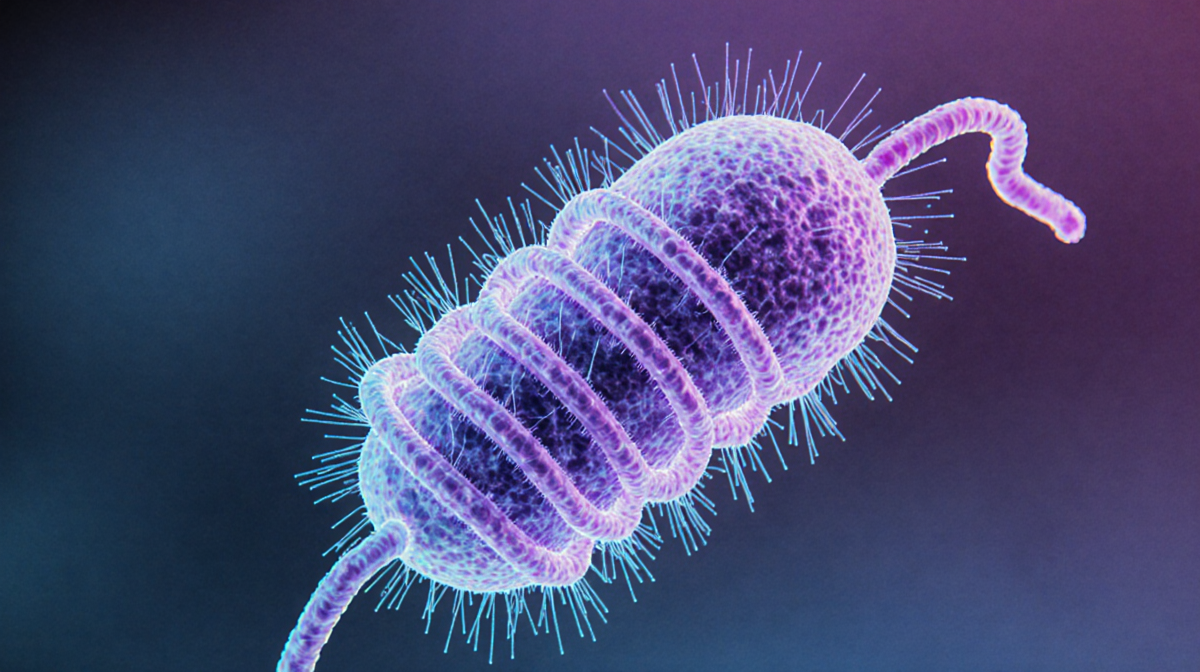
Some bacteria travel through incredibly small spaces. Researchers-and a researcher’s awesome illustration of a devilishly satisfied microbe-have revealed how the bacteria Caballeronia insecticola is able to traverse narrow passages in a bean bug’s digestive tract. In a study published last week in Nature Communications, a team of researchers found that Caballeronia insecticola navigates a bottleneck in the bug’s gut just 1 micrometer wide via a “flagellar wrapping” motion. In this process, the microbe wraps its flagellum-the tail-like part bacteria use to move-around itself and advances like a rotating corkscrew. The finding reveals how this species successfully moves through such a narrow passage and could also inform treatment for harmful bacteria.
At a Glance
- Caballeronia insecticola uses flagellar wrapping to cross a 1 micrometer bottleneck.
- 15 % of bacteria use wrapping in broad chambers, but 65 % do so in tight corridors.
- The flexible hook at the flagellum’s root enables this motion.
- Why it matters: Understanding this mechanism may help control bacterial spread and inspire micro-robot design.
How the Bacteria Move
Flagellar Wrapping Mechanics
A few years ago, Daisuke Nakane, a researcher at the University of Electro-Communications, noted that Caballeronia insecticola sometimes wraps its flagella around the front of its body instead of trailing them behind. He described the configuration as a “screw-thread” that rotates like a miniature tunneling machine, helping the cell push forward. “This wrapped ‘screw-thread’ configuration rotates like a miniature tunneling machine, helping the cell push forward,” said Nakane.
Experimental Setup
To test the hypothesis, the team placed Caballeronia insecticola in a microfluidic device with channels nearly identical in width to the natural bottleneck. In videos captured by the researchers, the bacteria moved smoothly through these restricted channels, confirming the wrapping behavior in a controlled environment.
The Science Behind the Motion
Fluid Dynamics Simulation
In a narrow space, liquid around the cell barely moves because the walls hold it back. An extended flagellum-which normally pushes water backward-becomes almost useless. “But a wrapped flagellum creates a rotating helical surface that squeezes fluid through the tiny gap between the cell and the wall,” explained Nakane. “This generates strong forward thrust, turning the bacterium into a self-propelled screw perfectly tuned for tight environments.”
Helical Thrust Mechanism
Computer simulations revealed that the rotating helical surface acts like a piston, forcing fluid through the narrow gap. The resulting pressure differential produces a thrust that propels the bacterium forward. The simulations also showed that species capable of flagellar wrapping maintained speed in tight tunnels, while those that could not either slowed dramatically or stopped.
Hook Flexibility: The Key
Genetic Manipulation Experiments
The researchers identified the hook-a flexible joint at the flagellum’s root-as the critical component. They performed genetic modifications to swap the hook of Caballeronia insecticola with a stiffer version from another species. The modified bacteria lost the ability to wrap and ground to a screeching halt in tight spaces. Conversely, when the stiff hook was replaced with the soft, flexible hook from Caballeronia insecticola, the other species could, at least to some degree, engage in flagellar wrapping and move through tighter spaces.
Hook Flexibility Analysis
“Physics simulations recapitulated these results, reinforcing the simple but elegant rule: a flexible hook enables wrapping; wrapping enables tunneling; tunneling enables survival,” said Nakane. “And this wasn’t just a laboratory phenomenon. When we tested stiff-hook mutants inside real bean bugs, their ability to colonize the host plummeted. Without wrapping, they could not pass through the one-micrometer barrier. Evolution had clearly shaped the hook’s softness to help the bacteria navigate their host’s internal architecture.”
Broader Implications
Other Bacteria
Scientists observed similar movements in organisms such as Campylobacter, Helicobacter, and Pseudomonas-bacteria that travel through glandular ducts and mucus layers-suggesting that flagellar wrapping may be a common trait among microbes needing to traverse narrow and viscous areas.
Potential Applications
The ability to either hinder or augment this strategy could slow harmful bacteria and support beneficial ones. This clever gear switch may also inspire the configuration of nanoscale drilling systems or micro-robots. “Perhaps more excitingly, the ability to either hinder or augment this strategy could slow harmful bacteria and support beneficial ones,” Nakane added.
Key Takeaways
- Flagellar wrapping lets Caballeronia insecticola cross a 1 micrometer bottleneck.
- Flexibility of the flagellar hook is essential for wrapping.
- The mechanism offers insights for controlling bacterial spread and designing micro-scale devices.