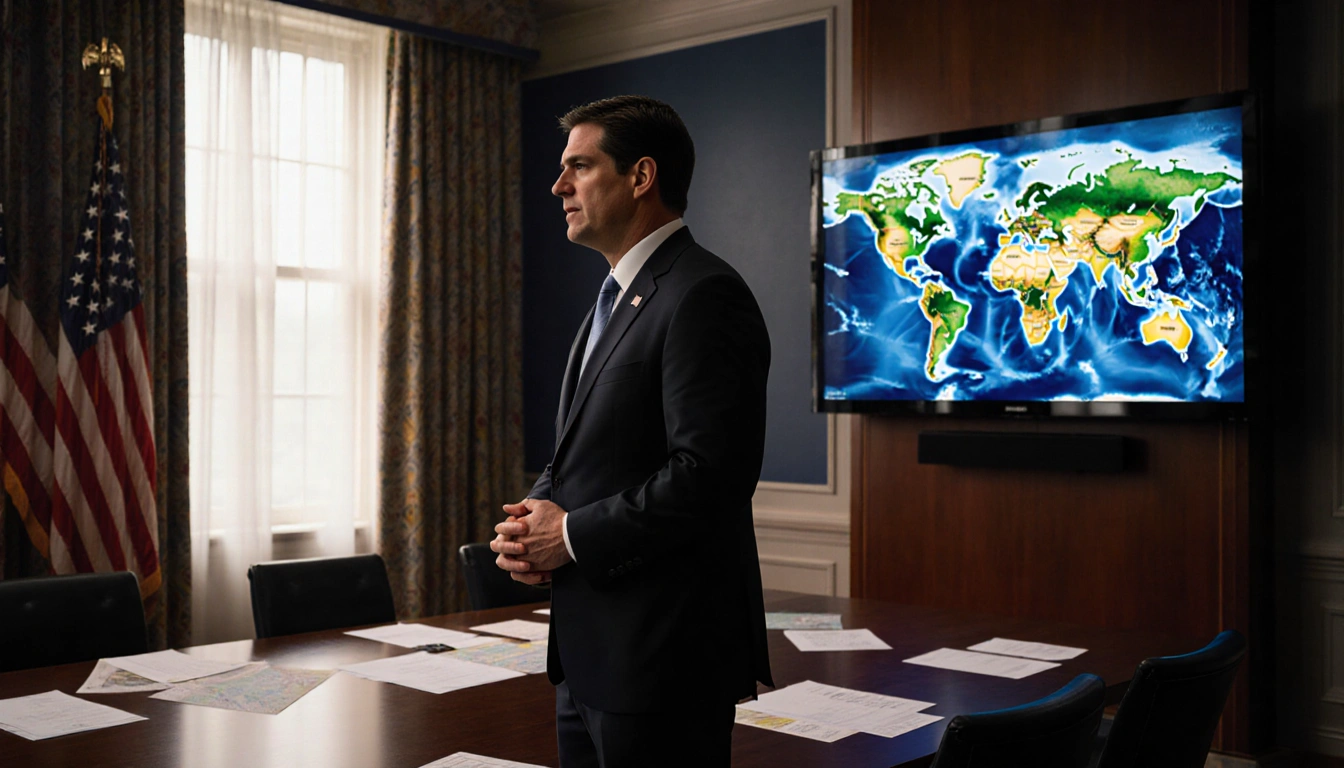
In a marathon end-of-year briefing that stretched more than two hours, Secretary of State Marco Rubio spoke to reporters about the Trump administration’s foreign policy priorities, from Russia-Ukraine talks to a Gaza ceasefire plan and a hard-line stance on Venezuela. The session, held in the State Department’s briefing room, was Rubio’s first lengthy appearance since the office stopped holding twice-weekly press briefings in August.
## Russia-Ukraine and Gaza negotiations
National-security officials from Britain, France and Germany were in Florida to meet Ukraine’s lead negotiator, Rustem Umerov, and U.S. envoys Steve Witkoff and Jared Kushner. The talks were part of Trump’s latest Ukraine-Russia peace proposal. A White House official, speaking on condition of anonymity, said Witkoff and Kushner would also see Egyptian, Turkish and Qatari officials that Friday to discuss the next phase of the Israel-Hamas plan.
Progress on the Gaza ceasefire has been slow since the plan was announced in October. U.S. officials are pushing to set up a “Board of Peace” that would oversee Gaza after two years of war and create an international stabilization force to police the area. When asked about contributions to that force, Rubio said, “I think we owe them a few more answers before we get there.” He added that once the Board and a Palestinian technocratic group are in place, the U.S. can “firm up the stabilization force, including how it’s going to be paid for, what the rules of engagement are, what their role will be in demilitarization.”
Witkoff and Kushner are also scheduled to meet Saturday with Russian President Vladimir Putin’s adviser Kirill Dmitriev in Miami, according to officials. Rubio, who will be in Florida for the holidays, said he would probably attend. However, he emphasized that a peace deal cannot be forced: “We understand that you’re not going to have a deal unless both sides have to give, and both sides have to get.” He continued, “Both sides will have to make concessions if you’re going to have a deal. You may not have a deal. We may not have a deal. It’s unfortunate.”
## Venezuela policy
In the Caribbean and eastern Pacific, Rubio has championed military operations against vessels suspected of drug smuggling. The actions, which began in early September, target what the administration calls “narco-terrorists” linked to left-ist Venezuelan President Nicolás Maduro, who has been charged with narco-terrorism in the United States. Rubio defended Trump’s prerogatives on Venezuela, saying the administration believes “nothing has happened that requires us to notify Congress or get congressional approval or cross the threshold into war.” He added, “We have very strong legal opinions.”
During an NBC News interview, Trump would not rule out a war with Venezuela. Rubio and Defense Secretary Pete Hegseth have said the current operations are directed at “narco-terrorists” smuggling deadly drugs into the United States. Maduro insists the real purpose is to force him from office. When asked if the U.S. wants “regime change in 2026,” Rubio sidestepped the question but described the regime as “illegitimate, that cooperates with Iran, that cooperates with Hezbollah, that cooperates with narco-trafficking and narco-terrorist organizations,” adding that the regime “includes not just protecting their shipments and allowing them to operate with impunity, but also allows some of them to control territory.”
## Other peacemaking efforts at risk
Trump has spoken of wanting to be remembered as a “peacemaker,” but ceasefires the administration helped craft are already in trouble. Renewed military action between Cambodia and Thailand and between Rwanda and Congo threaten the agreements. Rubio said the commitments “today are not being kept” of the Thailand-Cambodia conflict, which now risks reigniting after Thai airstrikes. He added that the work now is to bring the parties back to the table.
## Rubio’s America-First reforms
Since taking over the State Department, Rubio has moved quickly to implement Trump’s “America First” agenda. He helped dismantle the U.S. Agency for International Development and reduced the size of the diplomatic corps through a significant reorganization. Critics say the decision to eliminate USAID and slash foreign-aid spending has cost lives overseas, but Rubio and others deny this. He pointed to ongoing disaster relief operations in the Philippines, the Caribbean and elsewhere, and new global health compacts signed with countries that previously had USAID programs. Rubio said, “We have a limited amount of money that can be dedicated to foreign aid and humanitarian assistance,” and that it “has to be applied in a way that furthers our national interest.”
## Key Takeaways
– Rubio’s briefing covered Russia-Ukraine, Gaza, and Venezuela, emphasizing that peace requires concessions from both sides.
– The U.S. is pursuing a Board of Peace and stabilization force for Gaza, with Rubio noting more answers are needed.
– Military operations against drug-running vessels in Venezuela are ongoing, with Rubio defending the administration’s legal basis and rejecting a need for congressional approval.
Rubio’s long-running State Department session underscored the Trump administration’s focus on hard-line foreign policy and its willingness to reshape aid and diplomatic structures in pursuit of an America-First strategy. The outcomes of the upcoming talks in Miami and the continued pressure on Venezuela remain closely watched as the administration moves toward the new year.