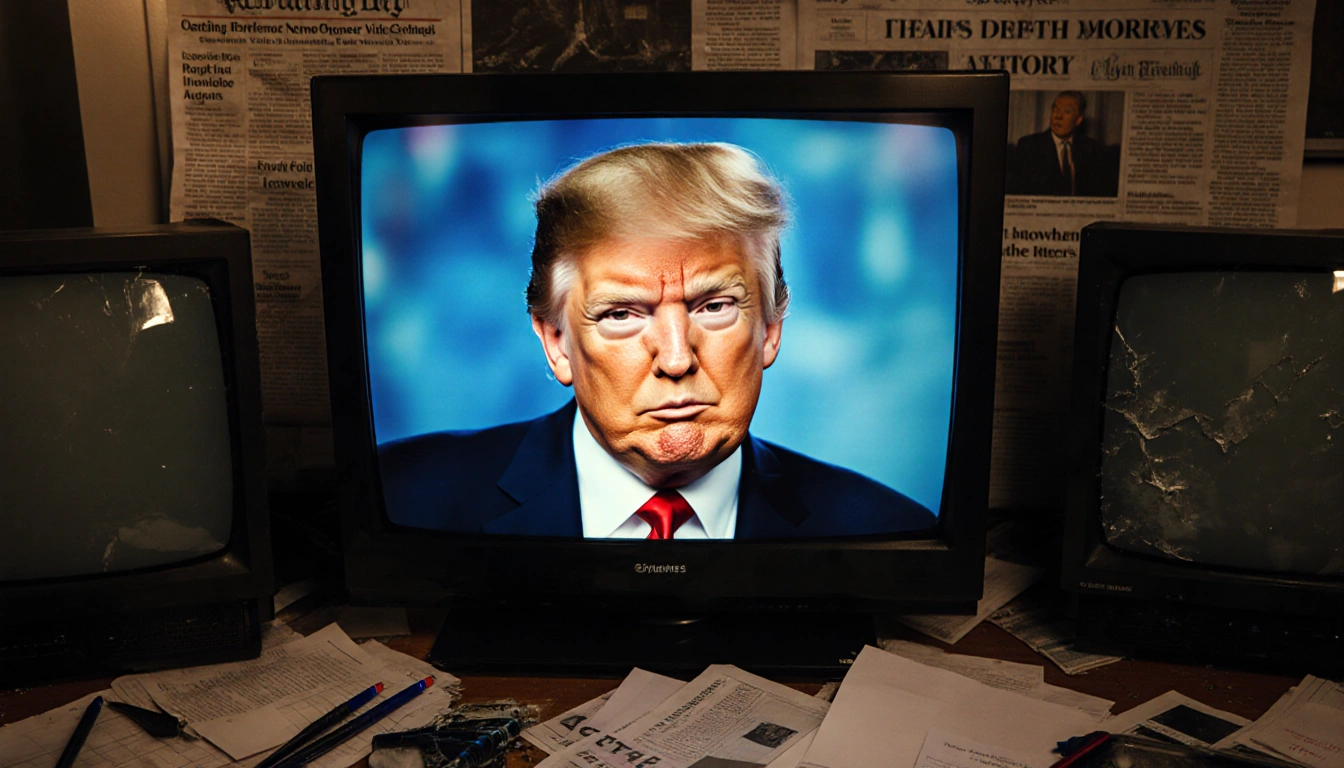
When Donald Trump delivered his first address of his second term, every major U.S. network broadcast the 18-minute speech live on air, cable and online.
The Broadcast and Its Context
The Republican president stood in the Diplomatic Reception Room and spoke for 18 minutes, issuing a series of aggressive, politically-motivated arguments that misstated facts, blamed his predecessor, exaggerated the results of his nearly 11 months in office and amplified his promises about what’s to come.
Network Decision-Making
Networks typically grant presidents the benefit of the doubt. A president’s request usually begins with the White House press secretary or communications director contacting Washington bureau chiefs, offering a general description of the topic. The request is then relayed to network executives who weigh whether to preempt or delay programming, a decision that can affect advertising revenue.
Former NBC News executive Mark Lukasiewicz, now dean of Hofstra University’s communications school, said, “It’s not that the Oval Office and the White House haven’t been used for political speeches before,” adding, “But, as with a great deal of what Donald Trump does as president, this was outside the norm.” He noted that news executives are reluctant to flout the historical standard that when the president feels he needs to speak, the networks should let him speak.
Competing Pressures
Trump’s speech aired on the same day that Federal Communications Commission chairman Brendan Carr told Congress that the FCC is not an independent agency as has been understood through generations of administrations. Trump’s history of browbeating journalists and suing news organizations to multimillion-dollar settlements-particularly with CBS and ABC-added further tension.
The White House did not immediately reply to questions about the process that led to the address, and the networks did not respond to Associated Press inquiries. Spokespeople at MS NOW and CNN, cable networks whose prime-time programming already is oriented to political coverage, declined comment.
Historical Precedent and Recent Examples
Presidential addresses often involve rare national security matters. For example, when President Barack Obama announced the killing of Osama bin Laden, his aides told networks the president wanted to discuss a major national security matter. In 2014, networks rejected Obama’s request to speak about immigration policy while Congress was at an impasse. In 2022, Biden spoke at length about American democracy, but several networks did not carry his remarks from Philadelphia.
Trump’s Content and Claims
By Wednesday afternoon, White House aides and some executive-branch agencies had telegraphed to journalists that the speech would be more oriented to the state of the nation nearly a year into Trump’s presidency-a framing that would still put the speech within historical norms. Trump, however, went beyond those traditional boundaries.
He blamed Biden and Democrats for “the worst (inflation) in the history of our country,” though inflation rates had begun falling before Biden left office and are now at or near historically routine levels. Trump accused immigrants in Minnesota of stealing “billions and billions” of dollars and used war language to describe Biden-era immigration levels as an “invasion.” He claimed he secured $18 trillion in foreign business investments, a figure that the White House puts closer to half that amount. He also asserted that he scored a landslide in 2024, despite his Electoral College vote share ranking in the bottom third of the past 230 years of victorious presidents.
The White House offered charts that only Fox opted to show.
Key Takeaways
- Trump’s first address of his second term was 18 minutes long and broadcast on all major networks.
- The speech was politically charged, misstating facts and blaming the previous administration.
- Networks traditionally grant presidential requests based on national security or rare matters, but Trump’s request was considered outside the norm.
- The speech aired the same day FCC Chairman Brendan Carr questioned the agency’s independence, adding to the political climate.
- Trump’s remarks included claims about inflation, immigration, foreign investments and election results, many of which were disputed by the White House.
The airing of Trump’s address highlights the ongoing debate over whether mainstream media should broadcast purely political speeches that may not involve national security or other traditionally covered topics.