EU officials had hoped to sign the EU-Mercosur free-trade agreement in Brazil this weekend, after 26 years of negotiations. But after a tense EU summit, European Commission President Ursula von der Leyen announced that the signature would be delayed “a few extra weeks to address some issues with member states.” The decision follows fierce farmer protests and last-minute opposition from France and Italy, which threatens to derail the pact that backers see as a major geopolitical move for both continents.
## The Summit and the Delay
On Thursday, von der Leyen and European Council President Antonio Costa reached an agreement on the sidelines of the EU summit with Italian Premier Giorgia Meloni. The pact conditions Italy’s January vote in favor of the agreement, an EU official said. The delay will give the EU two-thirds of its member states the time needed to address concerns raised by farmers and national governments.
## Farmer Protests in Brussels
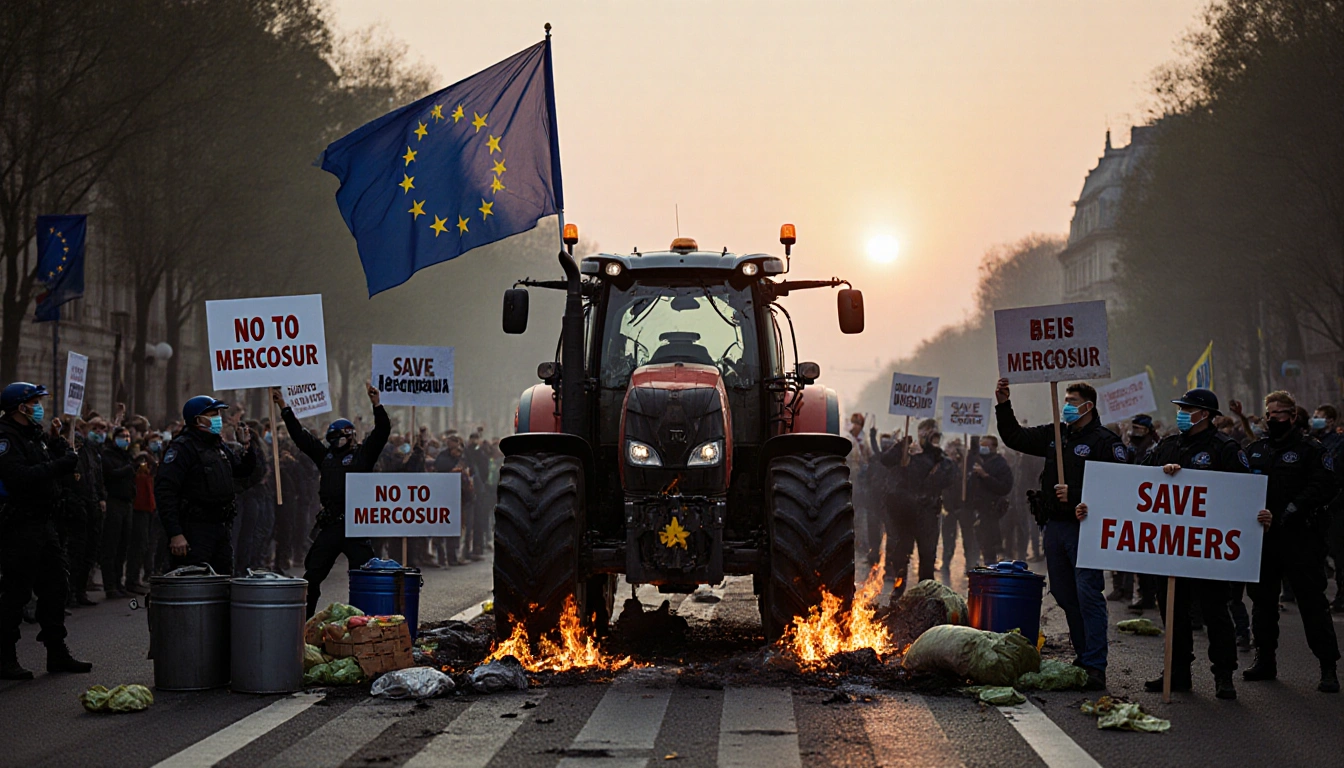
The decision came hours after farmers in tractors blocked roads and set off fireworks in Brussels to protest the trade deal. Police responded with tear gas and water cannons. The farmers brought potatoes and eggs to throw, burned tires and a faux wooden coffin bearing the word “Agriculture.” Their fire unleashed a black cloud that swirled with white tear gas. The European Parliament evacuated some staff due to damage caused by protesters.
“We are fighting to defend our jobs,” said Armand Chevron, a 23-year-old French farmer. Hundreds of farmers, including 60-year-old Pierre Vromann, parked tractors to block roads around key EU institutions. Vromann said the deal would be “bad for farmers, bad for consumers, bad for citizens and bad for Europe,” and that it would hurt cattle and grain producers in the nearby Belgian city of Waterloo. Other farmers came from Spain and Poland.
## Opposition from France and Italy
French President Emmanuel Macron welcomed the postponement, as did French farmers unions, who fear the deal would undercut their livelihoods. Macron said he has been in discussions with Italian, Polish, Belgian, Austrian and Irish colleagues about delaying the pact to address farmers’ concerns. He demanded safeguards to monitor and stop large economic disruption, increased regulations in Mercosur nations such as pesticide restrictions, and more inspections of imports at EU ports.
Italian Premier Giorgia Meloni warned against signing the agreement this week. “Work is underway to postpone the Mercosur summit, which gives us a few more weeks to try to provide the answers our farmers are asking for, the safeguards that are necessary for our products, and thus enable us to approve the Mercosur agreement,” she said early Friday. Von der Leyen needs the backing of at least two-thirds of EU nations to secure the deal; Italy’s opposition would give France enough votes to veto the signature.
In Greece, farmers have set up roadblocks along highways across the country for weeks, protesting delays in agricultural subsidy payments as well as high production costs and low product prices that they say are strangling their sector.
## Global Trade Implications
Supporters say the EU-Mercosur deal would offer a clear alternative to Beijing’s export controls and Washington’s tariff blitzkrieg, while detractors say it will undermine both environmental regulations and the EU’s iconic agricultural sector. German Chancellor Friedrich Merz said ahead of the Brussels summit, “If the European Union wants to remain credible in global trade policy, then decisions must be made now.”
Agathe Demarais, a senior fellow at the European Council on Foreign Relations, added that the deal is about strategic competition between Western nations and China over Latin America. “A failure to sign the EU-Mercosur free trade agreement risks pushing Latin American economies closer to Beijing’s orbit,” she said.
South American leaders have remained determined to pursue an alliance with Europe. President Luiz Inácio Lula da Silva, who has been a fervent promoter of the agreement, said he was surprised by Italy’s hesitancy. At a cabinet meeting, Lula said, “If we don’t do it now, Brazil won’t make any more agreements while I’m president,” and that the deal would “defend multilateralism” as Trump pursues unilateralism.
Far-right President Javier Milei of Argentina, a close ideological ally of Trump, also supports the deal. He said, “We must stop thinking of Mercosur as a shield that protects us from the world and start thinking of it as a spear that allows us to effectively penetrate global markets,” he said.
## Key Takeaways
– The EU-Mercosur free-trade agreement will cover a market of 780 million people and a quarter of global GDP, but its signing has been postponed by a few extra weeks.
– Farmer protests in Brussels and opposition from France and Italy have forced the EU to delay the deal, raising questions about the bloc’s negotiating credibility.
– South American leaders, especially Brazil’s Lula, view the pact as a strategic move to counter China and maintain multilateralism.
The delay underscores the complex balance the EU must strike between economic integration and protecting its agricultural sector, while global trade tensions with the United States and China continue to intensify.