What does Austin’s Christmas weather look like? A typical year in the Texas capital sees a high of 62°F and a low of 42°F, but the city’s climate history is full of extremes. From scorching days that set records to bone-chilling nights that freeze the imagination, the National Weather Service’s archives hold the stories of Austin’s most memorable Christmases. This article pulls those records together to give a clear picture of how the city can surprise its residents during the holiday season.
The Hottest Christmas Ever
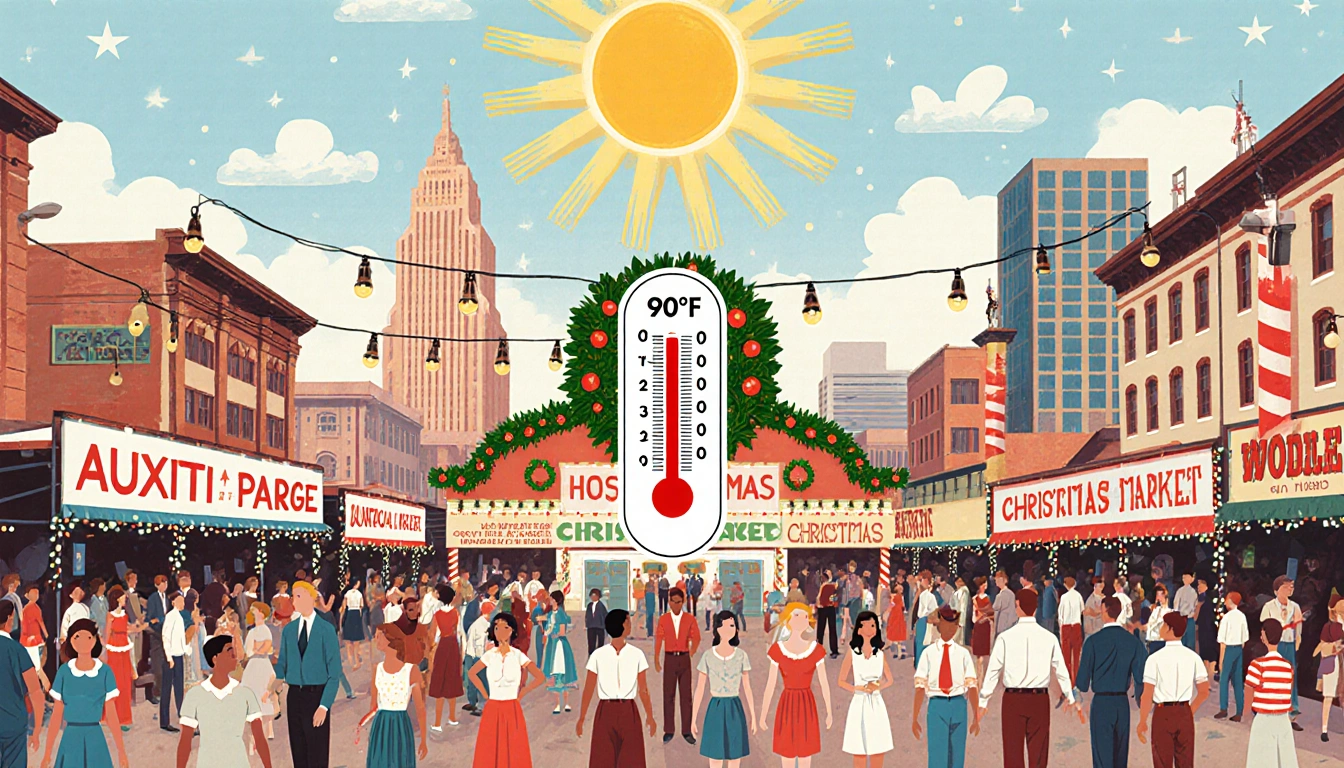
The record for the hottest Christmas in Austin’s history belongs to 1955. On Christmas Day that year, temperatures climbed to a blistering 90°F, a full ten degrees hotter than any other recorded Christmas. That number remains unmatched in the city’s climate archive.
That same year, the high on Christmas Eve reached 82°F, tying with 1964 for the warmest Eve on record. The 82°F reading underscores how a single day can set a benchmark for heat. It shows that even a typical winter day can bring extraordinary warmth.
These records illustrate the range of temperatures that Austin can experience during the holiday season. The 1955 high of 90°F stands out as a clear outlier among the city’s typical winter temperatures. It reminds residents that extreme heat can occur even in a season that usually feels mild.
The 1955 record high of 90°F was the most extreme temperature recorded for a Christmas in Austin. The high of 90°F stood out as the city’s record for a Christmas day. Residents at the time noted the intensity of the warmth.
The Coldest Christmas Ever
In stark contrast, 1983 holds the title for the coldest Christmas in Austin’s history. On Christmas Eve, the high temperature dropped to just 23°F while the low plunged to a bone-chilling 12°F. Those numbers are the lowest recorded for the city during the holiday.
The following day, the maximum temperature only reached 25°F, with the low falling to 10°F. Those frigid readings remind residents that even a city known for its heat can experience truly cold weather. They are a testament to the city’s climatic variability.
The 198th coldest Christmas showcases how quickly temperatures can drop during the winter months. The 23°F high on Eve and the 10°F low on Christmas Day are record lows that stand out in the city’s history. They illustrate the extremes that Austin can encounter.
The temperatures fell to 10°F on Christmas Day, the lowest recorded for the city. The low of 10°F was the coldest day in the city’s recorded history. The 10°F low was the lowest recorded for a Christmas day in Austin.
The Wettest Christmas Ever
Rain has also played a dramatic role in Austin’s Christmas history. While the average precipitation for both Christmas Eve and Christmas Day is less than a tenth of an inch, several years have seen much heavier downpours. Those events have left a lasting impression on the city’s weather record.
In 1975, Christmas Eve brought more than 1.5 inches of rain, and in 2000, Christmas Day saw a similar amount. These rainfall totals are the largest single-day precipitation events on record for the city during the holiday. They highlight how the city can experience significant wet weather.
The most recent heavy rainstorm occurred on Christmas Eve 2023, with more than an inch falling, and a comparable storm happened on Christmas Day 1938. These records demonstrate that heavy rain can happen in any decade. They also show that the city’s climate can produce surprises.
The heavy rain events of 1975, 2000, 2023, and 1938 set records for the city. The rainfall totals in 1975 and 2000 were each more than 1.5 inches. The rainfall totals in 2023 and 1938 were each more than an inch.
The Snowiest Christmas Ever
Snow is a rarity in Austin, but the city has recorded trace amounts on two Christmases. In 1998, a trace of snow fell on Christmas Eve, and in 1939, a trace appeared on Christmas Day. Those traces are the only instances of snow in the city’s recorded history.
Officially, Austin has never experienced a ‘white Christmas’-the definition requires at least one inch of snow on the ground during the National Weather Service’s morning observation. That standard has never been met in the city. It explains why the traces never left lasting accumulation.
The 1998 and 1939 traces remind us that even a city with a mild climate can see snow, however fleeting. They serve as a reminder that the city’s weather can surprise residents. They also add a unique chapter to Austin’s holiday weather story.
The trace of snow in 1998 and 1939 was recorded by the National Weather Service. The snow was only a trace, meaning it did not accumulate on the ground. These traces are the only instances of snow recorded for Austin.
Data Hub and Weather Coverage
This story is part of the KXAN Data Hub, a platform that compiles data-driven narratives on a variety of topics, including weather and climate, politics, education, sports, and economic growth in Texas. Each story in the hub is updated as new data becomes available, ensuring readers have access to the most current information. The hub’s focus on data helps tell the whole story behind each event.
The video above shows the latest from the KXAN First Warning Weather team, giving viewers a visual sense of the city’s current conditions. The First Warning Weather team provides real-time updates and analysis for residents. Their coverage is a key resource during extreme weather events.
The hub’s database includes not only weather data but also political, educational, and economic statistics relevant to Texas. Users can explore how different factors interconnect across the state. This comprehensive view supports informed decision-making for policymakers and citizens alike.
Key Takeaways
- Austin’s Christmas weather history includes a record 90°F day and a 10°F low.
- Heavy rain events have exceeded 1.5 inches on multiple Christmases.
- Snow has only been recorded as a trace, never meeting the white-Christmas threshold.
Closing
By looking back at these records, Austin residents can appreciate the full range of weather conditions the city can experience during the Christmas season. From a record 90°F day to a 10°F low, from heavy rain to rare snow, the city’s climate shows both its warmth and its chill.