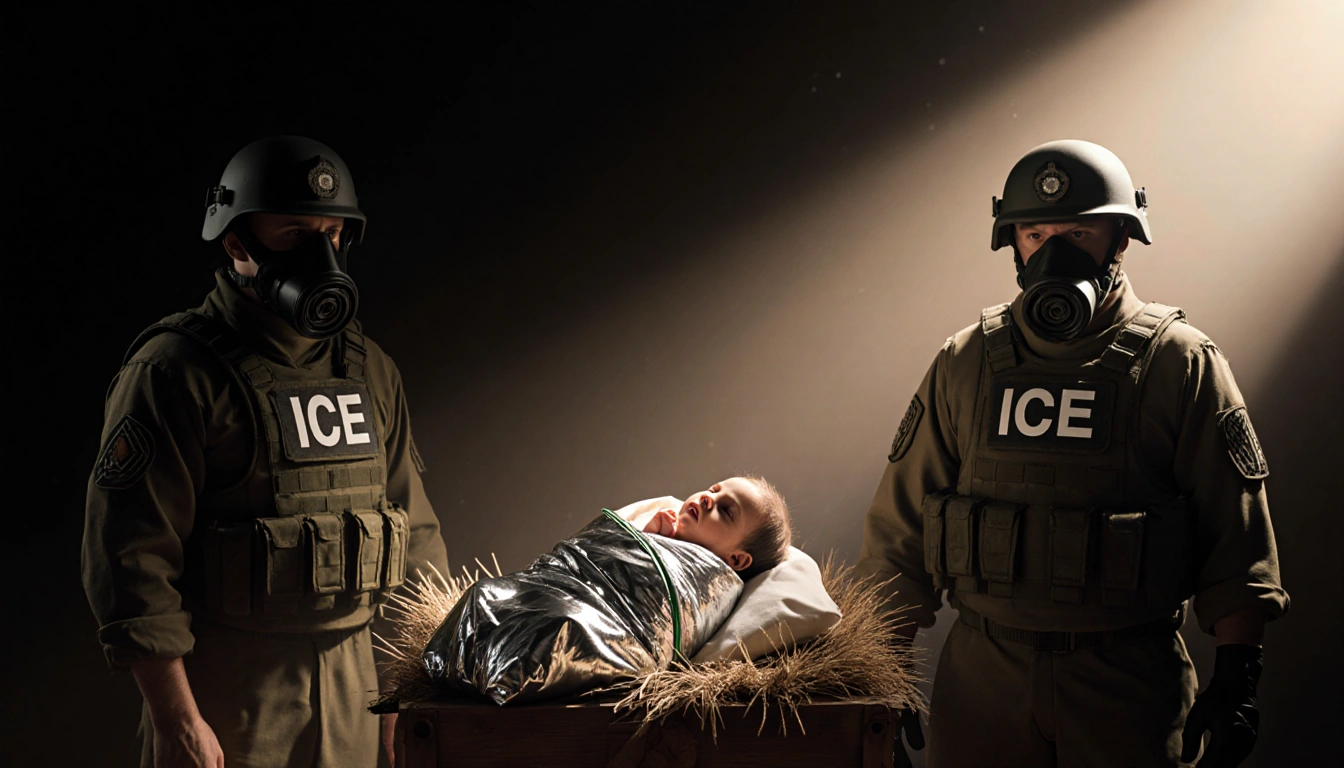
In a striking display at churches across the country, a baby Jesus has been wrapped in a silver emergency blanket and zip‑tied, while Roman soldiers in tactical vests labeled “ICE” guard the scene.
A New Kind of Nativity
At the Lake Street Church in Evanston, Illinois, a child‑sized figure of Jesus sits in a manger on a snowy lawn. The infant is wrapped in a silver emergency blanket, his wrists secured with a zip tie. Mary, wearing a plastic gas mask, stands beside him. Roman soldiers in tactical vests labeled “ICE” stand guard.
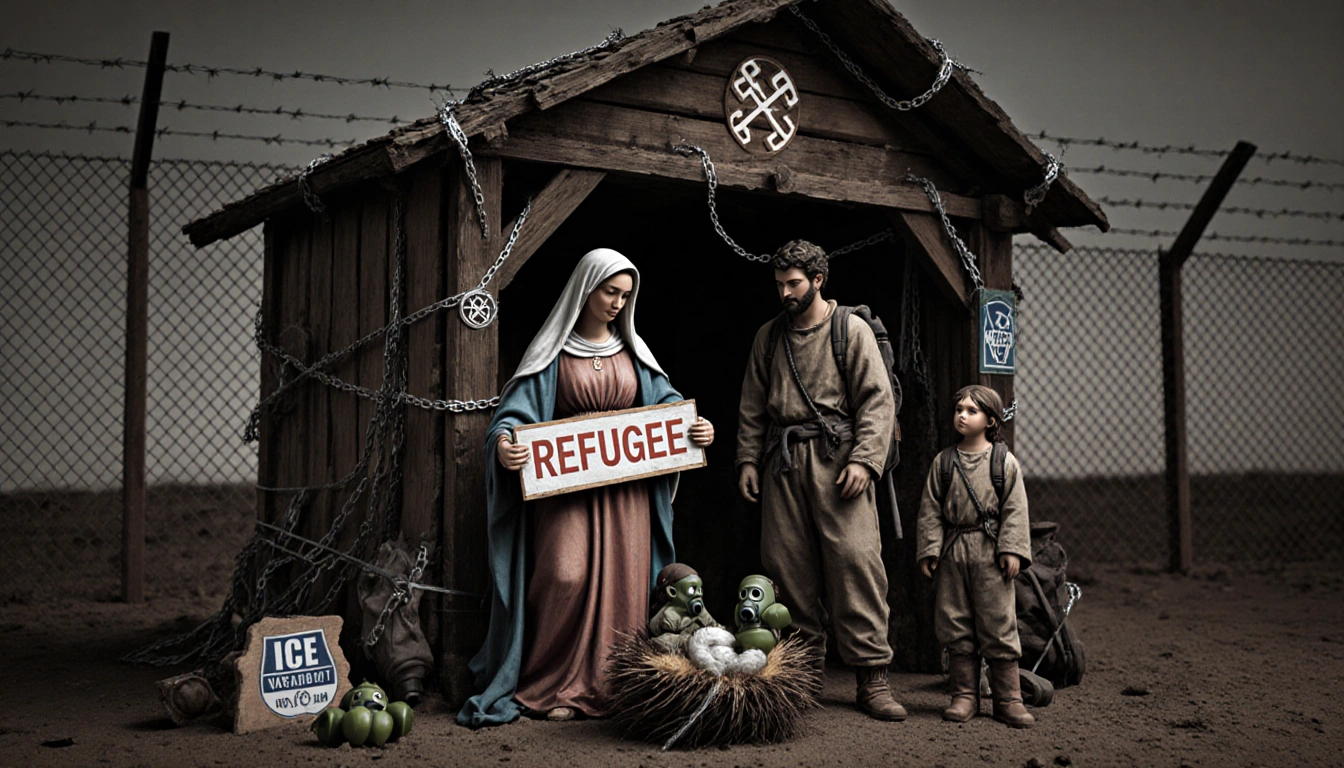
Across town, the Urban Village Church in another Chicago suburb has a sign outside its manger that reads, “Due to ICE activity in our community the Holy Family is in hiding.”
In Dedham, Massachusetts, a hand‑painted sign now hangs where the Christ child once stood: “ICE was here.”
These reimaginings have sparked both support and outrage as churches use the Christmas tableau to comment on federal immigration enforcement under the Trump administration.
The Message Behind the Art
Church leaders say they are placing the ancient story in a contemporary frame, portraying the Holy Family as refugees to reflect the fear of separation and deportation that many families experience today. Rev. Michael Woolf, senior minister at Lake Street, said, “Christmas is a time when we have public art out on the lawn and we get an opportunity to say something.”
Woolf added that a Baptist congregation’s Nativity scene last year showed Jesus in rubble, a “plea for peace” in Gaza.
St. Susanna Parish in Dedham has a history of protest displays. In 2018, parishioners locked baby Jesus in a cage to protest the Trump administration’s family‑separation policy at the border. The following year, they depicted the infant floating in plastic‑polluted water to highlight climate change.
Archdiocese Response
Boston Archbishop Richard Henning ordered this year’s display taken down. Father Steve Josoma, the parish priest, has not yet complied. A diocesan spokesperson said, “The people of God have the right to expect that, when they come to church, they will encounter genuine opportunities for prayer and Catholic worship — not divisive political messaging.”
Some Catholic activists want the priest punished. C.J. Doyle, director of the Catholic Action League of Massachusetts, said, “This is really a grave scandal for Catholics, and I think he’s playing with fire.” He added that the archbishop could remove Josoma as pastor, suspend him from active ministry, or even close the parish.
Community Reality
Josoma explained that the display’s purpose is to move “beyond static traditional figures and evoke emotion and dialogue” in response to the fear many parishioners face as federal forces arrest more than undocumented immigrants, sweeping up longtime legal residents and spreading anxiety.
In Illinois, the detention campaign has left bystanders choking on chemical sprays and children traumatized at the site of neighbors and teachers being taken away, prompting state and local investigations.
Jillian Westerfield, associate minister at the Evanston church, said, “We wanted to reflect sort of the reality that our community is experiencing.” After the figure of Joseph blew down and was damaged, leaving Mary alone with the baby, they put up an explanatory sign: “Joseph didn’t make it. We hold this space to honor and remember all the victims of immigration enforcement terror.”
Westerfield added that critics either don’t fully understand the message or “find it really challenging to their conscience and are lashing out at the art rather than engaging with what the actual message is.”
Refugee Support and the Bigger Picture
Phil Mandeville, who sits on St. Susanna’s Parish Council and coordinates a multi‑church refugee support committee, said long‑standing relationships make the parish resolute about keeping the display. The committee has worked with about 10 refugee families since 2019, helping them find housing, enroll in school, learn English and secure work.
Mandeville noted that much of the effort is done in partnership with the federal government, which puts families through extensive vetting before they arrive. “Just to emphasize the reason for all of this — it’s not a stunt,” he said. “We work on a daily basis with refugees. But people get upset about a bit of plaster. I care more about individuals than I do a manger scene. I understand what it represents — I don’t understand why no one cares about these human beings.”
He added, “Look at the Gospel just before Christ was executed — that was political. We were always taught: when you’re unsure how to act, ask, ‘What would Christ do?’ Now we’re doing that, and it doesn’t seem to jibe.”
Divided Reactions
The controversy in Evanston drew volunteers from a nearby synagogue, who stood outside during Lake Street’s services to help worshippers feel safe. Reactions outside the Dedham church ranged widely.
Walter Niland snapped a selfie and said he disagreed with the display. “I believe that the church enjoys a tax‑exempt status,” he said. “We should speak to spiritual matters, not matters of political division.”
Others came to challenge the parish directly, including one man who livestreamed his attempt to pull on locked church doors. Steve Grieger, a former Catholic schoolteacher, drove an hour from Worcester to show his support.
Grieger said, “The Archdiocese says, ‘Oh no, that goes against our tradition.’ Well, we’re living in times that are totally abnormal. We can’t just proceed as normal.” He added, “If we’re following the scriptures of Jesus, then we have to recognize that these ICE raids, and all of these terrible things going on, are totally against that.”
A Broader Context
The debate comes as immigration enforcement intensifies in states and cities whose leaders object to the immigration crackdown. In September alone, a combined total of at least 2,000 people were arrested in Illinois and Massachusetts, according to federal arrest figures released by immigration authorities.
The archdiocese in Massachusetts ordered that the manger must be “restored to its proper sacred purpose.”
The controversy reflects a broader national conversation about the role of faith communities in political protest and the limits of religious expression in public spaces.
Key Takeaways
- Churches across the U.S. have replaced traditional Nativity scenes with anti‑ICE imagery, sparking both praise and criticism.
- The displays aim to highlight the fear of separation and deportation that many families face under federal immigration enforcement.
- Archdiocesan officials and some Catholic activists have called for removal or punishment of clergy who maintain the protest art.
The story continues to evolve as churches, dioceses, and communities grapple with how to balance faith, protest, and public perception in a polarized political climate.