
Austin’s latest traffic safety initiative is delivering measurable results for pedestrians across the city.
The pilot program, focused on left-turn safety, has already reduced crashes at 16 key intersections.
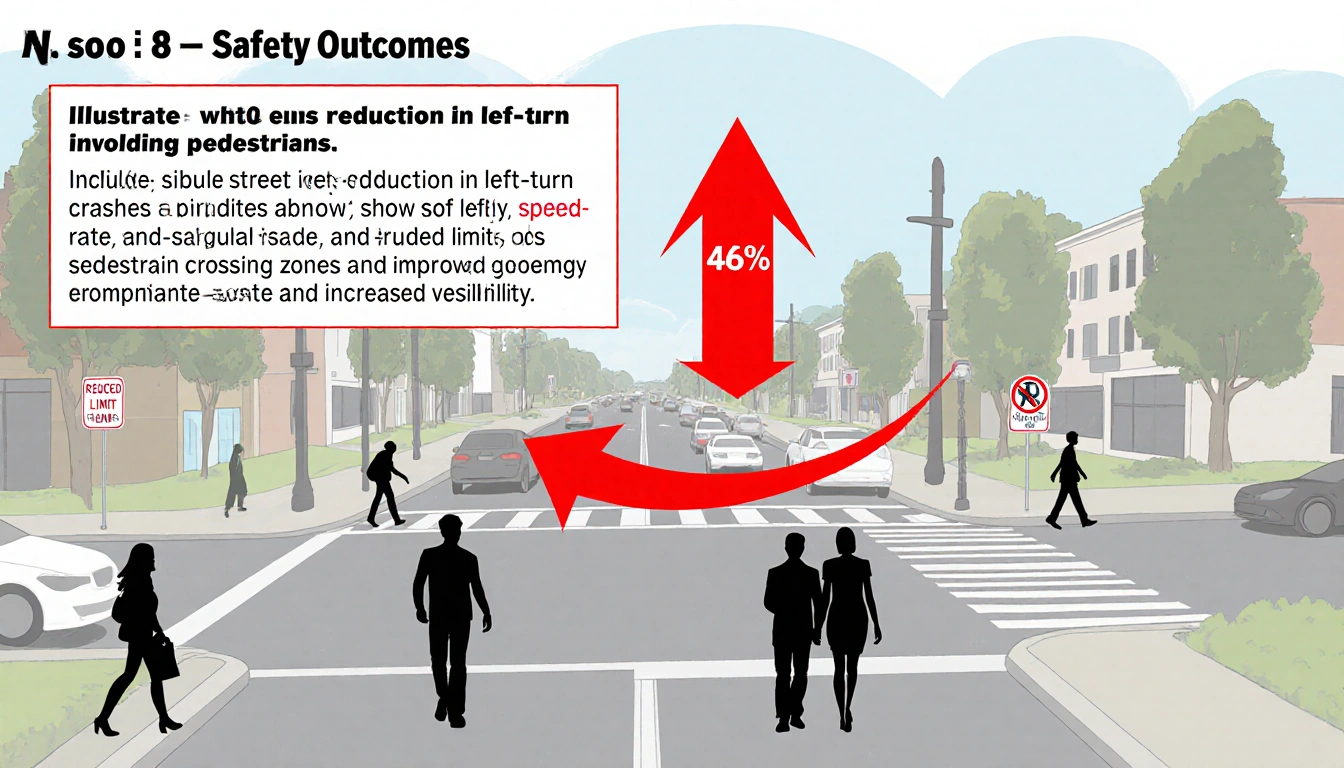
Data collected during the trial shows a 46% drop in left-turn crashes involving pedestrians.
Injury crashes involving left turns also fell by 34%, indicating broader safety gains.
Beyond crash statistics, the program improved turning angles and made driver behavior more predictable.
City officials report an 82% reduction in crash costs within the improved zones.
Program Overview
The initiative was launched to address the high frequency of left-turn incidents at busy crosswalks.
City planners selected 16 intersections that historically recorded the most pedestrian-related crashes.
Interventions included re-timed traffic signals, clearer lane markings, and enhanced signage.
These changes were designed to give pedestrians a safer crossing window.
The pilot also aimed to reduce driver confusion by providing clearer right-of-way rules.
All modifications were implemented over a six-month period with continuous monitoring.
Safety Outcomes
The data confirms the program’s effectiveness in cutting pedestrian-related crashes.
A 46% reduction in left-turn crashes involving pedestrians demonstrates a significant safety improvement.
Injury crashes saw a 34% decline, underscoring the program’s impact on reducing serious incidents.
The reductions were consistent across all 16 intersections, indicating a uniform benefit.
Safety gains were achieved without increasing overall traffic volume in the study area.
These results support the continuation and expansion of the program to additional locations.
Economic Impact
Beyond safety, the pilot produced substantial financial benefits for the city.
Officials report an 82% decrease in crash-related costs within the improved intersections.
Cost savings include reduced emergency response, medical treatment, and property damage expenses.
The program’s economic impact also extends to lower insurance premiums for local businesses.
Reduced crash frequency translates into fewer vehicle repairs and maintenance for commuters.
Overall, the initiative offers a compelling return on investment for municipal budgets.
Driver Behavior Improvements
Improved turning angles were a key design feature of the pilot.
Drivers now approach intersections with more predictable paths, reducing conflict points.
Clearer lane markings guide vehicles to yield correctly to pedestrians.
Enhanced signage alerts drivers to upcoming crosswalks and right-of-way rules.
These changes foster a safer environment for both motorists and pedestrians.
The city notes that driver compliance with new rules has increased markedly.
City’s Commitment
City officials emphasize their commitment to pedestrian safety across Austin.
The pilot’s success demonstrates the effectiveness of targeted traffic interventions.
Mayor and council members have pledged continued support for expanding the program.
Future plans include reviewing additional intersections for similar upgrades.
The city also aims to integrate data analytics for ongoing safety monitoring.
Stakeholders welcome the evidence of improved safety and cost savings.
Next Steps
The city will conduct a comprehensive evaluation of the pilot’s outcomes.
Evaluation metrics will include crash rates, cost savings, and driver compliance data.
Based on findings, the city will decide on scaling the program citywide.
Public feedback will be solicited through community meetings and online surveys.
Implementation timelines for new intersections will be established in the next fiscal year.
The city plans to share best practices with neighboring municipalities.
Implementation Details
The pilot’s 16 intersections were chosen for their high pedestrian crash history.
Each intersection received customized signal timing adjustments tailored to local traffic patterns.
Lane markings were updated to clearly delineate left-turn lanes and crosswalks.
Signage upgrades included larger, reflective signs to improve visibility at night.
All changes were installed with minimal disruption to existing traffic flows.
Continuous data collection ensured real-time monitoring of safety improvements.
Key Takeaways
- 46% reduction in left-turn crashes involving pedestrians.
- 34% drop in injury crashes involving left turns.
- 82% decrease in crash-related costs.
- Improved turning angles and driver behavior.
Closing
Austin’s left-turn safety pilot offers a promising model for urban traffic safety.
The program’s success is measured in reduced crashes, lower costs, and improved driver behavior.
City officials view the initiative as a template for future safety projects.
Residents can expect continued enhancements to intersection safety as the program expands.
The city remains focused on protecting pedestrians while maintaining efficient traffic flow.
Austin’s commitment to data-driven safety initiatives signals a proactive approach to urban mobility.