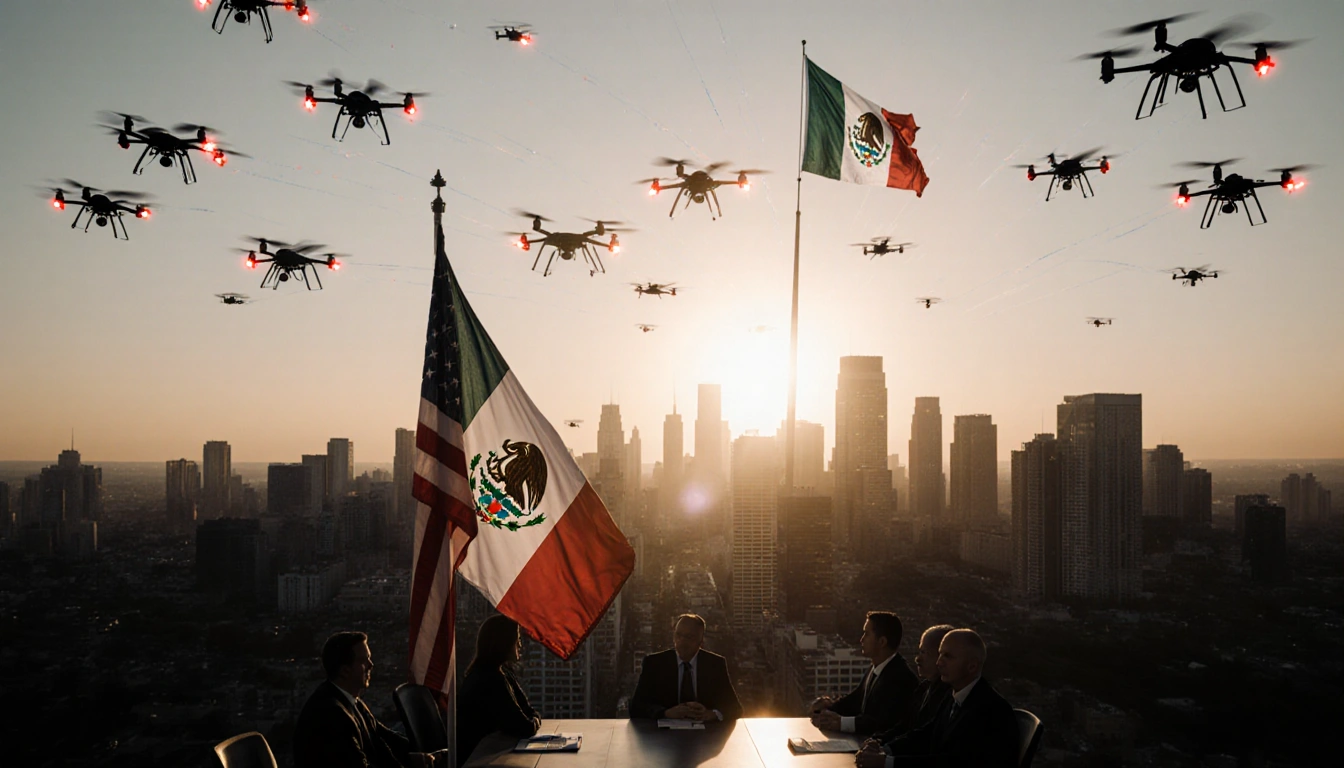
A recent meeting in Mexico City saw the U.S. and Mexico agree to tighten intelligence sharing on the growing use of drones by drug cartels.
The Meeting
The U.S.-Mexico Security Implementation Group (SIG) met in Mexico City last week. Mexican President Claudia Sheinbaum said the use of drones by criminals was a topic of particular interest that had not been discussed before. She explained what Mexico is doing and what is known, emphasizing that the discussions strengthen security on both sides of the border.
Intelligence Sharing Agreement
At the SIG meeting last Thursday, the two governments agreed to link intelligence analytics software as needed to identify drone threats. Sheinbaum clarified that this does not grant the U.S. permanent access to Mexican security assets or establish an anti-drone operation in Mexico. She also noted that Mexico has not documented extensive drone activity along the U.S. border, despite the Oct. 15 explosive drone attack on a government building in Tijuana. She said the issue is important to the United States, but not because of a specific case.
Drone Threat Landscape
Last February, a federal agency warned that Mexican drug cartels authorized explosive drone attacks against U.S. law-enforcement agents at the southern border. In 2024, the U.S. Northern Command’s top general told a Senate committee that more than 1,000 drones were crossing the border from Mexico every month. Cartels have used drones to attack rivals and intimidate villagers in Guerrero and Michoacan for allegedly cooperating with rival groups. Experts say the drones and their explosives are not very sophisticated, but cartels continue to evolve in their use and tactics.
Expert Commentary
On Tuesday, the Center for Strategic and International Studies (CSIS) opined that the United States needs to set up a Southwest “drone wall.” CSIS Associate Fellow Henry Ziemer wrote that while Mexican criminal groups have yet to employ weaponized drones on U.S. territory, unmanned aerial systems help cartels track border patrols, monitor U.S. forces, and deliver narcotics and other contraband. He called for the Department of Defense to use borderland military bases and zones to test anti-drone systems, noting that the Southwest border can act as a testbed for prototypes.
Key Takeaways
- The United States and Mexico will share intelligence to prevent drone attacks on U.S. law-enforcement agents.
- Over 1,000 drones cross the border monthly, prompting enhanced cooperation.
- CSIS recommends testing anti-drone systems on the Southwest border.
The agreement marks a significant step toward addressing the growing drone threat posed by drug cartels along the U.S.-Mexico border.