
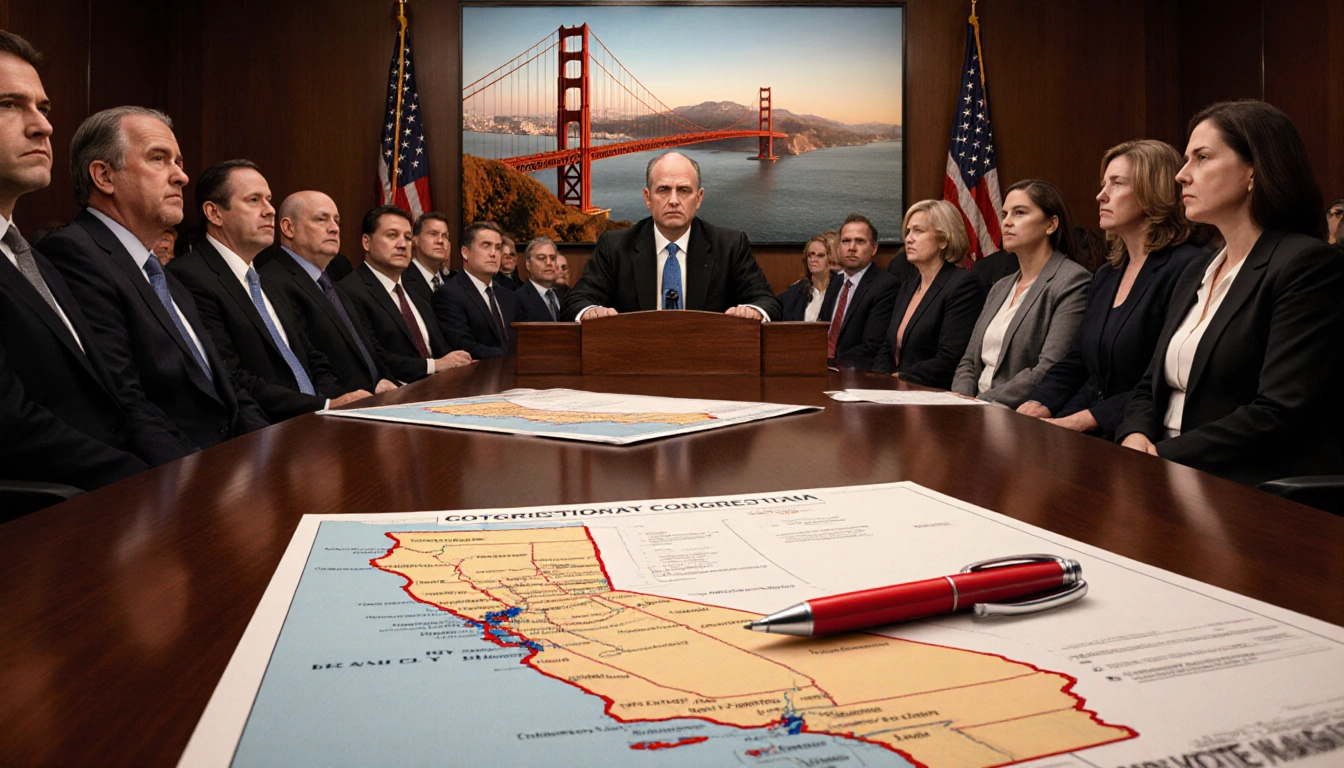
California’s new congressional map, approved by voters last month, is now the focus of a federal court hearing that could decide whether Democrats can flip up to five U.S. House seats in 2026.
The Map and Its Purpose
The map was adopted through Proposition 50, a ballot measure that voters approved in November. It was designed to help Democrats flip as many as five seats in the midterm elections. The measure was a response to a Republican‑led effort in Texas backed by President Donald Trump.
The Legal Challenge
The Justice Department, joined by the California Republican Party, has sued California for allegedly gerrymandering its map in violation of the Constitution by using race to favor Hispanic voters. The lawsuit asks a three‑judge panel to grant a temporary restraining order blocking the new map by Dec. 19, the date candidates can take the first official steps to run in the 2026 elections. The Supreme Court, earlier this month, allowed Texas to use its new map for the 2026 election, but the Justice Department has only sued California.
Claims About Race and Voting Rights
The lawsuit cites a news release from state Democrats that says the new map ”retains and expands Voting Rights Act districts that empower Latino voters” while making no changes to Black majority districts in the Oakland and Los Angeles areas. It also references a Cal Poly Pomona and Caltech study that concludes the new map would increase Latino voting power. The lawsuit states, ”Race cannot be used as a proxy to advance political interests, but that is precisely what the California General Assembly did with Proposition 50 — the recent ballot initiative that junked California’s pre‑existing electoral map in favor of a rush‑job rejiggering of California’s congressional district lines.”
The Justice Department alleges that Paul Mitchell, a redistricting consultant who drew the map for Democrats, and state leaders admitted that they redrew some districts to have a Latino majority.
Newsom’s spokesperson Brandon Richards said in a statement: ”In letting Texas use its gerrymandered maps, the Supreme Court noted that California’s maps, like Texas’, were drawn for lawful reasons.” He added, ”That should be the beginning and the end of this Republican effort to silence the voters of California.”
The Hearing’s Technical Focus
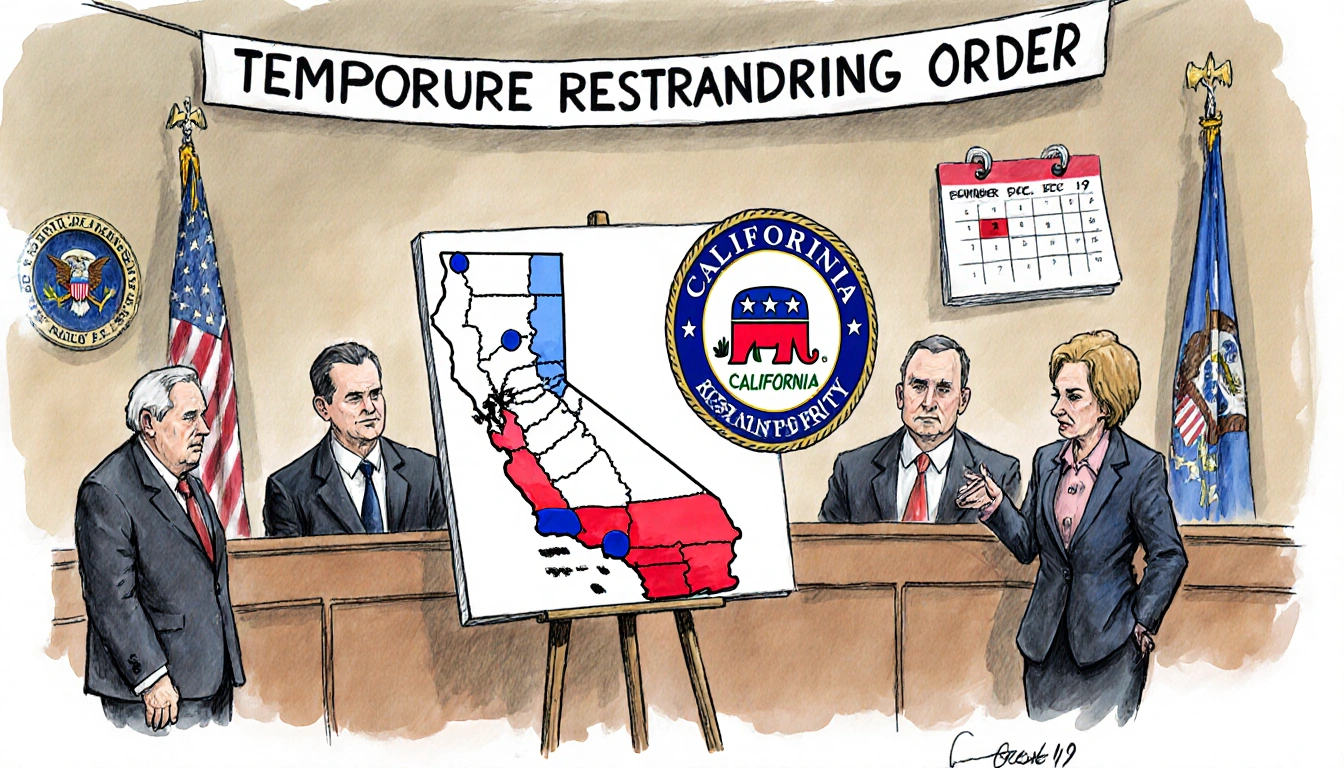
The hearing began with a dense, technical discussion about the 13th district in the Central Valley. Issues touched on the Hispanic voting‑age population, census population blocks, and different software used to manage and massage the data. Elections analyst Sean Trende, called by the plaintiffs, told the judges that ”Race was the predominant interest in drawing the district.” He pointed to a thumb‑like appendage jutting out of the northern end of the new district, which he described as a precise knife cut to capture certain voters. Defense attorneys questioned whether political shifts in the region could have dictated how lines were drawn rather than racial considerations. At one point Trende acknowledged that the thumb‑like bump in the district boundary was not as extreme as congressional maps seen in other states.
Political Stakes
House Democrats need to gain just a handful of seats next year to take control of the chamber, which would imperil President Trump’s agenda for the remainder of his term and open the way for congressional investigations into his administration. Republicans hold 220 seats and the Democrats hold 213. The fight over California’s map is part of a broader national contest in states such as Missouri, North Carolina and Ohio that have adopted new district lines that could provide a partisan advantage.
Key Takeaways
- California’s new congressional map is under federal court scrutiny for alleged racial gerrymandering.
- The Justice Department and Republicans seek a restraining order until Dec. 19.
- The map was designed to expand Latino voting power while preserving Black majority districts.
The case, reported from Sacramento by Nguyễn, underscores the high stakes of congressional redistricting and the intense legal battles that can shape the balance of power in the U.S. House of Representatives.
This story has been corrected to show that the partisan split in the House is 220 Republicans and 213 Democrats, not 219 Republicans and 214 Democrats.