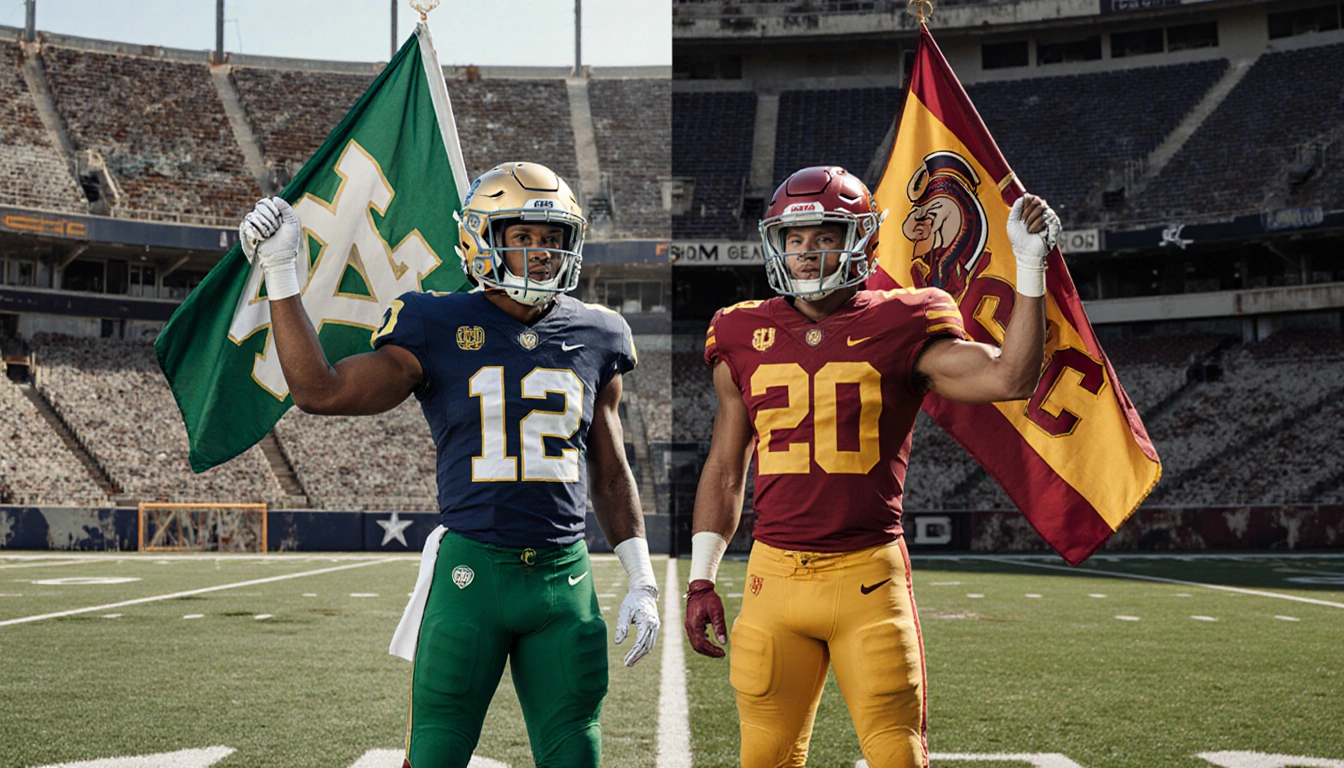
Notre Dame’s long-standing rivalry with the University of Southern California has been put on hold, a move that shocked fans across the nation.
The Fighting Irish announced on Monday that they had filled the last open slot in their 2026 schedule with a trip to Brigham Young University as part of a home-and-home series.
The two teams, which were both left out of this year’s College Football Playoff, will also play each other in 2027.
However, Notre Dame’s 2027 schedule lists only nine games, raising questions about whether the USC matchup will be reinstated.
The pause has reignited debate over how to keep the Battle for the Jeweled Shillelagh alive.
Notre Dame and USC officials released a joint statement emphasizing the importance of the rivalry to fans, teams, and college football as a whole.
The statement reads, “USC and Notre Dame recognize how special our rivalry is to our fans, our teams and college football and our institutions will continue working to bring back the Battle for the Jeweled Shillelagh.”
The officials added, “The rivalry between our two schools is one of the best in all of sport and we look forward to meeting in the future.”
This declaration underscores the desire to preserve the historic competition.
The statement was issued on the same day the schedule announcement was made.
Irish coach Marcus Freeman has repeatedly expressed his commitment to keeping the rivalry alive.
In mid-October, before the game, Freeman said, “It’s very clear, let’s continue this thing and that’s it.”
He continued, “They handle the rest of it. (Athletic director) Pete Bevacqua and (deputy athletic director for football) Ron Powlus and our leadership, they’ll handle the discussions with them. But they know the head coach of this football program desires to continue this rivalry.”
Freeman’s remarks highlight the internal support for the matchup.
His statements were recorded during the lead-up to the scheduled game.
The rivalry began in 1926, and since then the Irish have maintained a lead of 53 wins to 38 losses, with five ties.
The series has been a fixture of college football lore.
The Battle for the Jeweled Shillelagh has been played annually for decades, with only a few interruptions.
The most recent interruption occurred during the 1943-45 World War II years.
The 2020 pandemic also caused the schools to skip their annual matchup.
During World II, the rivalry was put on hold from 1943 to 1945, a break that reflected the broader national focus on the war effort.
The hiatus lasted three years, after which the teams resumed play.
The decision to pause the series was made by both schools in response to wartime constraints.
The interruption is one of the few gaps in the long history of the rivalry.
It is often cited as a historical footnote in discussions of the series.
In 2020, the COVID-19 pandemic prompted most schools to adopt a conference-only schedule, leading Notre Dame and USC to forgo their annual matchup.
The pandemic caused widespread changes in college football scheduling.
The decision to skip the game was consistent with the national trend.
The pause in 2020 added to the series’ list of interruptions.
The schools have since expressed a desire to resume the rivalry.
Notre Dame has also put several other prominent rivalries on hold over the years.
The Fighting Irish used to face Michigan and Michigan State almost annually starting in the 1970s.
However, they have not played Michigan since 2008.
They have not played Michigan State since 2017.
These gaps illustrate the challenges of scheduling non-conference games.
Notre Dame also played Purdue every season from 1946 to 2014.
The two teams squared off again in 2021 and have played each other in the past two years as well.
The continuity of that rivalry contrasts with the gaps in the USC series.
The 2021 matchup was part of a broader effort to maintain traditional games.
The recent games show the school’s commitment to long-standing competitions.
Negotiations to keep the USC matchup alive became more difficult after USC joined the Big Ten last season.
The Trojans now prefer to schedule non-conference games in August or September.
The two schools have historically met in October or November.
The shift in scheduling preferences has added complexity to arranging future games.
The change reflects the impact of conference realignment on traditional rivalries.
The two schools that have combined to win 22 national championships and produced 15 Heisman Trophy winners have traditionally met in October or November.
The timing of the rivalry has been a staple of the college football calendar.
The move to earlier months would represent a departure from tradition.
The schools have expressed a desire to preserve the historical schedule.
The debate over timing remains unresolved.
Next year, to the dismay of many, the teams are unlikely to play at all.
The lack of a scheduled game in 2027 has disappointed fans and alumni.
The uncertainty is tied to the limited number of games on Notre Dame’s 2027 calendar.
The decision reflects the broader challenges of arranging non-conference matchups.
The future of the rivalry remains uncertain.
Las Vegas Raiders coach and former USC coach Pete Carroll said Monday, “I have no space to think of why somebody would want to do that.”
He added, “I hope that doesn’t carry over to other matchups that have been so important to people over the years and so much fun, not so much the teams. It’s for the fans and for the alumni. That’s too bad. I’m disappointed to hear that.”
Carroll’s remarks highlight the emotional impact of the pause.
His comments were made public during a press conference.
The statement reflects the broader disappointment among fans.
Carroll’s emphasis on fans and alumni underscores the cultural significance of the rivalry.
He noted that the matchup is “for the fans and for the alumni.”
The emotional weight of the game is evident in his statements.
The loss of the game is seen as a blow to tradition.
The reaction from the broader community has been one of disappointment.
While there is a chance that Notre Dame or USC could buy out a game to keep the series active, the recent announcement makes such a move unlikely.
The schools’ joint statement suggests a willingness to work toward a future meeting.
However, the scheduling constraints make a buyout less probable.
The possibility remains in theory but is not currently being pursued.
The schools have not indicated a concrete plan to purchase a slot.
The situation remains fluid.
The future of the Notre Dame-USC rivalry will depend on scheduling flexibility and mutual agreement.
Both institutions have expressed a desire to continue the series, but logistical challenges persist.
The schools may revisit the arrangement in the coming years.
The rivalry’s history and fan interest could motivate a renewed effort.
The outcome will be determined by negotiations and conference rules.
In summary, the rivalry has been paused due to scheduling changes and conference realignment.
The 2026 and 2027 schedules reflect the current state of affairs.
The joint statement and quotes from coaches show a shared interest in resuming the series.
The historical gaps highlight the challenges of maintaining a long-running matchup.
The future remains uncertain but not closed.
For now, fans of the Irish and Trojans must wait to see whether a future game can be arranged.
The pause serves as a reminder of how modern college football can alter historic rivalries.
The schools have expressed a commitment to bringing the Battle for the Jeweled Shillelagh back to the field.
The next steps will involve careful scheduling and negotiation.
The rivalry’s legacy will continue to be celebrated by alumni and supporters.
The outcome will ultimately be decided by the institutions involved.
The story of Notre Dame and USC’s rivalry continues to evolve, reflecting broader trends in college football scheduling and conference affiliation.
The 2026 BYU game and the 2027 uncertainty are key points in this narrative.
The joint statement and coach quotes emphasize the importance of the matchup.
Fans will watch for future announcements.
The rivalry’s history remains a cornerstone of college football lore.
The next chapter will reveal whether the Jeweled Shillelagh will shine again.