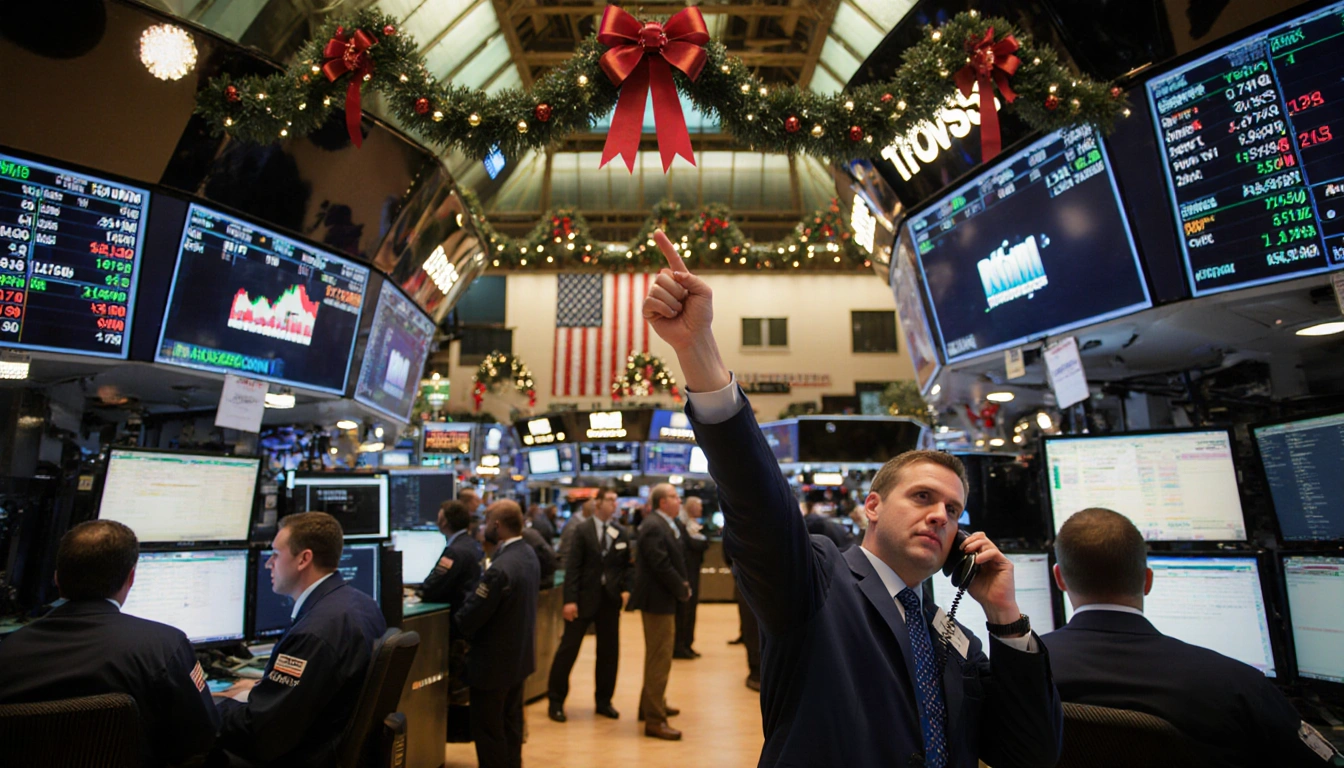
Wall Street opened higher on Monday, with the S&P 500 climbing 0.6% to 6,878.49 as technology firms and banks lifted the market into a calm holiday week.
Market Performance
The Dow Jones Industrial Average added 227.79 points, or 0.5%, to 48,362.68, while the Nasdaq composite rose 121.21 points, or 0.5%, to 23,428.83. The Russell 2000 index gained 1.2%, outpacing the other major indexes.
Tech and Banking Drivers
Technology companies carried the gains, with Nvidia up 1.5% and Uber and Lyft posting 2.5% and 2.7% increases after announcing plans to bring robotaxi services to London next year. JPMorgan led the banking sector with a 1.9% rise.
Smaller Companies and AI Influence

The gains also pushed major indexes further into winning territory for the month as a choppy December nears its end. Technology companies, especially those focused on artificial intelligence, have been the main force behind the market’s oscillations. “If a Santa Claus rally does kick in this year, St. Nick’s gift bag will likely need to be full of positive tech sentiment,” wrote Chris Larkin, managing director of trading and investing at E-Trade from Morgan Stanley.
Corporate Moves and Energy Prices
Paramount Skydance rose 4.3% after sweetening its hostile takeover bid for Warner Bros. Discovery with an irrevocable personal guarantee from Larry Ellison, the founder of Oracle and father of Paramount CEO David Ellison. The guarantee backs the deal with billions of dollars. Warner Bros. Discovery added 3.5%, while Netflix fell 1.2%.
Dominion Energy declined 3.7% after the Trump administration announced it was pausing leases for five large-scale offshore wind projects, including Dominion’s Coastal Virginia Offshore Wind project.
Gold and silver touched record highs, with gold up 1.9% to $4,469.40 and silver up 1.6%. Crude oil rose 2.4% to $58.01 a barrel, and Brent crude climbed 2.6% to $62.07 a barrel following a U.S. Coast Guard pursuit of another sanctioned oil tanker in the Caribbean.
Economic Outlook and Fed Expectations
Treasury yields edged higher; the 10-year Treasury rose to 4.16% from 4.15% late Friday. The U.S. market will close early on Wednesday for Christmas Eve and remain closed on Thursday for Christmas. The short trading week includes several economic reports that could shed more light on the condition and direction of the U.S. economy.
On Tuesday, the government will release the first of three estimates on gross domestic product, reflecting the broader economy’s performance in the third quarter. Wednesday will see the Labor Department release its weekly data on applications for jobless benefits, a proxy for U.S. layoffs. The Conference Board will publish its December consumer confidence survey on Tuesday.
These reports follow last week’s updates showing inflation remains elevated and consumer confidence has diminished over the last year. Overall, the job market has been slowing and retail sales have weakened. The ongoing trade war has added pressure on consumers and businesses already squeezed by higher prices. The mix of stubbornly high inflation and a weaker jobs market has put the Federal Reserve in a more difficult policy position.
The Fed has cut its benchmark interest rate at its last three meetings, despite inflation remaining stubbornly above its 2% target. Fed officials have grown increasingly concerned about the slowing job market, pushing them to trim rates. Cutting interest rates to bolster the economy because of a weak job market could fuel inflation, however. Wall Street is mostly betting that the Fed will hold steady on interest rates at its meeting in January.
Key Takeaways
- Technology and banking stocks led a broad market rally, lifting major indexes into positive territory for December.
- AI-focused stocks are poised to determine whether the month ends on a gain or loss.
- Economic data releases during the short holiday week will influence expectations for the Fed’s next policy move.
The market’s calm opening sets the stage for a potentially quiet holiday week, with investors watching both corporate developments and economic indicators closely as the year draws to a close.