U.S., Ukraine and major European countries have reached consensus on 90 percent of terms for a deal to end Ukraine’s war with Russia, but territorial control issues remain unresolved.
Negotiations Near Completion
Two senior U.S. officials said Monday that 90 percent of the terms had been agreed after 2½ days of talks between President Trump’s special envoy Steve Witkoff, Jared Kushner, Ukrainian President Volodymyr Zelensky and top European officials in Berlin. Zelensky posted on X that the negotiations were a ”first draft” and that ”the military part looks quite solid.” He added that the two sides ”worked very well together” but cautioned that ”destructive” elements should be removed, saying, ”This matters, because dignity matters.”
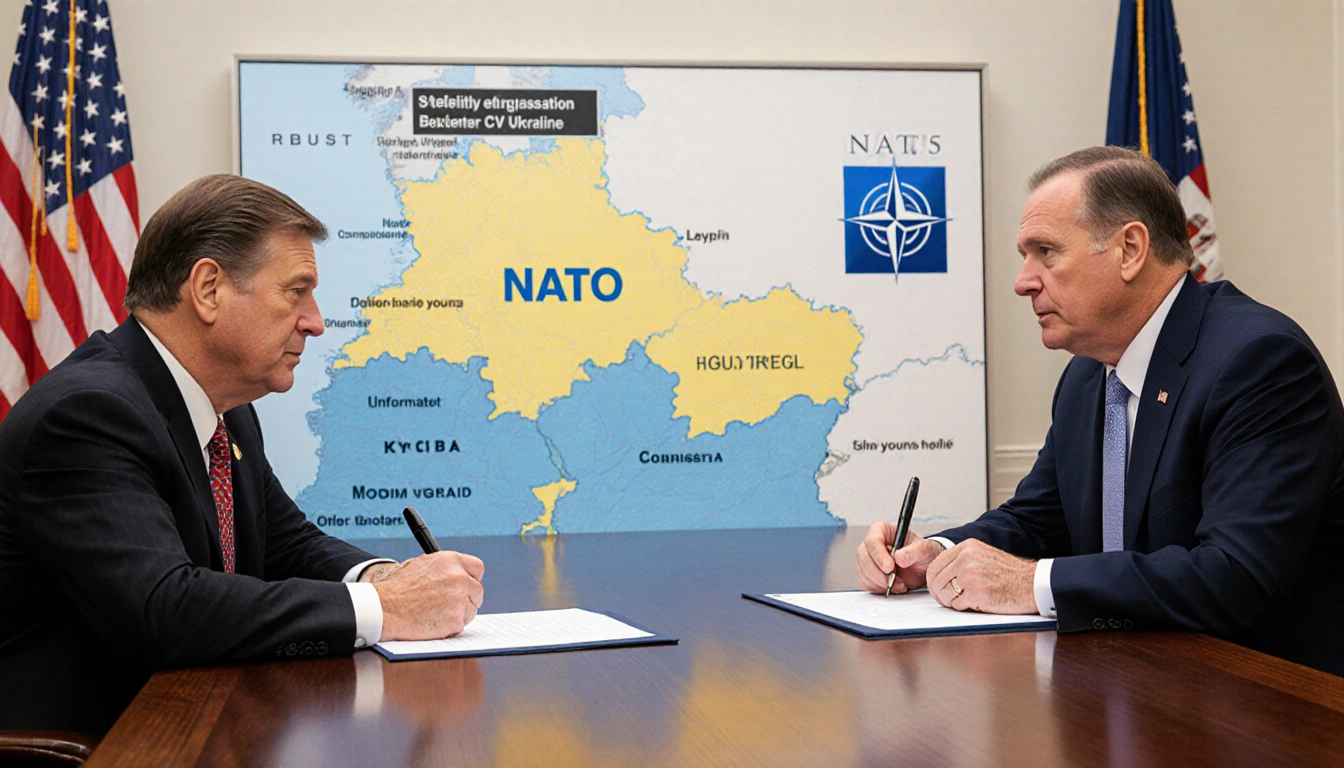
A Miami meeting is slated for the weekend with ”working groups, military people, looking at maps,” a senior official told reporters in a phone briefing. ”We believe that we probably solve for, I don’t know, it could be 90 percent, literally 90 percent of the issues between Ukraine and Russia,” the official said, adding that ”there’s some more things that have to be worked out.”
Security Guarantees and U.S. Commitments
The officials said consensus was reached on security guarantees ”like” NATO’s Article 5 mutual‑defence pact, though they would not detail the U.S. commitments. ”It would have to go before the Senate, and President Trump is willing to do that,” the second senior U.S. official said. The guarantees were described as the ”platinum standard,” with the added note that no U.S. troops would be deployed in Ukraine. Ukrainians and Europeans were surprised that the administration could get Russia to sign off on such guarantees, given Moscow’s opposition to Ukraine joining NATO.
European leaders issued a joint statement that would allow Ukraine to maintain a peacetime army of 800,000 and create a European ”multinational force”—supported by the U.S.—to help rebuild the country’s armed forces and provide air and sea defence. The U.S. will also lead a ceasefire monitoring and verification mechanism to give early warning and a deconfliction mechanism. In the event of an armed attack, guarantees would include a legally binding commitment to take measures that ”may include armed force, intelligence and logistical assistance, economic and diplomatic actions.”
Territorial Issues and Economic Incentives
The officials said territorial control is likely to be settled in bilateral talks between Ukraine and Russia, while the White House proposes ”thought‑provoking” ideas to halt fighting in contested areas. Russia has called for Ukraine to retreat from Donbas areas it has failed to seize militarily and wants international recognition of territory it has held since 2014. Zelensky rejected a U.S. idea for an ”economic free zone” in territory Russia has not captured by force, though the U.S. official noted that much time was spent ”trying to define” the zone and how it would operate.
On the Zaporizhzhia power plant, controlled by Russia along the front lines, the officials said progress is being made toward a 50/50 sharing of the plant’s power, but no resolution yet on who will operate it. ”There’s still a little bit of a gap between the Russians and the Ukrainians on how that should go, but at the end of the day, they both want it to be repaired and functioning in a good way, and providing energy,” the official said. ”And it seems like we’re close to them agreeing to essentially a 50/50 split of the power, which would be, I think, a good outcome there.”
The White House is working on ways to bring Russia back into the global economy so it has ”incentives not to go back to war in the future.” The administration is developing plans to use roughly $200 billion of frozen Russian assets for projects in Ukraine, including powering a massive new data centre at Zaporizhzhia, restarting Russian energy flows to Western Europe, and creating opportunities for U.S. companies to invest with Russia in strategic sectors such as rare‑earth extraction and Arctic drilling.
Russia has filed a lawsuit against Euroclear, the Belgium‑based institution holding most frozen assets, as the EU moved last week to indefinitely freeze the funds while debating how to seize them for Ukraine. The U.S. officials said negotiators addressed ”extensively” Russia’s frozen funds ”how to try and find a way to use them for reconstruction in a way that hopefully can work through an agreement,” but did not provide further details.
Key Takeaways
- 90 percent of the terms for a Ukraine‑Russia peace deal have been agreed, but territorial control remains unresolved.
- Security guarantees similar to NATO’s Article 5 are being considered, with no U.S. troops in Ukraine.
- Economic incentives, including the use of frozen Russian assets, aim to re‑integrate Russia into the global economy and support Ukraine’s reconstruction.
The negotiations continue to evolve, with further meetings and detailed discussions expected in the coming weeks.