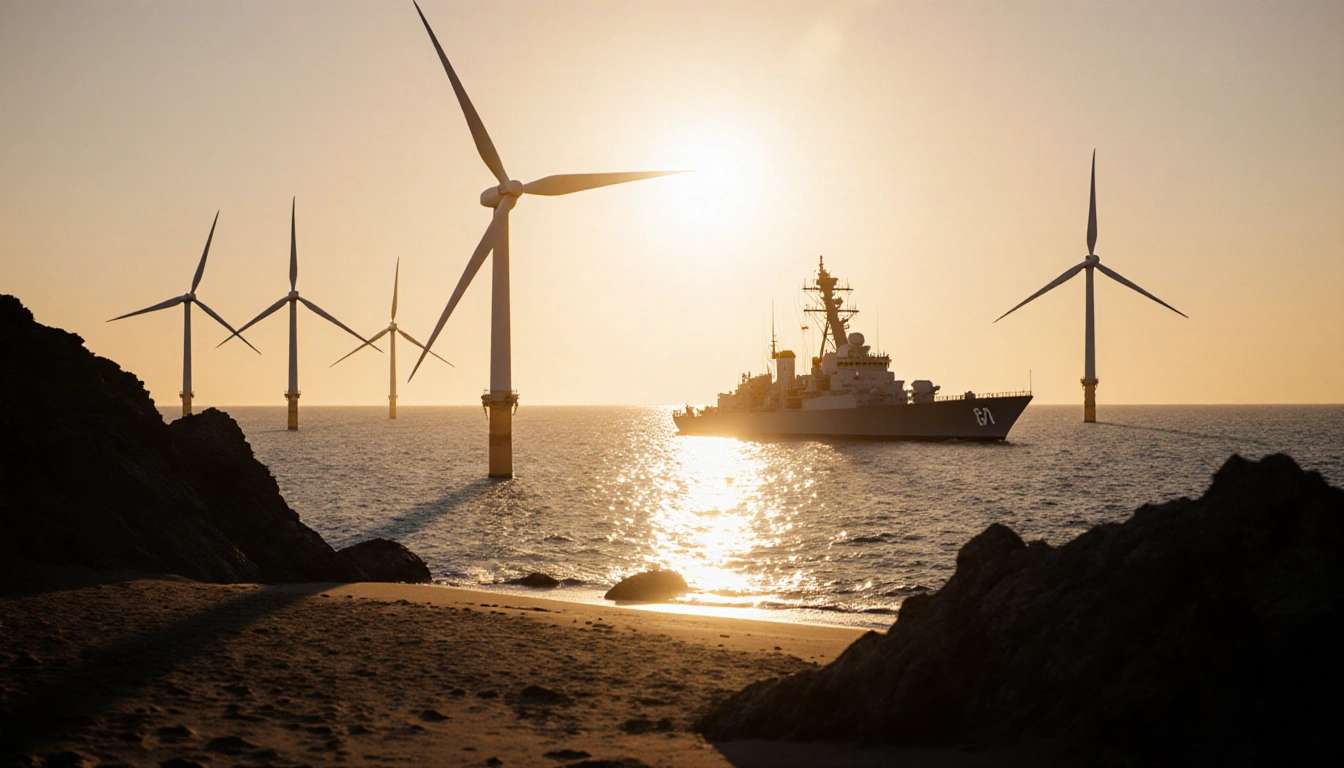

On Monday, the Trump administration announced the immediate suspension of leases for five large-scale offshore wind projects along the East Coast, citing national security risks identified by the Pentagon.
The move follows a federal judge’s ruling that declared President Donald Trump’s executive order blocking wind energy projects unlawful. Interior Secretary Doug Burgum said the pause would give the Interior Department time to work with the Defense Department and other agencies to assess ways to mitigate the risks. The statement did not specify an end date or detail the exact security concerns. The action is the latest effort to curb offshore wind as part of a broader push against renewable energy.
The Interior Department explained that unclassified reports have long shown that the movement of massive turbine blades and highly reflective towers can create radar clutter. This clutter can obscure legitimate moving targets and generate false targets near wind projects, according to the department. The pause was framed as a precautionary measure to protect the American people, Burgum said. “Today’s action addresses emerging national security risks, including the rapid evolution of the relevant adversary technologies, and the vulnerabilities created by large-scale offshore wind projects with proximity near our east coast population centers.” The Interior Department did not elaborate on the specific risks.
The five projects whose leases were halted are Vineyard Wind in Massachusetts, Revolution Wind in Rhode Island and Connecticut, Coastal Virginia Offshore Wind, and Sunrise Wind and Empire Wind in New York. These projects were awarded permits after years of review by state and federal agencies, including the Coast Guard, the Naval Undersea Warfare Center, the Air Force and others, according to former USS Cole commander Kirk Lippold. Lippold argued that the permitting process had involved the Department of Defense at every stage and that the projects would diversify the country’s energy supply. Senator Sheldon Whitehouse said Revolution Wind had been thoroughly vetted and fully permitted, and that the review included any potential national security questions.
Whitehouse criticized Burgum’s action as vindictive harassment, saying it “looks more like the kind of vindictive harassment we have come to expect from the Trump administration than anything legitimate.” The Interior Department’s pause could complicate legal challenges to the move, though wind supporters say the national security argument is overstated. The pause follows the administration’s broader strategy to block renewable energy projects while supporting aging fossil-fuel plants, according to environmental groups. Critics argue that the decision undermines clean, affordable power that is vital for a growing grid. The pause has been described by some as a lawless and erratic stop-work order.
Judge Patti Saris of the U.S. District Court for the District of Massachusetts vacated President Trump’s January 20 executive order that paused leasing and permitting for wind projects. Saris ruled the order was arbitrary and capricious and violated U.S. law. The ruling was issued in favor of a coalition of state attorneys general from 17 states and Washington, D.C., led by New York Attorney General Letitia James. The coalition had challenged the executive order that halted leasing and permitting for wind energy projects. The court’s decision underscored the legal limits of executive power over renewable energy development.
Wind proponents have labeled the administration’s actions illegal and said offshore wind provides some of the most affordable, reliable electric power to the grid. Ted Kelly of the Environmental Defense Fund said, “For nearly a year, the Trump administration has recklessly obstructed the build-out of clean, affordable power for millions of Americans, just as the country’s need for electricity is surging.” Kelly added, “Now the administration is again illegally blocking clean, affordable energy,” and urged that America’s largest source of renewable power not be kneecapped. The Environmental Defense Fund also criticized the administration for supporting coal plants that pollute air. The group said the pause “will threaten grid reliability … lead to energy inflation and threaten thousands of jobs.”
Dominion Energy, which is developing Coastal Virginia Offshore Wind, said the project is essential for national security and meeting Virginia’s growing energy needs driven by new data centers. The company warned that stopping the project “will threaten grid reliability … lead to energy inflation and threaten thousands of jobs.” The Virginia project is nearly 70% complete, and its pause creates a “perfect storm” to harm customer affordability and grid reliability, according to energy expert David Shepheard of Baringa. Shepheard added, “This is a new one for the area: a Washington-borne nor’easter where the political winds are going to stop the blades from spinning.”
Developers of U.S. offshore projects include Denmark-based Ørsted, Norway-based Equinor and a subsidiary of Spanish energy giant Iberdrola. Ørsted, which owns two of the affected projects, saw its stock prices decline by more than 11% on Monday. The suspension was praised by a New Jersey group that opposes offshore wind. Robin Shaffer, president of Protect Our Coast New Jersey, said, “Today, the president and his administration put America first.” Shaffer added, “Placing largely foreign-owned wind turbines along our coastlines was never acceptable,” and argued that Empire Wind poses a threat because of its close proximity to major airports, including Newark Liberty, LaGuardia and JFK. He also cited concerns that offshore wind threatens commercial and recreational fishing industries.
The pause has drawn sharp criticism from developers, environmental groups, and some lawmakers, while anti-wind advocates celebrate the decision. The Interior Department’s statement that it will assess mitigation strategies with the Defense Department suggests a potential path forward, but the lack of a clear timeline fuels uncertainty. The move comes at a time when the United States is grappling with grid reliability, energy costs, and the transition to cleaner energy sources. The pause also highlights the tension between national security concerns and the country’s energy diversification goals. The debate continues as stakeholders weigh the economic, environmental, and strategic implications of the decision.
With the pause in place, the future of the five projects remains uncertain, and the broader offshore wind industry faces renewed scrutiny. The legal and political battles over wind development are likely to intensify as developers seek to challenge the administration’s decision. Meanwhile, the national security argument remains a central point of contention, with experts like Kirk Lippold and Senator Whitehouse offering contrasting views. As the country’s energy landscape evolves, the balance between security, innovation, and sustainability will continue to shape policy decisions. The outcome of this pause will reverberate across the renewable energy sector and beyond.