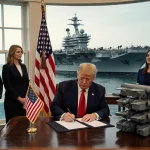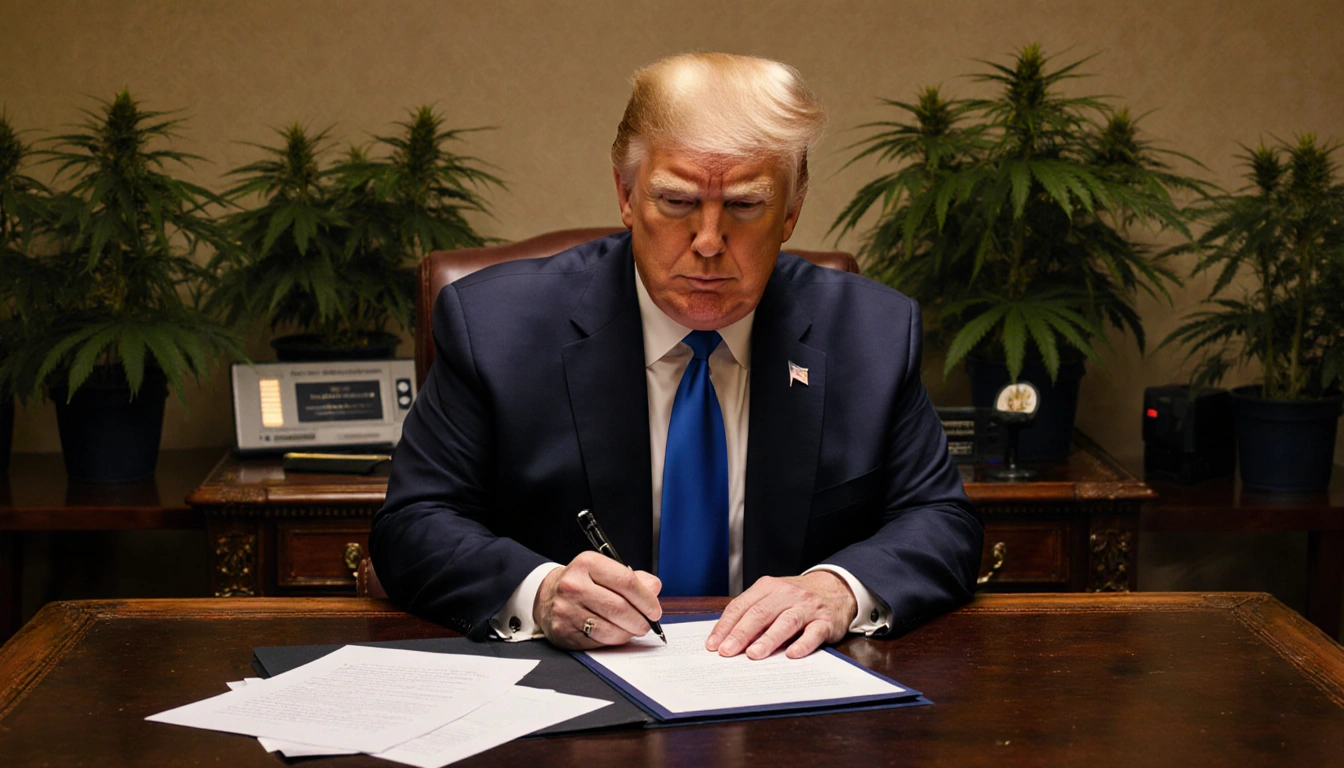
President Trump signed an executive order Thursday to move marijuana from Schedule I to Schedule III, a step intended to speed up medical research on the plant.
Executive Order Details

The order directs the attorney general to expedite the rescheduling process. Biden had begun the work but left it unfinished when Trump took office, and Trump said in August that he was open to completing the task.
Trump’s Statements
A senior administration official told reporters that the order “focuses on increasing medical research for medical marijuana and CBD – cannabidiol.” The official added that the president is “very focused on the potential medical benefits” and that the approach will “automatically … start working to improve the medical marijuana and CBD research to better inform patients and doctors. That’s the primary goal.”
Trump emphasized that the order does not legalize marijuana or sanction recreational use. He warned against abuse, saying, “If it’s abused, it’s never safe to use powerful, controlled substances in recreational matters, and especially in this case, if you take a look illegal and unregulated drugs, very, very bad thing.” He added, “Unless a drug is recommended by a doctor for medical reasons, just don’t do it. At the same time, the facts compel the federal government to recognize that marijuana can be legitimate in terms of medical applications when carefully administered.”
Scientific and Medical Support
The administration cited 2023 reviews from the Department of Health and Human Services that found more than 30,000 licensed health-care practitioners could recommend medical marijuana to over 6 million registered patients for at least 15 conditions. Trump noted polling data showing that a vast majority of people favor rescheduling.
Physicians welcomed the reclassification. Ilana Braun, a cancer psychiatrist and medical-cannabis researcher at the Dana-Farber Cancer Institute, said cannabis could serve as a non-addictive way to manage anxiety during cancer care. She explained that rescheduling “allows us to ask these questions rigorously, about dosing, about safety and who may benefit most,” and that such research “reflects the best of federal investment helping people not only live longer, but live better.”
Nora Volkow, director of the National Institute on Drug Abuse, defended the move, stating, “We cannot close our eyes to research and the opportunity that we are hearing from patients that, for some of them, cannabis can solve their problem. And so, what we need to do is do research.”
Implications for Businesses and Law
The order will not change criminal penalties or recreational use. Rescheduling to Schedule III would allow marijuana businesses to deduct expenses or add credits to their annual federal taxes-something not permitted for Schedule I or II substances. Senior officials declined to comment on whether Trump might expand recreational use.
Key Takeaways
- The executive order moves marijuana from Schedule I to Schedule III to boost medical research.
- The change does not legalize recreational use or alter existing penalties.
- The reclassification will enable businesses to claim tax deductions and encourages further scientific study.
The order marks a significant policy shift that prioritizes research while maintaining current restrictions on recreational marijuana use.