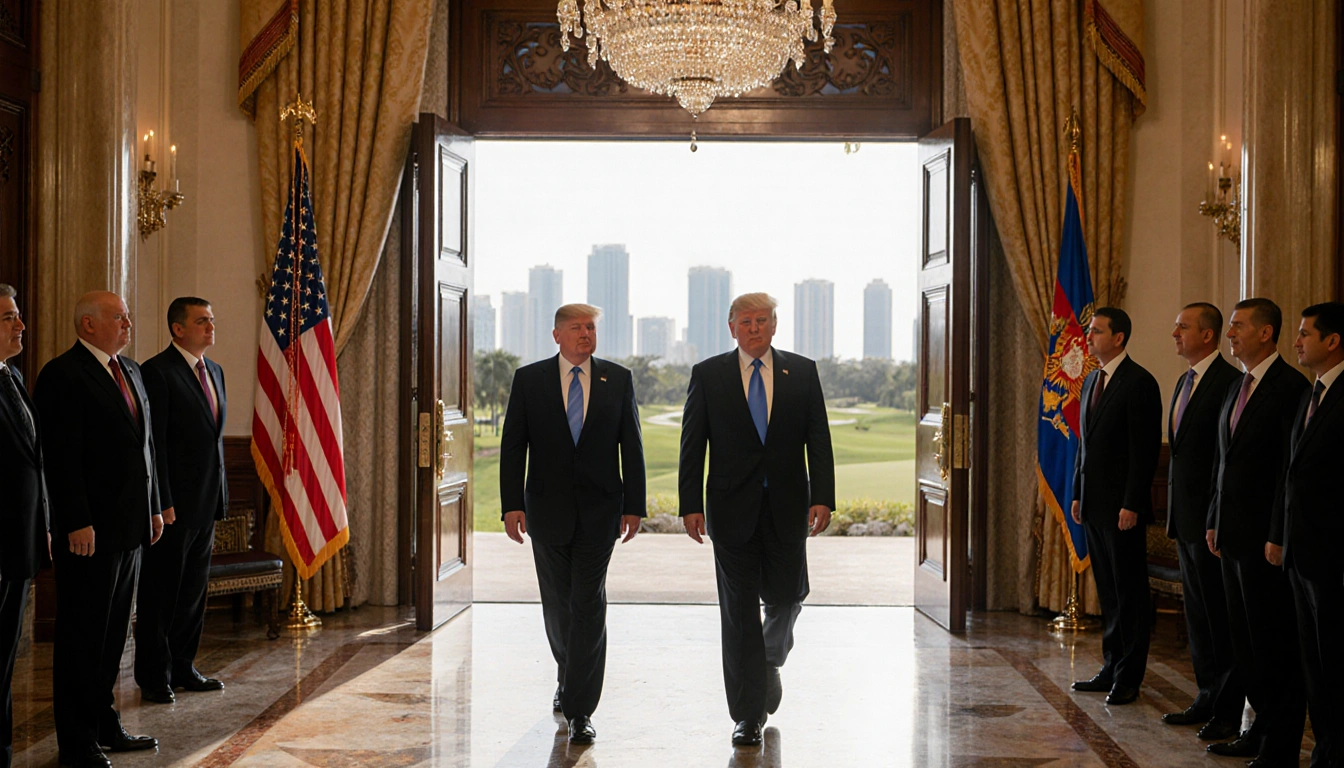
President Donald Trump announced on Tuesday that the United States will invite Kazakhstan and Uzbekistan to next year’s U.S.-hosted Group of 20 (G20) summit, held at his golf club in Doral, Florida. The decision follows separate phone calls Trump had with Kazakh President Kassym-Jomart Tokayev and Uzbek President Shavkat Mirziyoyev.
A New Invitation for Non-Members
While neither Kazakhstan nor Uzbekistan is a member of the G20, the host nation often extends invitations to non-members. The 2026 summit will take place at Trump’s golf club near Miami, a location that has already been earmarked for the gathering of world leaders. Trump described the relationship with both countries as “spectacular” in a social media post about the calls. He is currently on vacation at his Mar-a-Lago resort in Florida.

Central Asia on the Radar
The Trump administration is placing greater emphasis on Central Asia, a region rich in minerals that produces roughly half the world’s uranium. The focus is part of a broader effort to secure rare earth metals essential for high-tech devices, including smartphones, electric vehicles and fighter jets. Central Asia’s critical mineral exports have long tilted toward China and Russia, and the U.S. is looking to diversify its supply chains.
Recent Visits to Washington
Last month, the leaders of Kazakhstan and Uzbekistan visited Washington, D.C., together with leaders from Kyrgyzstan, Tajikistan and Turkmenistan. The visit was aimed at discussions with President Trump and underscored the administration’s intent to strengthen ties with the region.
The Abraham Accords Connection
During his visit, President Tokayev announced that Kazakhstan, a Muslim-majority country, will join the Abraham Accords-an initiative launched by the Trump administration to strengthen ties between Israel and Arab and Muslim-majority nations. The move is largely symbolic, but it reflects the administration’s attempt to revive a signature foreign-policy achievement from Trump’s first term, when diplomatic and commercial links were forged between Israel and the United Arab Emirates, Bahrain and Morocco.
Controversial Stance Toward South Africa
Trump also announced last month that South Africa will be barred from participating in next year’s summit at his Miami-area club. He said he would stop all payments and subsidies to the country over its treatment of a U.S. government representative at this year’s meeting. Trump chose not to send an American government delegation to the current summit hosted by South Africa, citing violent persecution of white Afrikaners. South Africa has rejected the claim as baseless.
Key Takeaways
- Trump will invite Kazakhstan and Uzbekistan to the 2026 G20 summit at his Doral golf club.
- The move signals a renewed U.S. focus on Central Asia’s mineral resources and rare earth metals.
- Kazakhstan’s announcement to join the Abraham Accords ties the region to Trump’s broader Middle East policy.
- South Africa will be excluded from next year’s summit, reflecting ongoing tensions over human-rights concerns.
The invitation to Kazakhstan and Uzbekistan highlights a strategic pivot toward Central Asia, a region that holds significant mineral wealth and is pivotal to the United States’ supply-chain security for advanced technologies. By extending the G20 invitation, Trump signals a willingness to broaden the forum’s reach while also addressing geopolitical and economic priorities that align with the administration’s broader foreign-policy agenda.