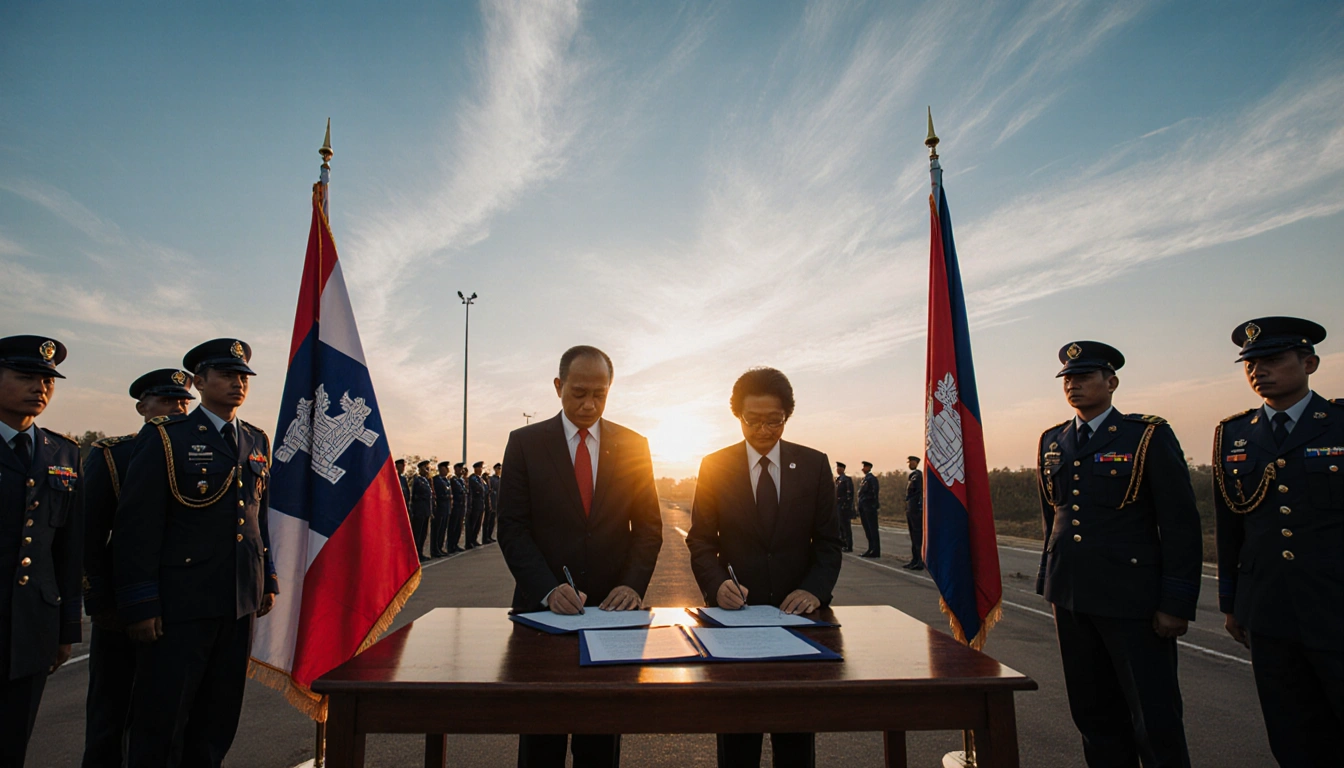
Thailand and Cambodia have agreed to a ceasefire that ends weeks of violent clashes along their contested border, a move that could reshape the region’s security dynamics. The agreement took effect at noon local time on Saturday.
Ceasefire Agreement Details
The pact ends all fighting and prohibits further military movements by either side. It also bars any violations of each country’s airspace for military purposes. The ceasefire is intended to provide a stable framework for the border region.
Airstrikes and Recent Combat
Only Thailand used airstrikes during the conflict, striking Cambodian sites as recently as Saturday morning, according to the Cambodian defense ministry. These strikes were the last military actions before the ceasefire.
Prisoner Release
The deal requires Thailand to repatriate 18 Cambodian soldiers it has held as prisoners since July, once the ceasefire has held for 72 hours. The release of these prisoners was a major demand of the Cambodian side.
Signing of the Agreement
Defense ministers Tea Seiha of Cambodia and Nattaphon Narkphanit of Thailand signed the document at a border checkpoint. The signing followed three days of lower-level talks by military officials as part of the General Border Committee. The meeting underscored the diplomatic progress made after months of tension.
Background of Earlier Ceasefires
The agreement declares commitment to an earlier ceasefire that ended five days of fighting in July and to follow-up agreements. It includes 16 de-escalation measures agreed upon during that period. Those earlier agreements set the stage for the current pact.
International Involvement
The original July ceasefire was brokered by Malaysia and pushed through by pressure from U.S. President Donald Trump, who threatened to withhold trade privileges unless the parties agreed. Trump’s involvement was formalized in October at a regional meeting in Malaysia that he attended. The U.S. stance added diplomatic weight to the negotiations.
Propaganda and Minor Violence
Despite the ceasefires, a bitter propaganda war continued between the two sides. Minor cross-border violence persisted, escalating into widespread heavy fighting in early December.
December Escalation
The early December surge of hostilities brought renewed clashes along the border. The violence intensified the urgency for a comprehensive ceasefire agreement.
Casualties in Thailand
Thai officials report that 26 soldiers and one civilian have been killed directly as a result of the combat since December 7. The losses highlight the human cost of the conflict.
Civilian Impact in Thailand
In addition to military casualties, Thailand has recorded 44 civilian deaths from collateral effects of the fighting. These figures underscore the broader societal impact.
Cambodian Casualties
Cambodia has not released official military casualty figures but reports that 30 civilians have been killed and 90 injured. The data reflect the civilian toll on both sides.
Evacuations
Hundreds of thousands of people have been evacuated from affected areas on both sides of the border. The mass movements demonstrate the scale of displacement caused by the fighting.
Mutual Blame
Each side blamed the other for initiating the fighting and claimed to be acting in self-defense. The accusations have complicated efforts to achieve lasting peace.
Mine Concerns
The agreement calls on both sides to adhere to international agreements against deploying land mines, a major concern for Thailand. Thai soldiers along the border have been wounded in at least nine incidents this year by newly planted Cambodian mines.
Thai Wounded by Mines
The nine incidents involved injuries to Thai troops, prompting calls for greater mine-clearing cooperation. The wounds illustrate the ongoing danger of unexploded ordnance.
Cambodian Explanation
Cambodia says the mines were left over from decades of civil war that ended in the late 1990s. The claim highlights differing perspectives on mine origin.
Information Warfare Clause
The agreement also includes a clause that both sides agree to refrain from disseminating false information or fake news. The provision aims to curb misinformation that fuels tensions.
Border Demarcation
Previously established measures to demarcate the border will resume under the new agreement. The resumption is intended to clarify territorial disputes.
Crime Cooperation
The sides also agree to cooperate on an effort to suppress transnational crimes. The collaboration focuses on shared security challenges beyond the immediate border.
Online Scams
The agreement references online scams perpetrated by organized crime that bilk victims worldwide for billions of dollars each year. Cambodia is identified as a center for such criminal enterprises.
Key Takeaways
- Thailand and Cambodia agree to halt military moves, release prisoners, curb mine use, and tackle misinformation and cross-border crime.
- The ceasefire follows a history of earlier agreements, international pressure, and escalating violence.
- Human costs include dozens of soldiers, civilians, and mass evacuations on both sides.
The agreement marks a significant step toward lasting peace, though the challenges of mine clearance, misinformation, and transnational crime remain.