At a Glance
- Trump will host Ukrainian President Zelenskyy at Mar-a-Lago to push a 90%-ready peace draft amid Russia’s intensified attacks on Kyiv.
- Meeting focuses on security, economic agreements, and territorial issues in Donbas.
- Zelenskyy says Ukraine is willing to do whatever it takes to stop the war and urges strong negotiating table.
- Why it matters: The outcome could end four years of war and reshape U.S. foreign policy.
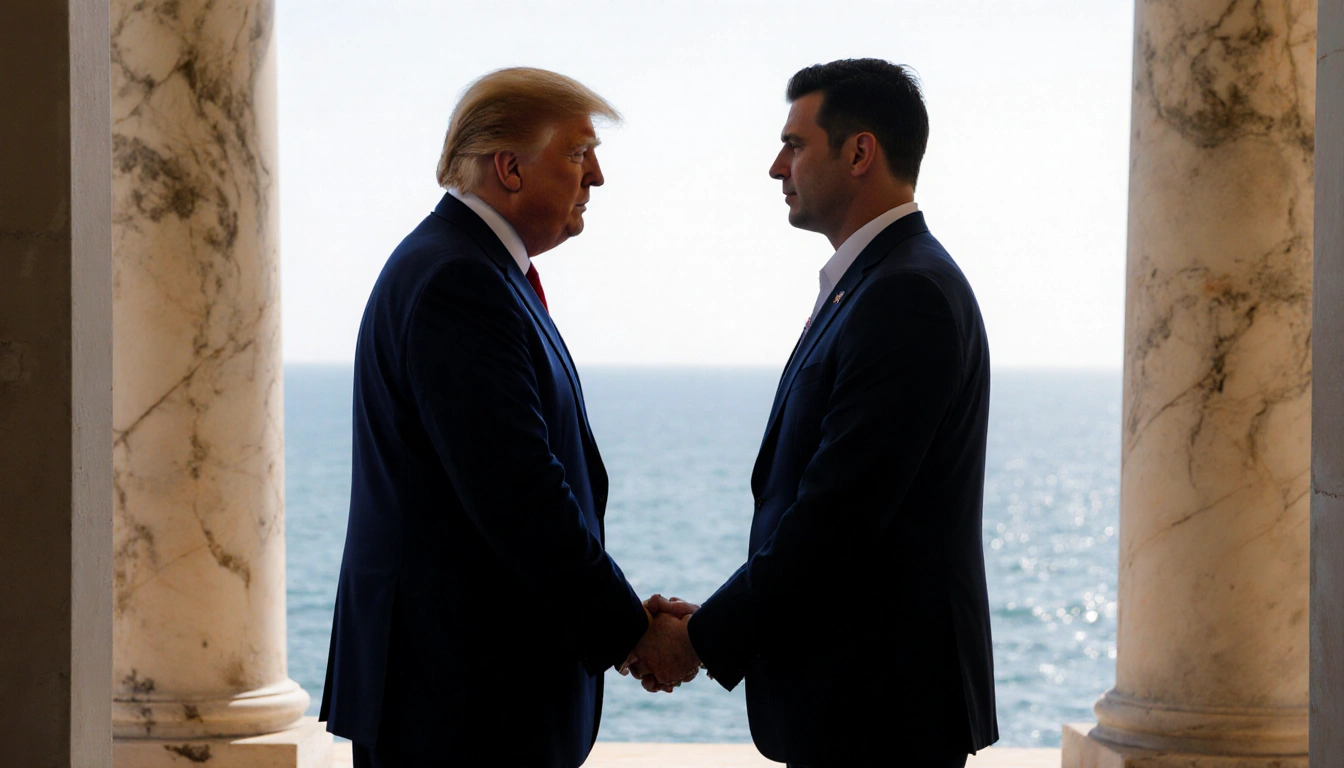
President Trump will host Ukrainian President Volodymyr Zelenskyy on Sunday at Mar-a-Lago to try to close out a peace agreement that would end nearly four years of war that began with Moscow’s invasion of Ukraine.
Meeting Overview
The two will meet at Mar-a-Lago, Trump’s private club in Palm Beach, where the U.S. president is spending the holidays and has an agenda mostly filled with daily rounds of golf. Zelenskyy said the two planned to discuss security and economic agreements and he will raise “territorial issues” as Moscow and Kyiv remain fiercely at odds over the fate of the Donbas region in eastern Ukraine.
Key discussion points
- Security and economic agreements
- Territorial issues in Donbas
- Economic assistance and support
Russia’s Escalation and Ukraine’s Response
In the days before the meeting, Russia has intensified its attacks on Ukraine’s capital, using missiles and drones to attack Kyiv and try to increase the pressure on Zelenskyy.
Zelenskyy posted on X:
> “Ukraine is willing to do whatever it takes to stop this war,”
> “We need to be strong at the negotiating table.”
Zelenskyy wrote:
> “We want peace, and Russia demonstrates a desire to continue the war. If the whole world – Europe and America – is on our side, together we will stop” Russian President Vladimir Putin.
In a meeting with Canadian Prime Minister Mark Carney in Halifax, Nova Scotia, on Saturday, Zelenskyy said the key to peace is “pressure on Russia and sufficient, strong support for Ukraine.” To that end, Carney announced $2.5 billion Canadian (US$1.8 billion) more in economic assistance from his government to help Ukraine rebuild.
Negotiation Progress
Trump and Zelenskyy sitting down face-to-face also underscored the apparent progress made by Trump’s top negotiators in recent weeks as the sides traded draft peace plans and continued to shape a proposal to end the fighting. Zelenskyy told reporters Friday that the 20-point draft proposal negotiators have discussed is “about 90% ready” – echoing a figure, and the optimism, that U.S. officials conveyed when Trump’s chief negotiators met with Zelenskyy in Berlin earlier this month.
During the recent talks, the U.S. agreed to offer certain security guarantees to Ukraine similar to those offered to other members of NATO. The proposal came as Zelenskyy said he was prepared to drop his country’s bid to join the security alliance if Ukraine received NATO-like protection that would be designed to safeguard it against future Russian attacks.
Ongoing Discussions and Future Steps
Zelenskyy also spoke on Christmas Day with U.S. special envoy Steve Witkoff and Jared Kushner, Trump’s son-in-law. The Ukrainian leader said in a post on X that they discussed “certain substantive details of the ongoing work” and cautioned in a subsequent post that “there is still work to be done on sensitive issues” and “the weeks ahead may also be intensive.”
Zelenskyy wrote:
> “There is still work to be done on sensitive issues,”
> “The weeks ahead may also be intensive.”
The U.S. president has been working to end the war in Ukraine for much of his first year back in office, showing irritation with both Zelenskyy and Putin while publicly acknowledging the difficulty of ending the conflict. Long gone are the days when, as a candidate in 2024, he boasted that he could resolve the fighting in a day.
Remaining Issues and Russian Demands
Before Sunday’s meeting, Zelenskyy said the key issues that remain unresolved between Ukraine and the U.S. include questions surrounding territory, the Zaporizhzhia nuclear power plant and funding for Ukraine’s postwar recovery. He said there also are outstanding technical matters related to security guarantees and monitoring mechanisms.
Ukraine has conveyed its position to the U.S., Zelenskyy said, adding that Trump administration officials would relay that to Russia.
Zelenskyy also said last week that he would be willing to withdraw troops from Ukraine’s eastern industrial heartland as part of a plan to end the war, if Russia also pulls back and the area becomes a demilitarized zone monitored by international forces.
Kremlin spokesman Dmitry Peskov told reporters Friday that the Kremlin had already been in contact with U.S.
> “It was agreed upon to continue the dialogue,” he said.
Putin wants Russian gains kept, and more
Putin has publicly said he wants all the areas in four key regions that have been captured by his forces, as well as the Crimean Peninsula, illegally annexed in 2014, to be recognized as Russian territory. He also has insisted that Ukraine withdraw from some areas in eastern Ukraine that Moscow’s forces haven’t captured. Kyiv has publicly rejected all those demands.
The Kremlin also wants Ukraine to abandon its bid to join NATO. It warned that it wouldn’t accept the deployment of any troops from members of the military alliance and would view them as a “legitimate target.”
Putin also has said Ukraine must limit the size of its army and give official status to the Russian language, demands he has made from the outset of the conflict.
Yuri Ushakov told the business daily Kommersant this month that Russian police and national guard would stay in parts of Donetsk – even if they become a demilitarized zone under a prospective peace plan.
Ushakov cautioned that trying to reach a compromise could take a long time. He said U.S. proposals that took into account Russian demands had been “worsened” by alterations proposed by Ukraine and its European allies.
Key Takeaways
- Trump and Zelenskyy are negotiating a 90%-ready peace draft amid Russia’s intensified attacks.
- Ukraine seeks security guarantees and NATO-like protection to end the war.
- Russia demands territorial gains, recognition of Crimea, and limits on Ukraine’s military.
The meeting at Mar-a-Lago could decide the future of Ukraine and the broader conflict, with implications for U.S. foreign policy and international security.