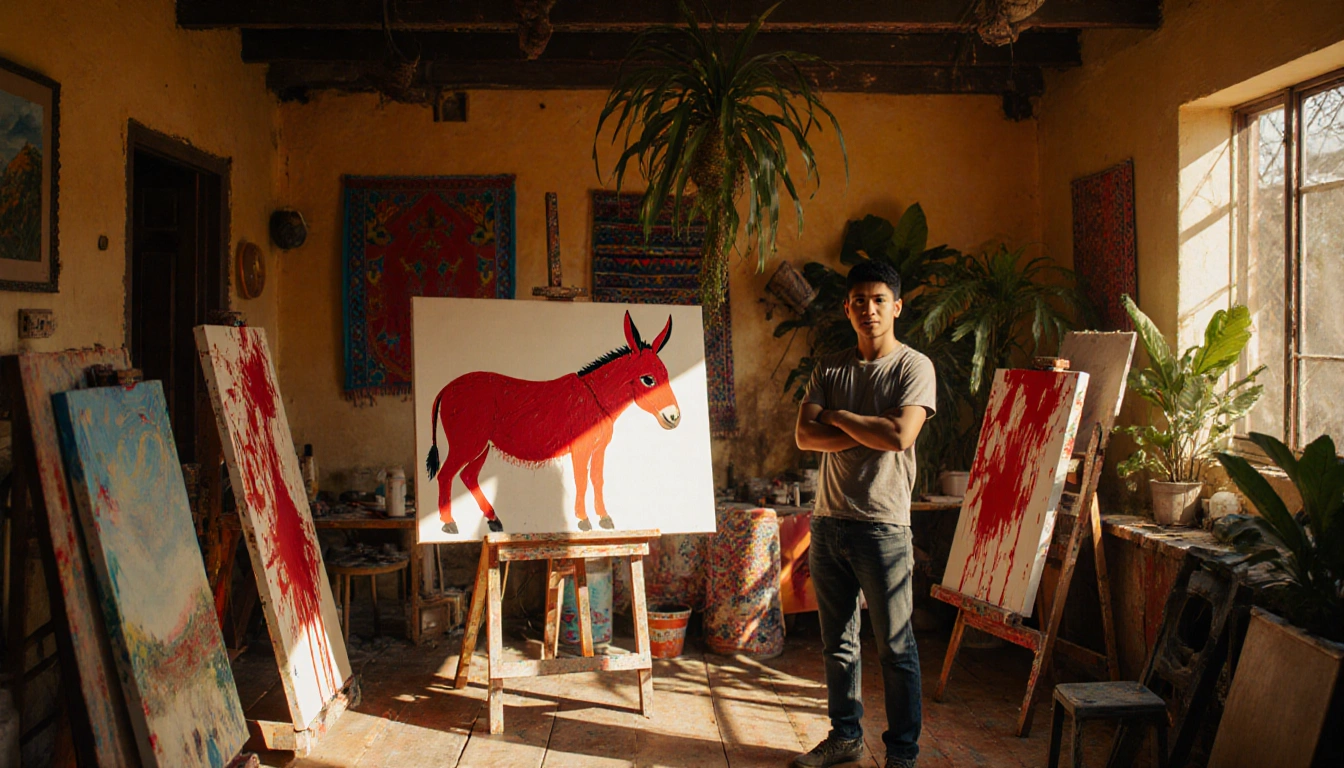
When Fernando Dávila was eight years old in Colombia, he failed a drawing class because he painted donkeys red.
The reason was simple: he is colorblind.
Dávila, now 72, has become a respected artist whose vibrant paintings have been shown across South America, Europe, and the United States.
He told reporters from his studio in a Miami suburb, “I have the most wonderful job in the world, which is painting every morning,” and added that mixing colors brings him joy and passion.
Until around age thirty, Dávila worked only in black and white, a limitation imposed by his congenital condition that makes distinguishing certain colors-especially red and green-difficult.
Colorblindness, which also confuses pink, violet, turquoise, and yellow-green, has no cure and reduces his visible spectrum to about 40% of colors.
In the mid-1980s, while living in New York, he began painting in color with the help of special glasses designed by an ophthalmologist.
The glasses consist of one transparent lens and one red-shaded lens; together they enable him to differentiate shades that would otherwise blur together.
With the lenses, he can see almost two-thirds of the colors; without them, he perceives only around 40%.
Dávila likened his condition to having a box of chocolates but only being able to taste a single sample, and he expressed a strong longing to experience every hue.
He said, “It’s something that I miss in my life, that if somebody says, ‘Look at this flower,’ which is bright, bright pink, I want to do it,” and added that this desire comes from his heart.
Colorblindness runs in his family: a grandfather and several great uncles saw only in black and white, while his mother and her three sisters were also colorblind, a rarer occurrence in women.
His two brothers also have trouble distinguishing colors, making the family’s visual experience a shared challenge.

Dávila has spent his career in Colombia, New York, and Florida, moving between these places as his artistic journey unfolded.
In 1999, the Colombian Congress honored him with the “Order of Democracy” for his contributions to the arts.
He has published two hardcover books and numerous catalogues that document his paintings, showcasing his evolution as an artist.
His work has also appeared at major auctions, including Christie’s and Sotheby’s, where collectors have sought his distinctive style.
His paintings often depict romantic images of men and women embracing, as well as landscapes, each rendered with a palette that frequently centers on the color blue.
Dávila remarked, “I think color is one of the most important things in life,” emphasizing how essential color is to his creative expression.
Mike Schneider in Orlando, Florida contributed to this report.
Key Takeaways
- Colorblind artist overcomes vision limits with special glasses to paint in color.
- Awarded Colombia’s “Order of Democracy” in 1999 for artistic contributions.
- Works displayed internationally and sold at Christie’s and Sotheby’s.
Fernando Dávila’s story illustrates how perseverance and innovative solutions can transform a perceived limitation into a celebrated artistic legacy, reminding us that even when color is partially out of reach, passion can bring it to life.