At a Glance
- Two helicopters collided midair over Hammonton, NJ, killing one person and critically injuring another.
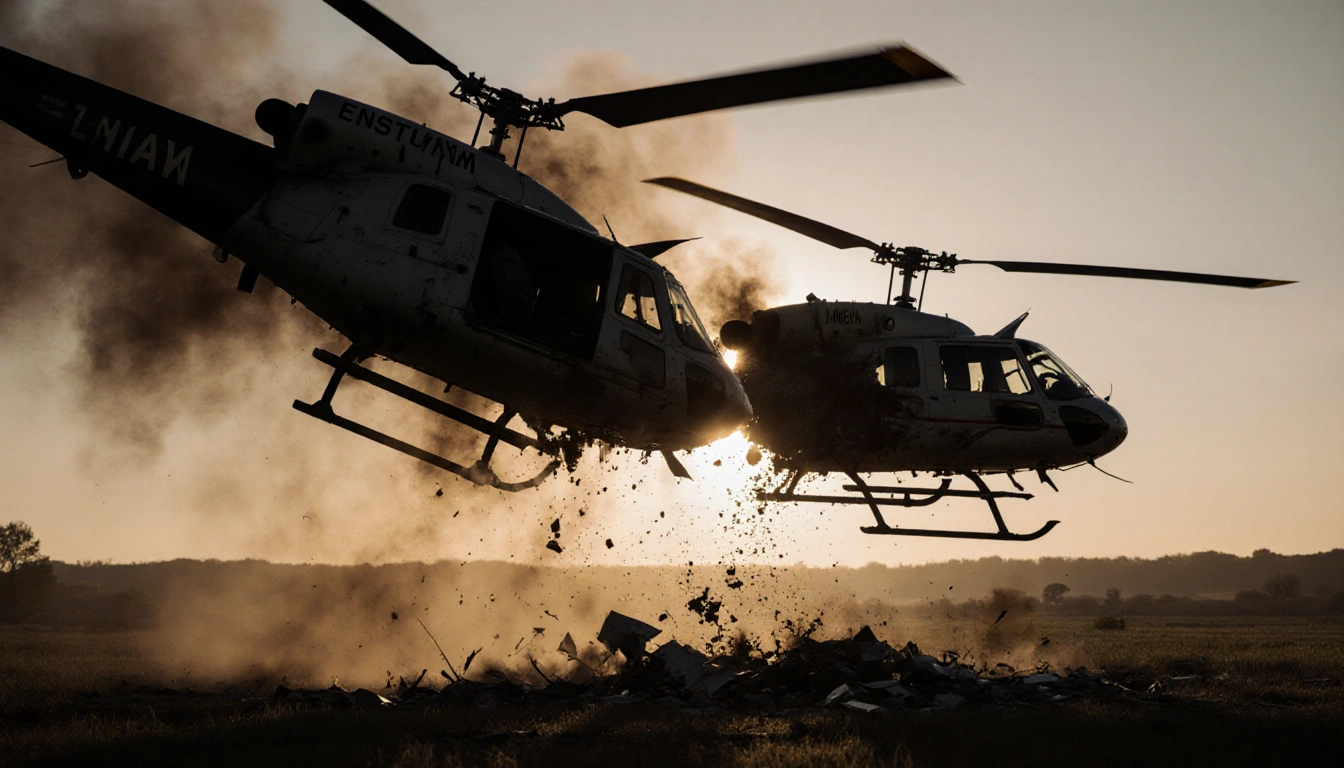
- The crash involved an Enstrom F-28A and an Enstrom 280C, each flown by a single pilot.
- The FAA and NTSB will investigate, focusing on pilot communications and visibility.
- Why it matters: It highlights the risks of midair collisions and the importance of “see and avoid” protocols.
A midair collision over Hammonton, N.J. on Sunday sent shock waves through the local community. Two helicopters, an Enstrom F-28A and an Enstrom 280C, slammed together at about 11:25 a.m., killing one person and leaving another with life-threatening injuries. Authorities are already probing the incident.
The Crash
The collision occurred over Hammonton Municipal Airport, a small airfield that serves the town’s aviation needs. Video footage shows the aircraft spinning rapidly toward the ground before impact.
Response
Kevin Friel said:
> “Rescuers responded to a report of an aviation crash at about 11:25 a.m.”
Fire crews extinguished the blaze while medical teams transported the injured pilot to a nearby hospital.
Investigation Focus
The FAA described the incident as a midair collision between the two Enstrom models, each carrying only its pilot. Both aircraft were lost in the crash, with one fatality and one critical injury.
The FAA and NTSB will lead the investigation, examining flight data and pilot communications. Investigators will also review the out-of-cockpit views for possible blind-side approaches.
Kevin Friel stated:
> “The FAA and NTSB will be investigating the crash.”
Alan Diehl, a former crash investigator for the FAA and NTSB, said:
> “Virtually all midair collisions are a failure to what they call ‘see and avoid,'” Diehl said. He added that the investigation will focus on whether either pilot could see the other aircraft.
- Review of pilot radio transmissions
- Analysis of aircraft flight paths
- Examination of weather and visibility conditions
Investigation Timeline

The FAA announced its investigation shortly after the crash, with investigators arriving on site within hours. Data recovery teams are currently extracting flight recorders for analysis.
Local Context
Hammonton is a town of about 15,000 residents in Atlantic County, located roughly 35 miles southeast of Philadelphia. Its rural setting and proximity to the Pine Barrens make it a quiet aviation hub.
The town’s history is rooted in agriculture, and its municipal airport serves both recreational and private aviation. The recent crash has shocked local residents who are accustomed to low-volume air traffic.
Aviation Culture
Hammonton hosts a small but active community of hobbyist pilots who frequently use the municipal airport. The crash has disrupted regular flight training schedules.
Weather Conditions
AccuWeather reported that the sky was mostly cloudy at the time of the collision. Light winds and good visibility were noted, suggesting weather was not a primary factor.
Visibility Analysis
AccuWeather’s report of good visibility suggests pilots could see each other under normal conditions. Investigators will verify if any equipment or weather anomalies affected visual cues.
Aircraft Details
| Helicopter Model | Pilot | Casualties |
|---|---|---|
| Enstrom F-28A | 1 | 1 fatality |
| Enstrom 280C | 1 | 1 serious injury |
Helicopter Specifications
The Enstrom F-28A is a single-engine, four-seat helicopter designed for flight training and personal use. The Enstrom 280C is a twin-engine model with enhanced performance capabilities.
Aviation Safety Implications
Midair collisions, though rare, often result from failures in the “see and avoid” principle. This incident underscores the need for improved situational awareness among pilots.
Investigators will scrutinize whether either pilot’s line of sight was obstructed by terrain or other aircraft. The findings could influence future pilot training and aircraft design.
Technological aids such as traffic collision avoidance systems (TCAS) may be evaluated for effectiveness in similar scenarios. The crash may prompt the FAA to revisit regulatory requirements for small helicopter operators.
Regulatory Precedents
Past FAA investigations into midair collisions have led to stricter pilot certification requirements. Similar incidents have prompted the implementation of collision avoidance systems on small aircraft.
Community Reaction
Local emergency responders praised the swift response of police and fire crews. Residents expressed concern over the safety of the town’s limited airspace.
The incident has sparked discussions about the need for stricter air traffic monitoring around municipal airports. Community leaders are calling for enhanced safety measures.
Economic Impact
Local businesses that rely on aviation tourism may feel the ripple effects of the crash. The town’s airport may see a temporary decline in flight operations.
Regulatory Context
The FAA oversees safety standards for all U.S. aircraft, including small helicopters. Its investigation will determine if existing regulations were followed.
The NTSB typically conducts thorough analyses of aircraft accidents, publishing detailed reports. Their findings may lead to new safety directives for the aviation industry.
FAA Investigation History
The FAA has conducted investigations into over 200 aircraft accidents in the last decade. Their findings have shaped safety regulations across the industry.
Future Considerations
Potential changes could include mandatory TCAS installation for all Enstrom models. Pilot training programs might be updated to emphasize “see and avoid” techniques.
Manufacturers may explore advanced collision-avoidance technologies tailored to low-speed helicopter operations. Regulatory bodies could require periodic safety audits for operators.
Pilot Training Updates
Training curricula might incorporate more rigorous “see and avoid” scenarios. Flight schools could use simulation exercises to reinforce situational awareness.
Key Takeaways
- Two Enstrom helicopters collided over Hammonton, killing one person and critically injuring another.
- The FAA and NTSB are investigating pilot communications and visibility.
- The incident highlights the importance of “see and avoid” protocols and may prompt regulatory changes.
Ongoing Investigation
Investigators are still gathering evidence and will release a preliminary report once key data points are confirmed. The public will be updated as the investigation progresses.
Closing
The Hammonton crash serves as a stark reminder of the risks inherent in aviation. Updates will follow as investigators uncover the full story behind the midair collision.