At a Glance
- Jack Sparrow and Will Turner walk on an upside-down boat in Pirates of the Caribbean.
- The scene relies on neutral buoyancy and a 3 m³ air-filled hull.
- Real-world physics shows the trick would need 3 tons of ballast or a deep dive.
- Why it matters: The film’s stunt sparks a fun dive into buoyancy, density, and gas laws.
The film opens with Captain Jack Sparrow and Will Turner slipping onto a ship’s hull that has been turned upside down and placed on the ocean floor. In the movie, they glide across the seabed using the boat’s air pocket to keep them afloat. The scene is a visual spectacle, but how much of it can we translate into reality?
The Physics of the Seafloor Stunt
The stunt hinges on the principle of buoyancy-the upward force that fluids exert on objects immersed in them. In the movie, the boat’s hull is full of air, giving it a large volume relative to its mass. The air’s weight is negligible, so the hull’s buoyancy can keep the crew from sinking.
Density and Neutral Buoyancy
Density is mass divided by volume. A 1-cubic-foot block of steel and a block of styrofoam have the same volume but different densities. The steel’s higher density makes it sink, while the styrofoam floats. If a block of water has the same volume, it will neither sink nor rise because its weight equals the buoyant force.
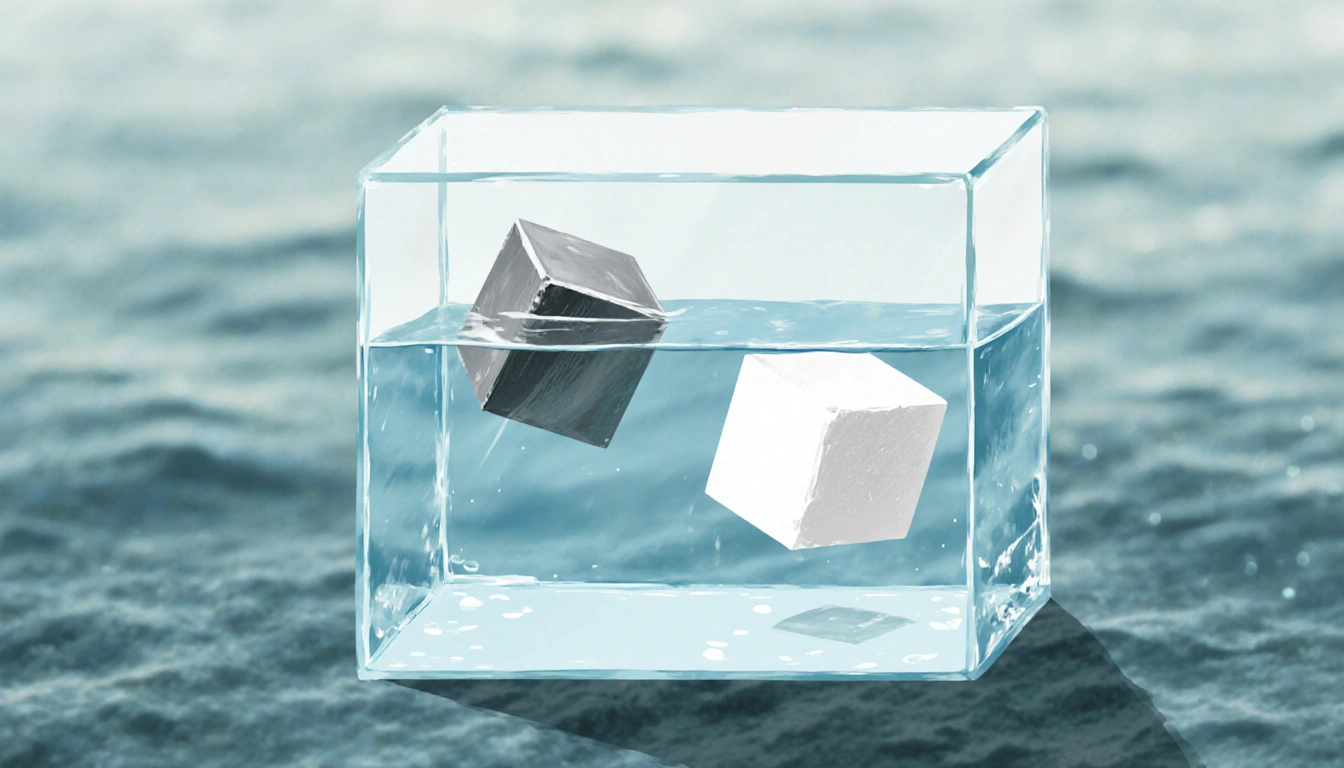
Humans are close to neutral buoyancy because our bodies are about 60 % water. That explains why we feel weightless underwater: the buoyant force nearly cancels gravity.
Why Ships Float
A steel ship can weigh 100,000 tons yet still float because its hull is hollow and filled with air. The shape creates a large displaced volume, so the buoyant force balances the ship’s weight. Adding cargo increases the ship’s weight, requiring it to displace more water to maintain equilibrium.
Forces on an Upside-Down Boat
The boat experiences four forces:
- Upward buoyant force (FB)
- Downward gravitational force (mg)
- Two forces from the crew’s weight pressing on the hull
- The hull’s reaction force on the crew
The crew’s contribution is tiny compared to the buoyant and gravitational forces, so we can ignore it in the calculations.
Calculating Buoyancy for the Boat
Using the formula F = ρVg, where ρ = 1,000 kg/m³ (water density) and g = 9.8 m/s², a 3 m³ hull displaces water that weighs 29,400 N. Converting to pounds gives a buoyant force of 6,600 lb.
Needed Weight to Stay Down
To keep the boat from rising, its total weight must equal or exceed 6,600 lb. Since the hull itself is far lighter, the crew would need to add more than 3 tons of ballast-perhaps gold doubloons-to achieve neutral buoyancy.
Air Compression and Depth
As depth increases, water pressure compresses the air inside the hull, reducing its volume and buoyancy. The total pressure rises by roughly 1 atm for every 10 m of depth.
Boyle’s Law Application
Boyle’s law states that P₁V₁ = P₂V₂ for a fixed amount of gas at constant temperature. If the hull starts with 1 m³ of air at the surface (P₁ = 1 atm), the volume at a depth where the pressure is 1.5 atm (5 m deep) becomes 0.67 m³.
Volume at 5 m Depth
At 5 m, the hull’s buoyancy drops to about 4,400 lb. The crew would still be far from being able to walk on the seabed without additional ballast.
Volume at 30 m Depth
At 30 m (about 100 ft), the pressure is 4 atm, and the hull’s volume shrinks to roughly 0.75 m³. The buoyancy then falls to 1,650 lb, a 75 % reduction from the surface value.
| Depth (m) | Pressure (atm) | Hull Volume (m³) | Buoyancy (lb) |
|---|---|---|---|
| 0 | 1 | 3.00 | 6,600 |
| 5 | 1.5 | 0.67 | 4,400 |
| 30 | 4 | 0.75 | 1,650 |
Breathing Concerns
At 30 m, the air pressure inside the hull would be 4 atm. Breathing compressed air at that pressure requires a slow, controlled ascent to avoid decompression sickness, also known as the bends.
Practical Limitations
Even if the crew could reach 30 m, the hull would still be too buoyant to support them without massive ballast. Adding gold or other dense material would make the boat heavy enough to stay down, but it would defeat the stealth of a pirate operation.
Summary of Findings
- A 3 m³ air-filled hull generates 6,600 lb of buoyancy at the surface.
- To keep the hull submerged, the crew would need to add more than 3 tons of weight.
- Deeper dives compress the air, reducing buoyancy, but still leave the hull too buoyant for walking.
- Breathing compressed air at 30 m introduces serious health risks.
Key Takeaways
- Neutral buoyancy is key to the film’s stunt, but it demands unrealistic ballast.
- Depth compresses air, lowering buoyancy but not enough to make the stunt feasible.
- The physics behind the scene are sound, but the practical execution is impossible.
The Pirates of the Caribbean stunt is a clever illustration of buoyancy and density, but the real-world physics show it would be a watery nightmare for any daring pirate.
Closing
While the scene is entertaining, the laws of physics confirm that walking on an upside-down boat is pure fantasy-no amount of gold can make it a reality.