At a Glance
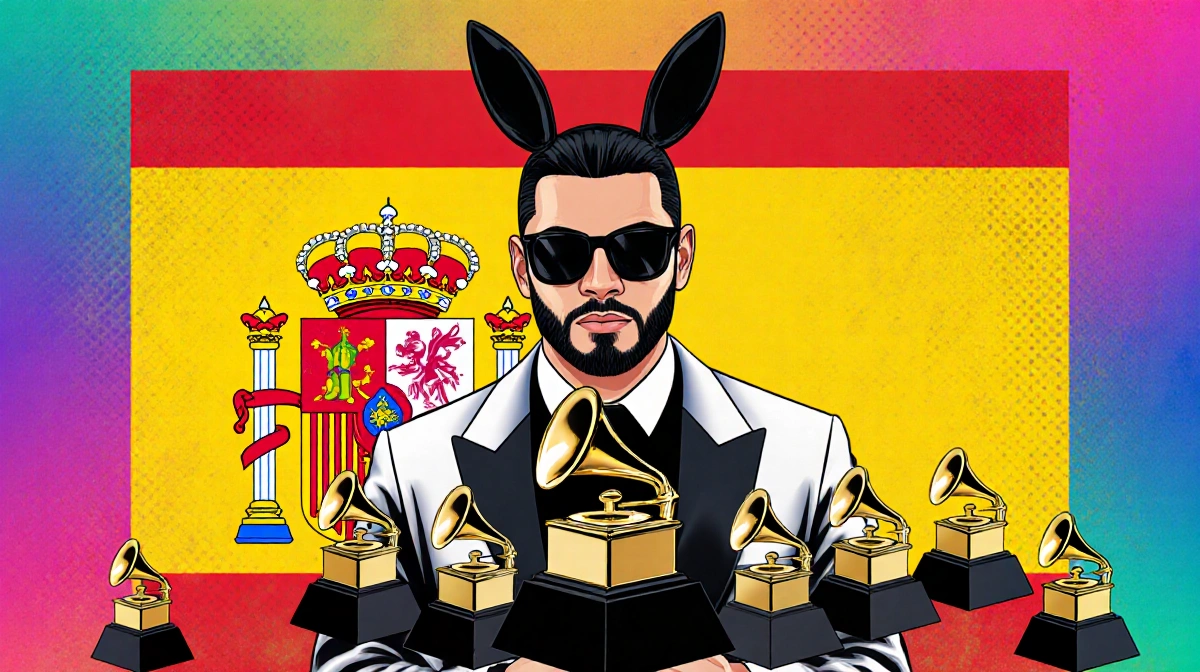
- Bad Bunny is up for six Grammy awards, a first for a Spanish-language artist.
- His album “Debí Tirar Más Fotos” is the second Spanish-language record nominated for Album of the Year.
- The nominations arrive just before he headlines the 2026 Super Bowl halftime show.
- Why it matters: The nods signal a milestone for Latino representation in mainstream music awards.
Bad Bunny’s sweeping six-category nomination slate for the 68th Grammy Awards marks a historic moment for Spanish-language music, placing him at the forefront of a cultural shift that extends beyond his own artistry.
Historic Nominations
The artist born Benito Antonio Martínez Ocasio is up for six awards at the Feb. 1 show, becoming the first Spanish-language artist to be nominated for album, song and record of the year simultaneously.
His critically acclaimed album, “Debí Tirar Más Fotos,” is only the second Spanish-language record to be nominated for Album of the Year, the first being his 2022 release “Un Verano Sin Ti.”
Vanessa Díaz
> “Bad Bunny’s nods extend beyond his own art and serve as a ‘very welcome recognition of Latin music that is growing.'”
Albert Laguna
> “Music from the Spanish-speaking Caribbean has been shaping global music tastes since the 19th century… Bad Bunny is another link in a much longer chain of the popularity of Caribbean music on a global stage.”
Vanessa Díaz
> “Reggaetón in particular… comes from the most marginalized communities in Puerto Rico. And so, the fact that Bad Bunny is receiving nominations in three main categories, and this is an artist who came up with trap… is the most groundbreaking thing about the entire situation.”
Petra Rivera-Rideau
> “A victory in the major categories could have ‘profound, symbolic meaning,’ but I’m interested to see if this is going to open doors for other people.”
Vanessa Díaz
> “If Bad Bunny does win, it will be ‘akin to Halle Berry being the first Black woman to win an Oscar. That was a watershed moment. Or Rita Moreno being the first Latina to win.'”
Albert Laguna
> “The lyrics on this album align with global struggles… Take, for example, ‘Lo que le pasó a Hawaii’ (‘What happened to Hawaii’), a rallying cry for cultural autonomy in an era of neocolonialization.”
Vanessa Díaz
> “The content of the lyrics- which are so steeped in the history of Puerto Rico, political histories, tourism and gentrification- there’s so much rich political and historical content. This album is historic even without a Grammy win.”
Rivera-Rideau
> “The traditional genres are ‘a lot more digestible’ to listeners who embrace the antiquated taboos surrounding Latin trap and scoff at reggaetón’s sexuality. As a result, the combination of sounds makes for an album that is ‘popular across generations.'”
Albert Laguna
> “There’s pleasure, in political critique, that the music makes possible in a beautiful way. And I think that’s very much welcomed.”
Across “Debí Tirar Más Fotos,” Bad Bunny and his producers weave traditional Puerto Rican folkloric styles into a hyper-contemporary context. Latin trap and reggaetón aren’t abandoned but fused with música jíbara, salsa, bomba, plena and even aguinaldo, a kind of Christmas music, in “Pitorro de Coco.”
While Bad Bunny’s previous albums also fused different genres-including bossa nova, mambo, rock, merengue and more-this album’s melange was more homegrown.
Laguna sees “Debí Tirar Más Fotos” as a direct challenge to the prevailing ‘formula for global pop stardom,’ which he describes as an artist making it locally, gaining traction and then ‘watering down’ their sound into something commercial and palatable for a global audience.
Bad Bunny went in the opposite direction. It’s his most Puerto Rican album ever,” says Laguna. He hopes it will communicate to other artists that they, too, can look to their ancestry and history for artmaking.
There’s so much amazing Latin music that has been overlooked and that’s part of what is so beautiful about this moment,” says Díaz. “And that’s why it feels like a win for all Latinos.”
The timing of the album’s release and recognition, too, feels consequential. “The U.S. has a history of othering Latinos, othering the Spanish language… We’re in a moment where that feels extremely acute,” she continues. “For a community that is being targeted on such a deep level, it is a little bit of light, a little bit of faith that we can still carve out our place here.”
Latinos and the Spanish-speaking community in the U.S. have grown increasingly wary amid growing anti-immigrant sentiment and raids, as President Donald Trump’s immigration policies and executive actions have vastly expanded who is eligible for deportation and routine hearings have turned into deportation traps for migrants.
In an interview with i-D Magazine earlier this year, Bad Bunny mentioned that concerns around the mass deportations of Latinos factored into his decision not to tour in the continental U.S. (Hundreds of people have been detained in Puerto Rico itself since large-scale arrests began in late January.)
The content of the lyrics- which are so steeped in the history of Puerto Rico, political histories, tourism and gentrification- there’s so much rich political and historical content,” Díaz adds. “This album is historic even without a Grammy win.”
But if Bad Bunny does win, Díaz says, it will be “akin to Halle Berry being the first Black woman to win an Oscar. That was a watershed moment. Or Rita Moreno being the first Latina to win.”
Beyond that, Laguna says the politics of the album are not exclusive to Puerto Rican or even Latino identity- “the lyrics on this album align with global struggles,” he says. Take, for example, “Lo que le pasó a Hawaii” (“What happened to Hawaii”), a rallying cry for cultural autonomy in an era of neocolonialization.
Rivera-Rideau says one of the reasons “Debí Tirar Más Fotos” has resonated is not just the political implications of using folkloric music in addition to música urbana, but its sound. The traditional genres are “a lot more digestible” to listeners who embrace the antiquated taboos surrounding Latin trap and scoff at reggaetón’s sexuality. As a result, the combination of sounds makes for an album that is “popular across generations,” she says.
But it only works because it is “musically really interesting. If it was just traditional music, and that’s only what people cared about, it wouldn’t have done as well as it did,” she explains. “Musically, it is super innovative and makes accessible a lot of these older genres that people in Puerto Rico listen to, but he’s been able to globalize these very local genres in a way that no one else has.”
That intergenerational appeal was a feature of Bad Bunny’s landmark Puerto Rican residency, with the age and global diversity of its audience.
A lot of people feel like this is a tense moment, it’s a difficult moment. And here’s someone giving us a sonic language in which to narrate this complex present,” Laguna says. “There’s pleasure, in political critique, that the music makes possible in a beautiful way. And I think that’s very much welcomed.”
Grammy Event Details
The 68th Grammy Awards will be held Feb. 1, 2026, at Crypto.com Arena in Los Angeles. The show will air on CBS and stream on Paramount+.
Key Takeaways
- Bad Bunny’s six nominations mark a historic first for Spanish-language artists.
- The album blends traditional Puerto Rican genres with modern trap, signaling a shift in Latin music.
- The nominations carry symbolic weight amid rising anti-immigrant sentiment in the U.S.
With a historic nomination slate and a Super Bowl headline set for the same week, Bad Bunny is poised to reshape the narrative of Latin music on the world stage.
By Morgan J. Carter for News Of Austin