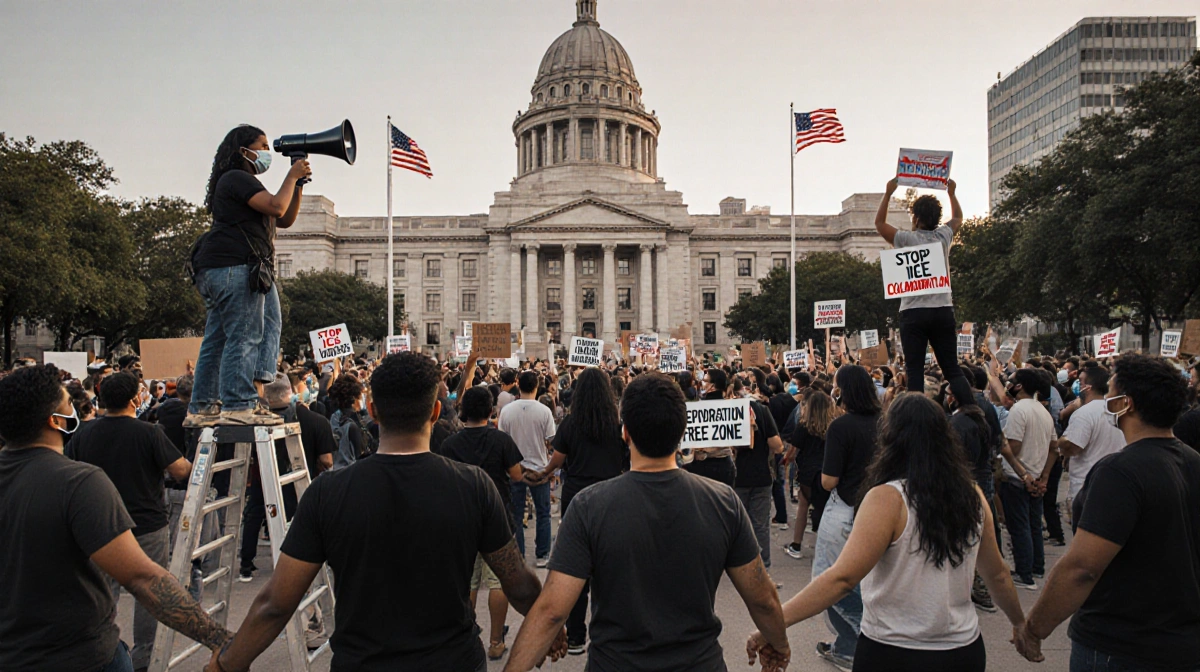
The morning of Jan. 20 saw a surge of civic action as 200 protesters gathered outside Austin City Hall, demanding that the Austin Police Department end its cooperation with U.S. Immigration and Customs Enforcement (ICE). The demonstration grew into a city-wide call for transparency and a halt to administrative warrants that have led to deportations of local residents.
At a Glance
- 200 protesters demanded the end of ICE collaboration at Austin City Hall.
- A petition with 10,000 signatures was presented to city officials.
- City leaders accepted the petition, while the protest expanded to West Cesar Chavez.
The Protest Unfolds
At 2 p.m. on Jan. 20, the crowd chanted “No more ICE!” and marched to West Cesar Chavez, holding signs that read “Immigrants Have Rights,” “Abolish ICE,” and “ICE Out of Austin.” Students had skipped class for a planned walkout, and a few draped Mexican flags over their shoulders. An hour later, advocacy groups, including Hands Off Central TX, handed a petition with over 10,000 signatures to the front doors of city hall. Mayor Pro Tem Vanessa Fuentes and other officials accepted the petition, acknowledging the community’s concerns.
Administrative Warrants Explained
The catalyst for the protest was a federal administrative warrant that the Austin Police Department used to contact ICE after Karen Gutiérrez Castellanos called 911 on the morning of Jan. 5. Within hours, Gutiérrez Castellanos and her five-year-old U.S. citizen child were detained and later deported to Honduras, a fact first reported by Univision. An administrative warrant authorizes an ICE agent to arrest for a suspected immigration violation without a judicial court’s review. The National Immigration Law Center notes that such warrants are issued by the federal agency, are not signed by a judge, and do not authorize ICE to conduct a search.
Voices from the Front
“APD is choosing to go above and beyond what is legally required of them to do,” Sulma Franco, an organizer with the nonprofit Grassroots Leadership, said at the protest. “What this collaboration will do is make our community and our city less safe.”
“But our neighborhoods are going to continue to face this action, and we need to continue to stand together, because if we don’t, it will get worse and worse,” Ry Vaz, a protester and local activist, said. “We want to keep our neighbors safe and our community secure.”
“We call on APD and our leaders in the city of Austin to be courageous, to stand with our immigrant communities, now and always. Remember, ICE is not part of our community. Our immigrant neighbors are,” Franco continued.
“APD, we hear the pressure you’re under, but you may not violate the Constitution,” said Texas House candidate Kate Lincoln-Goldfinch.
Policy Calls and Future Actions
City Council members Mike Siegal, Zo Qadri, Krista Laine, and Paige Ellis issued a joint statement on Jan. 14. They urged clarity and a revision of APD’s policy regarding administrative warrants, stating that the revisions would ensure officers understand that these warrants are discretionary, non-judicial requests by ICE. The statement also committed the council to keeping immigration enforcement out of the relationship between constituents and police.
On Jan. 15, the city of Buda and the Kyle Police Department announced that ICE operations were underway in their jurisdictions, clarifying that they were not involved. That same morning, the Hays County Sheriff’s Office received a call from ICE requesting an ambulance for a person being detained by federal authorities. During the arrest, the local man sustained injuries severe enough to be transported to a hospital, accompanied by Homeland Security personnel, according to the KPD.
Mano Amiga released a statement on Jan. 15, saying, “The presence of ICE agents in our neighborhoods undermines public safety, erodes community trust, and puts vulnerable families at risk. When federal agents operate in our streets, they turn everyday interactions into moments of trauma for children, workers, and neighbors who simply want to live without fear.”

Key Takeaways
- The protest highlighted the impact of administrative warrants on local families.
- City officials have begun to address policy clarity and potential reforms.
- ICE operations continue in surrounding jurisdictions, raising ongoing concerns.