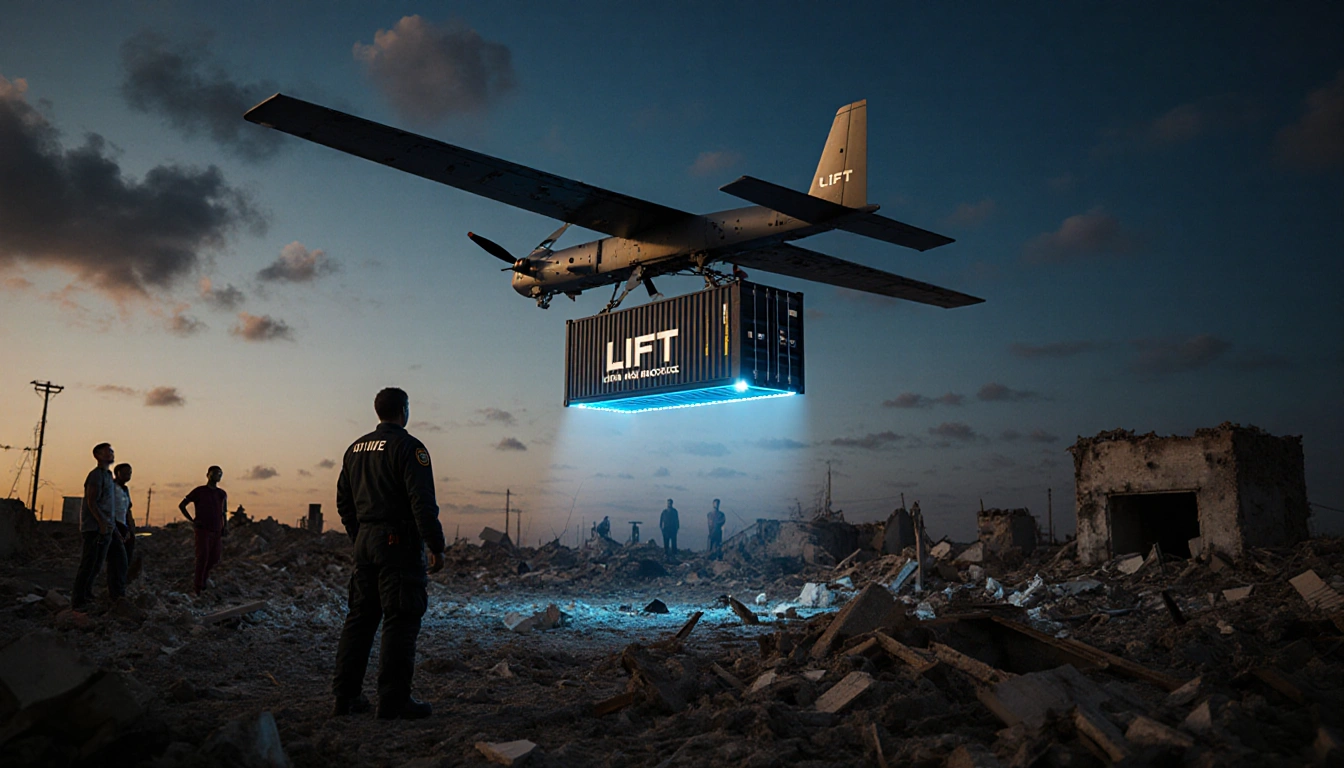
Eight teams from across the globe have advanced to the second phase of the GoAERO competition, a $2 million challenge aimed at developing flying vehicles for first responders. Among the finalists is an Austin-based partnership between LIFT and UT/Texas Aerial Robotics, whose prototype promises to deliver supplies to people in disaster zones.
The GoAERO prize, organized by a consortium of aerospace and emergency response organizations, seeks to accelerate the design of aircraft that can quickly reach areas that are difficult for ground vehicles. The competition’s overarching goal is to reduce the time it takes for first responders to arrive at an emergency scene.
This month, eight teams were chosen to move into stage two, a round that tests the prototypes under more demanding conditions and evaluates their operational readiness. The selection was announced in Austin, where the LIFT-UT partnership presented their aircraft.
Team lead Adam Lang said, “We’ve been developing this in the background for a while, and this was a really great forum for us to test out and kind of push our aircraft to the limits.” Lang’s team has been refining the design to meet the competition’s stringent criteria.
LIFT, the developer of the HEXA vehicle, originally created the aircraft to help people avoid traffic and reach their destinations faster. The HEXA platform has been adapted for the GoAERO challenge to serve a new purpose.
For the competition, the vehicle is intended to bring supplies to people during a disaster or to rescue them from remote areas. The design focuses on rapid deployment and payload delivery in emergency scenarios.
Lang added, “Say someone is trapped on the roof of the building or something. We can deliver water or whatever medical supplies they might need if we are in contact with that person.” The quote highlights the vehicle’s potential to provide immediate aid.
Gwen Lighter, CEO and co-founder of GoAERO, noted that “In the United States alone right now, on a perfect day when the sun is shining, over 5 million people live in ambulance deserts.” The statement underscores the urgency of improving emergency response times.
More than $300,000 in prize money was distributed for this phase of the competition. The funds were allocated among the eight finalists based on performance metrics and technical achievements.
Teams from around the world worked with engineers and experts from organizations such as NASA, RTX and Honeywell during the development process. The collaboration provided access to advanced simulation tools and testing facilities.
Next year, the finalists will compete in a final fly-off held in the San Francisco Bay Area at NASA Ames Research Center. The event will bring together all teams to demonstrate their aircraft in a controlled environment.
Lighter explained, “It’s a fly off when we have all of the teams gather and fly through three missions. Those missions are productivity, adversity, and maneuverability.” The missions are designed to assess the aircraft’s versatility.
GoAERO currently comprises 201 teams from 85 countries. The competition encourages global participation and allows teams to progress without needing to win a previous stage.
An additional $1.65 million will be awarded at the fly-off event, bringing the total prize pool for the competition to $2 million. The remaining funds are reserved for future phases.
Teams are not required to have won a prior stage to qualify for the next phase, which promotes inclusivity and encourages diverse engineering approaches.
The potential impact of the competition extends beyond the contest itself, as the technologies developed could transform how first responders deliver aid in hard-to-reach locations. Rapid aerial delivery could save lives in time-critical situations.
NASA Ames Research Center’s role as the venue for the final fly-off provides the teams with state-of-the-art wind tunnels and flight testing infrastructure, ensuring rigorous evaluation of the aircraft.
As the competition progresses, the world watches to see which designs will emerge as viable solutions for emergency response. The GoAERO prize continues to push the boundaries of aerial rescue technology.