
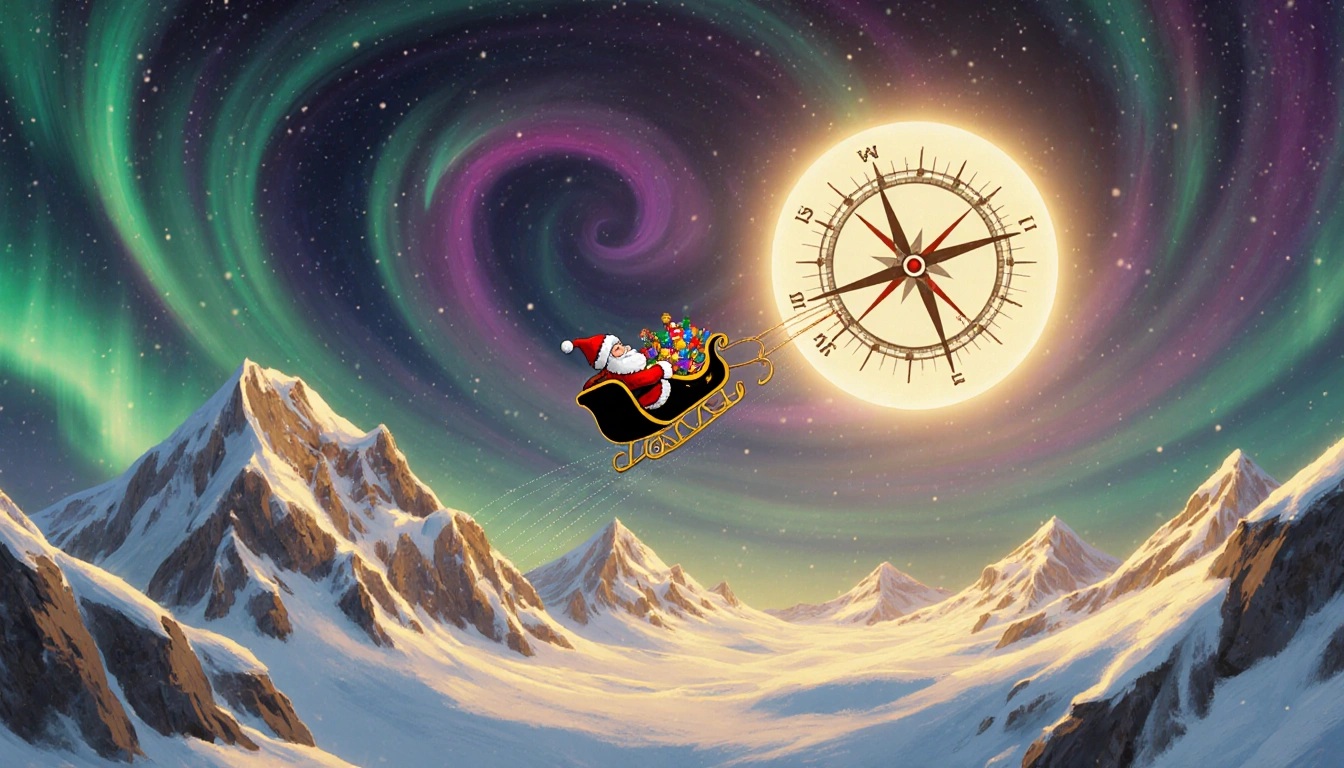
When Santa finishes delivering presents, he still faces a navigational puzzle: how to find the North Pole when the compass points to a different spot.
The Two North Poles
The Earth has two distinct poles that are often confused. The geographic North Pole, also called true north, sits at one end of the planet’s axis of rotation. It is the point where the axis extends from the south pole to the north pole, passing through the Earth’s center.
The magnetic North Pole is different. It is the point where Earth’s magnetic field lines converge and is the reference that compasses use. While the geographic pole is fixed on the map, the magnetic pole moves over time.
How the Magnetic North Moves
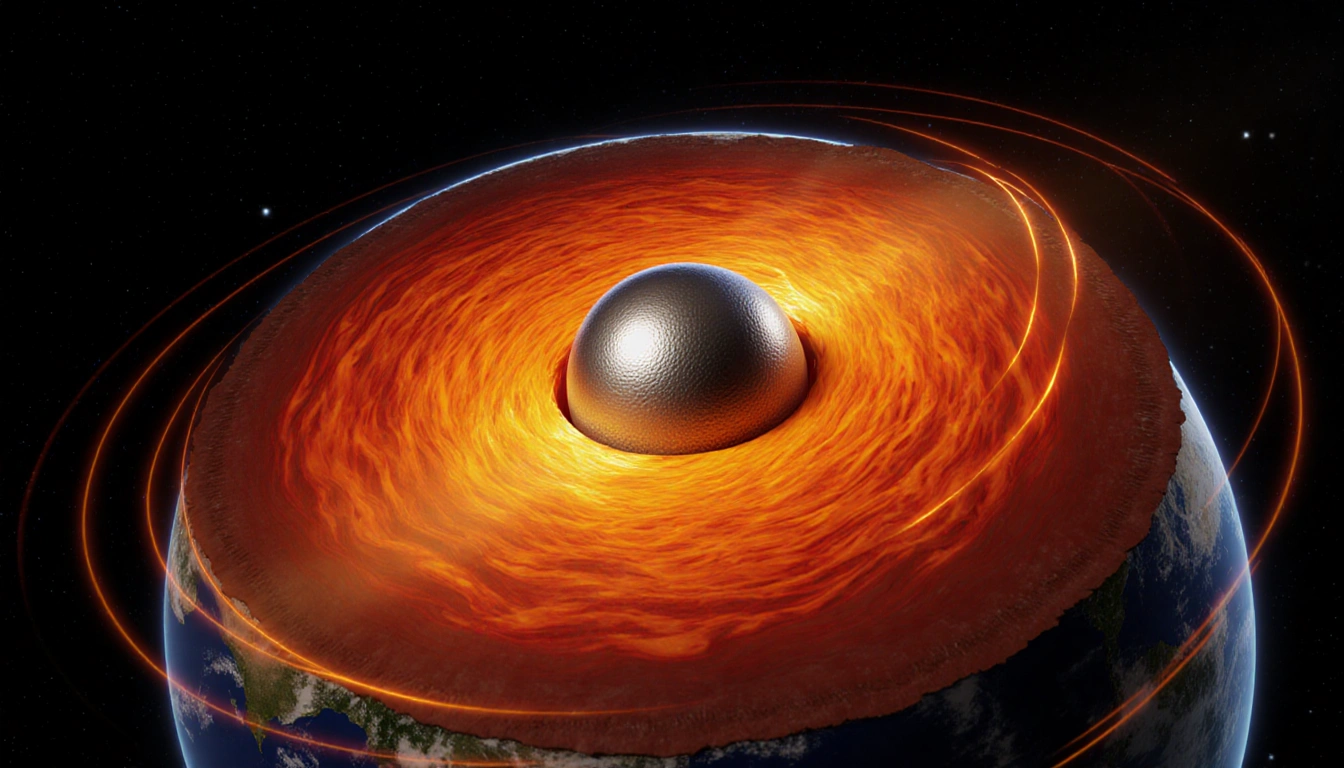
The movement of the magnetic North Pole results from Earth’s active core. The inner core, located about 3,200 miles below the surface, is solid and under immense pressure that prevents it from melting. Surrounding it is the outer core, a molten layer of iron and nickel.
Heat from the inner core causes the molten iron and nickel in the outer core to circulate, similar to soup in a pot on a hot stove. This circulation generates a magnetic field that blankets the entire planet. As the molten iron moves, the magnetic North Pole wanders.
For most of the past 600 years, the pole has drifted over northern Canada. It moved slowly, at a pace of about 6 to 9 miles per year, until around 1990 when its speed increased dramatically to up to 34 miles per year.
The pole has been traveling roughly toward the geographic North Pole for about a century. Scientists cannot explain the exact cause beyond a change in flow within the outer core.
Getting Santa Home
If Santa’s home is the geographic North Pole-located in the ice-covered middle of the Arctic Ocean-he must correct his compass bearing when the two North Poles are in different places. Both traditional compasses and smartphones rely on magnetic north to determine direction.
Modern GPS systems can pinpoint Santa’s location, but they cannot provide a direction without knowing the orientation of magnetic north. To navigate accurately, Santa must account for the difference between true north and magnetic north.
How Santa Adjusts
When using an old-fashioned compass, Santa needs to know the declination at his location. Declination is the angle between true north and magnetic north. With this angle, he can adjust his compass to point toward the geographic North Pole.
The National Oceanic and Atmospheric Administration offers an online calculator that helps determine declination for any location. If Santa uses a smartphone, the device’s built-in magnetometer measures Earth’s magnetic field and applies the World Magnetic Model to correct the heading.
Either method allows Santa to rely on magnetic north to guide him to your house and back to the North Pole, or perhaps the reindeer simply know the way.
Key Takeaways
- The geographic North Pole is fixed on the Earth’s axis, while the magnetic North Pole moves due to core dynamics.
- The magnetic pole drift accelerated from 6-9 miles per year to 34 miles per year around 1990.
- Santa must adjust his compass using declination or a smartphone’s magnetometer to navigate accurately.
Santa’s journey may seem mythical, but the science of navigation shows how even the jolliest traveler must respect the shifting forces of our planet.
Closing
Understanding the difference between true north and magnetic north not only helps Santa find his way but also reminds us that Earth’s magnetic field is a dynamic, ever-changing system. Whether through a simple compass or a sophisticated smartphone, navigation today still relies on the ancient science of magnetism.