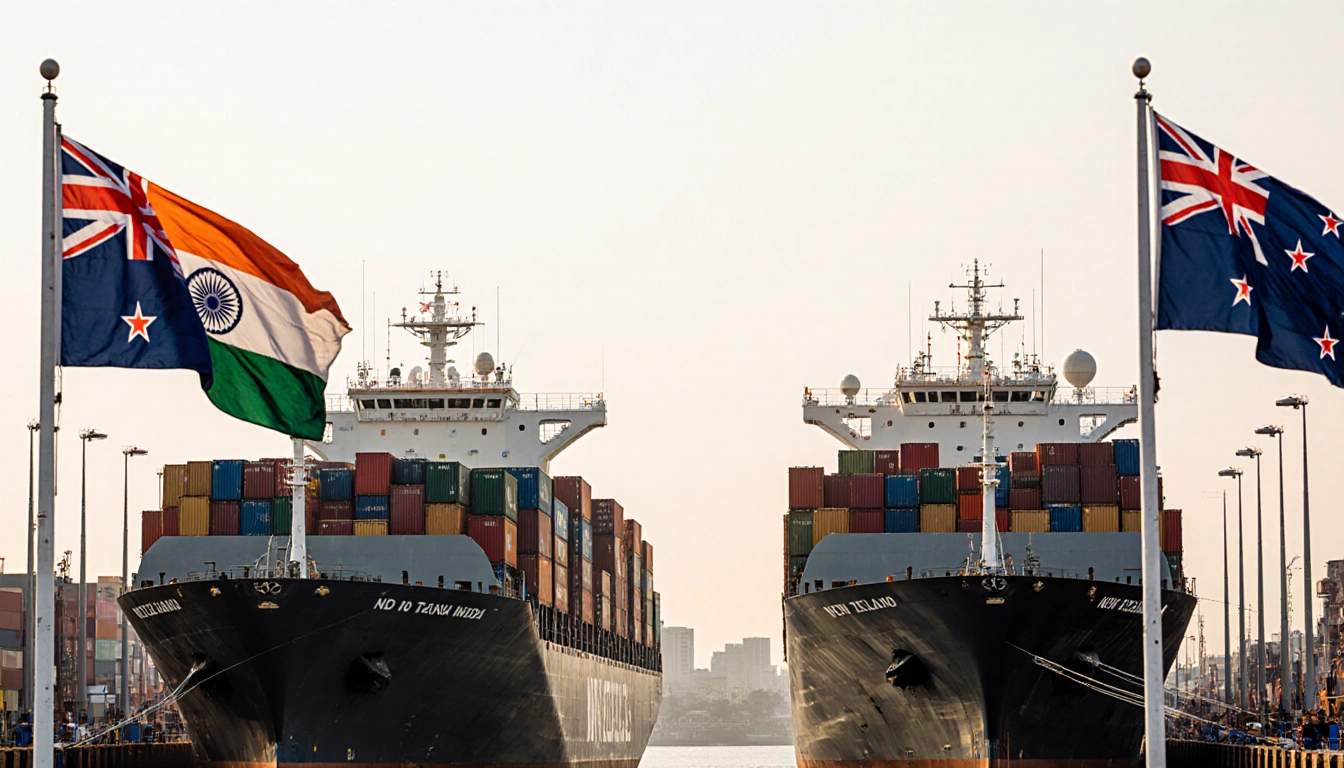
India and New Zealand announced Monday that they have reached a free trade deal, a move that could reshape their economic relationship and provide a boost amid global trade uncertainties.
The Deal in a Nutshell
The agreement, negotiated over nine months, will lower tariffs, ease regulatory barriers, and expand cooperation across goods, services, and investments. A formal signing is expected in the first quarter of next year after legal scrubbing of the negotiated text, Petal Dhillon, India’s chief negotiator, told reporters.
Market Access and Tariff Reductions
Under the pact, India will receive zero-duty export access for all its goods to New Zealand. In return, Wellington will obtain duty concessions and market access for roughly 70% of India’s tariff lines, covering 95% of its exports in a phased manner, Indian officials said.
Sectors that Stand to Benefit
- India: textiles, apparel, engineering goods, leather and footwear, marine products
- New Zealand: horticulture, wood exports, coal, sheep wool and meat, among others
Investment Commitments
New Zealand has pledged $20 billion in investment in India over 15 years as part of the agreement, the Trade Ministry said.
Exclusions and Domestic Sensitivities
India has excluded dairy imports such as milk, cream, whey, yoghurt, and cheese, along with animal and vegetable products, including goat meat, onions, and almonds, citing “domestic sensitivities.”
Trade Volume and Growth Expectations
Bilateral trade, which stood at $2.4 billion in 2024, is modest compared with India’s larger partners, but officials see strong growth potential. Trade Secretary Rajesh Agarwal said the two sides hope to double that figure in about five years.
Expert Perspectives
Trade analyst Ajay Srivastava noted, “Given the limited scale of bilateral trade, the agreement is less a trade breakthrough than a framework for deeper cooperation.”
Voices from New Zealand
Prime Minister Christopher Luxon posted on X that he spoke to Narendra Modi on conclusion of the talks. He said New Zealand’s exports to India are forecast to increase by $1.1 billion to $1.3 billion annually over the coming two decades as a result of the agreement.
He added, “Boosting trade means more Kiwi jobs, higher wages and more opportunities for hard working New Zealanders.”
Trade Minister Todd McClay highlighted the unique access the pact provides: “New Zealand is the first country to secure any access for apples and honey into India in an FTA. We have secured the best access for kiwi fruit into India of any country in the world.”
India’s Strategic Vision
Trade Minister Piyush Goyal said the agreement demonstrates India was “rapidly expanding” its trade relations with countries that complement the Indian economy rather than compete with it.
India is betting that a wider network of trade agreements will help cushion external shocks and anchor its export ambitions. In recent months, New Delhi has accelerated a push to finalize several free trade agreements. The country is in advanced talks with the European Union and Chile, among others, and hopes to finalize terms of reference soon to negotiate a pact with Canada.
Context: U.S. Tariffs and Global Trade
The stepped-up negotiations come as Indian exporters face pressure from higher U.S. import tariffs, which went into effect in August. The tariffs include an additional 25% levy on India for its unabated purchases of discounted Russian oil, bringing the combined tariffs imposed by the United States on its ally to 50%.
India has been the second biggest importer of Russian crude after China, drawing criticism from Washington that it was helping finance Moscow’s war machine against Ukraine.
While India and the U.S. have been negotiating a bilateral trade agreement, the tariffs have weighed on sectors such as textiles, auto components, metals and labor-intensive manufacturing.
Recent Trade Agreements
India signed comprehensive economic cooperation and trade agreements with the United Arab Emirates and Australia in recent years, lifting bilateral trade with both countries. In May, Britain and India announced a hard-wrought FTA that will slash tariffs on products including Scotch whisky and English gin shipped to India, and Indian food and spices sent to the U.K.
Last week, India signed a comprehensive economic partnership agreement with Oman.
—
AP video journalist Mayuko Ono in Tokyo contributed to this report.