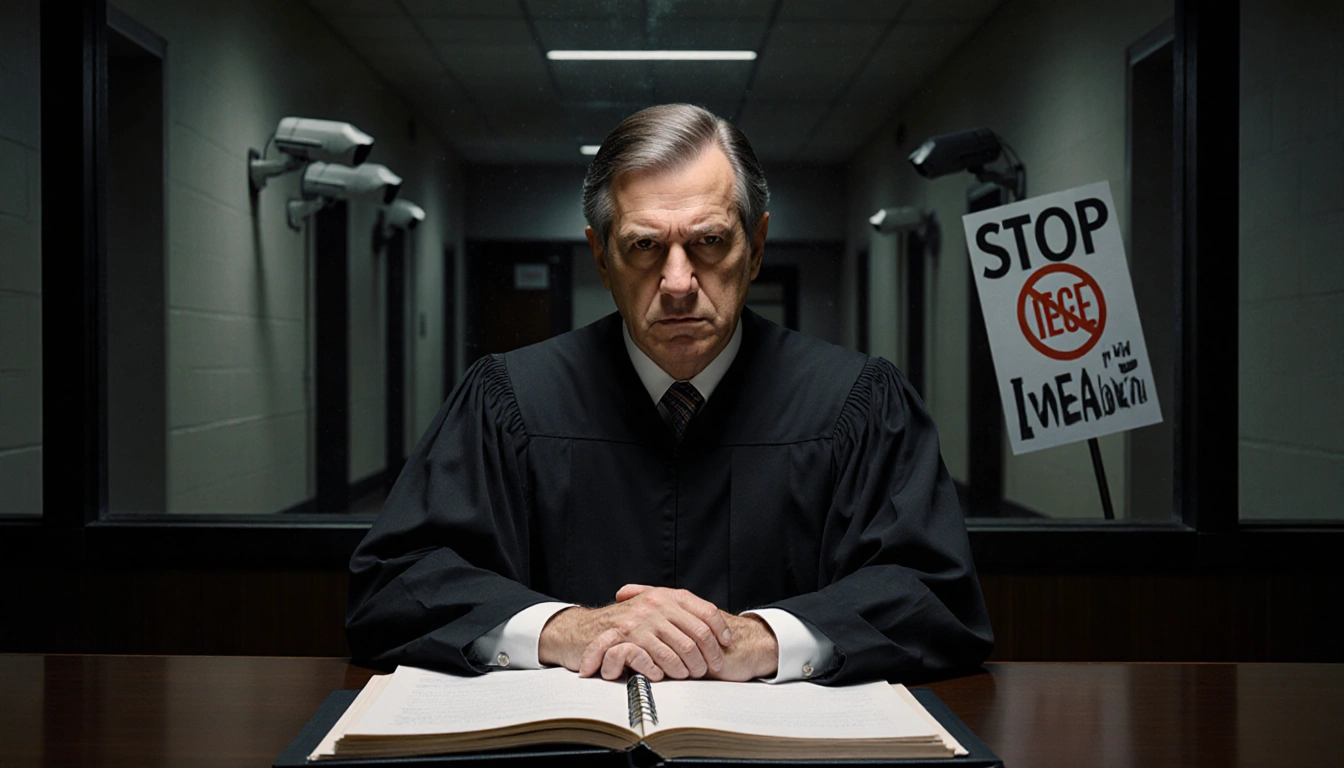
A federal judge in Washington has temporarily blocked the Trump administration from enforcing new rules that would limit how members of Congress can visit immigration detention facilities.
The decision was issued on Wednesday and casts doubt over the legality of a seven-day notice requirement imposed by U.S. Immigration and Customs Enforcement.
The judge’s ruling applies to all ICE detention centers and field offices across the country.
It marks a significant check on the executive branch’s control over congressional oversight.
U.S. District Judge Jia Cobb, appointed by President Joe Biden, found that the notice rule likely exceeds the statutory authority granted to the Department of Homeland Security.
She said that the requirement would prevent timely inspection of facilities during a period of rapid change.
The judge also highlighted the importance of congressional oversight in safeguarding detainee rights.
Her decision therefore restores a more immediate access pathway for lawmakers.
ICE had recently revised its visitor policy, adding a week-long notice period for any member of Congress who wished to tour a detention center.
The policy also excluded ICE field offices from the list of places that could be visited without advance notice.
The change was intended to streamline operations during a surge in immigration enforcement.
Critics argued that it would hinder the ability of lawmakers to monitor conditions.
In her opinion, Judge Cobb wrote that plaintiffs have an interest in facts about whether facilities are overcrowded or unsanitary, whether the staff is engaging in abuse, or the location of constituents or their family members.
She emphasized that the seven-day notice would delay the discovery of such facts.
The judge argued that the statutory framework does not support a delay of that length.
She concluded that the rule likely oversteps DHS’s authority.
Twelve Democratic members of Congress filed the lawsuit in Washington, D.C., in July after they were denied entry to several detention facilities.
The plaintiffs are seeking to challenge ICE’s amended visitor rules and the exclusion of field offices.
They contend that the policies obstruct their constitutional duty to oversee federal operations.
The lawsuit also accuses the Trump administration of obstructing oversight during a nationwide surge.
The lawsuit was filed in the U.S. District Court for the District of Columbia, where the judge sits.
The plaintiffs named the administration’s policies as a direct impediment to their oversight role.
They also highlighted that the policies were enacted during a period of heightened enforcement activity.
Their legal team argued that Congress has a right to inspect facilities in real time.
The defense, representing the federal government, argued that the plaintiffs lacked legal standing to bring the case.
They also claimed that concerns about changing conditions over a week were speculative.
The government asserted that the notice requirement was reasonable and within DHS authority.
They urged the court to dismiss the case on procedural grounds.
Judge Cobb rejected both arguments.
She held that the plaintiffs’ interest in the facts of detention conditions gives them standing.
She also found that the concern about changing conditions is not speculative but grounded in the nature of ICE facilities.
The judge therefore denied the government’s motion to dismiss.
Her ruling emphasizes the real and immediate impact on congressional oversight.
The judge’s quote about changing conditions within ICE facilities highlights the difficulty of reconstructing the state of a facility on a specific day after a week has passed.
She wrote that it is likely impossible for a member of Congress to reconstruct the conditions at a facility on the day that they initially sought to enter.
This reasoning underscores the practical need for timely access.
The judge’s opinion therefore supports the plaintiffs’ position.
The ruling has implications for how ICE will manage visitor requests moving forward.
It signals that the executive branch cannot unilaterally impose delays that would hinder congressional inspection.
The decision may prompt ICE to revise its policies to comply with the court’s findings.
It also reinforces the principle that oversight must be timely and effective.
Congressional oversight of immigration detention facilities has long been a contested area.
Lawmakers have historically used visits to assess conditions and ensure compliance with federal law.
The new policy was seen by many as a restriction on that oversight.
The judge’s decision restores the status quo by removing the unnecessary delay.
The context of the Trump administration’s broader immigration enforcement strategy is also relevant.
The policies were enacted during a nationwide surge in enforcement operations.
Critics argued that the surge was accompanied by increased reports of overcrowding and abuse.
The lawsuit therefore ties the policy change to a broader pattern of executive action.
The political ramifications of the ruling are significant.
It represents a check on the administration’s power to shape access to detention facilities.
The decision is likely to be welcomed by Democratic members of Congress.
Republican lawmakers may view it as a partisan move.
Judge Cobb’s nomination by President Joe Biden places her within a cohort of judges appointed to uphold checks on executive power.
Her ruling aligns with a broader judicial trend of scrutinizing DHS authority.
The decision is consistent with the statutory limits placed on the department.
It reinforces the role of the judiciary in balancing powers.
The statutory authority of DHS is defined in the Immigration and Nationality Act and related statutes.
The judge’s opinion suggests that the seven-day notice requirement exceeds those statutory limits.
She argued that the law does not grant DHS the power to impose such a delay.
This legal reasoning is central to the case.
The ruling is temporary and does not permanently change ICE policy.
It merely blocks enforcement of the current notice requirement until further proceedings.
The court may revisit the issue if ICE or the administration appeals.
The plaintiffs may seek a permanent injunction in future filings.
The impact of this decision will likely be felt across the country.
ICE facilities in all states will have to adjust their visitor protocols.
Congress will be able to schedule visits without the seven-day wait.
The decision could also influence future policy proposals by the executive branch.
The next steps involve ICE reviewing its visitor policy to ensure compliance with the court’s ruling.
The administration may file an appeal or seek a clarification from the court.
Congress may pursue additional legislation to codify the right to timely inspection.
The legal process will continue to unfold.
The ruling underscores the importance of judicial oversight in maintaining the balance between executive authority and legislative oversight.
It demonstrates how a single judge can influence national policy.
The decision will be closely monitored by legal scholars and policymakers alike.
It also serves as a reminder of the role of the courts in safeguarding democratic processes.
In sum, a federal judge has halted the Trump administration’s attempt to impose a week-long notice requirement on congressional visits to ICE detention facilities.
The decision restores the ability of lawmakers to inspect facilities promptly.
The ruling reflects a broader judicial stance on limiting executive overreach.
The case remains a key point of contention in the ongoing debate over immigration enforcement and congressional oversight.