
On Friday the Justice Department faces a looming deadline to release most of its files on Jeffrey Epstein, while Secretary of State Marco Rubio holds a rare formal news conference to address Venezuela, the Russia-Ukraine war, the Gaza ceasefire and other global priorities.
Justice Department Deadline on Epstein Files
A bill signed by President Trump on November 19 gave the Justice Department 30 days to publish the bulk of its records on Epstein, including the investigation into his 2019 death. Deputy Attorney General Todd Blanche told Fox News that the department would release “several hundred thousand” documents today, “and then over the next couple weeks, I expect several hundred thousand more.”
House Democrats, led by Rep. Robert Garcia and Rep. Jamie Raskin, issued a joint statement after a DOJ official announced a partial tranche. They said the department was “now violating federal law” and that they were “examining all legal options.” The statement added that “the survivors of this nightmare deserve justice, the co-conspirators must be held accountable, and the American people deserve complete transparency from DOJ.”
Rubio’s State Department News Conference
In a more than two-hour briefing, Rubio focused on Venezuela, the Russia-Ukraine conflict, the Gaza ceasefire, and U.S. national interests. He said the U.S. “has very strong legal opinions” about its actions and that “nothing has happened that requires us to notify Congress or get congressional approval or cross the threshold into war.”
He described the U.S. effort in the Caribbean as “unusually large” and noted the recent seizure of a tanker with sanctioned oil tied to Nicolás Maduro. On Venezuela, Rubio said the U.S. “is not going to reach a peace deal with narcotrafficking bands” and that “the US has amassed an unusually large force in the Caribbean Sea and the waters off the coast of Venezuela since this summer.”
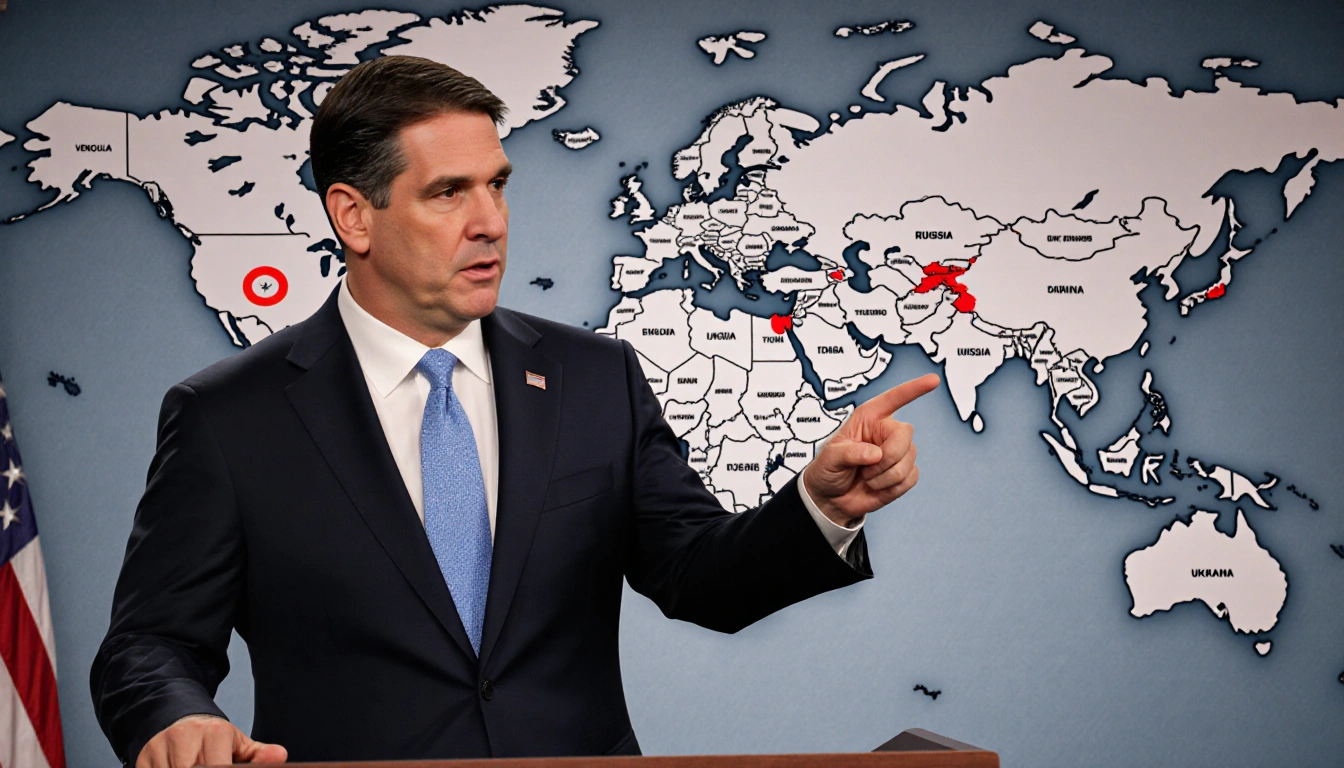
Regarding the Russia-Ukraine war, Rubio said the U.S. is “trying to figure out what can Russia give and what do they expect to get and what can Ukraine get.” He added that the U.S. is “trying to figure out what can Russia give and what do they expect to get and what can Ukraine get.”
On the Gaza ceasefire, Rubio said an “International Stabilization Force” would be built, but that details of daily governance and funding were still being finalized. He called the humanitarian truce “our No. 1 priority” and urged the new year as an opportunity for both sides to agree.
Rubio also spoke about China and Japan, saying the U.S. must “find the things we are able to work together on” with China while reaffirming the U.S. alliance with Japan.
U.N. De-escalation Call on Venezuela
U.N. Secretary-General António Guterres told reporters at New York headquarters that “the situation is obviously very tense.” He said the U.N. has been “consistently appealing for de-escalation, for dialogue, and for international law to be fully respected.”
Maduro had called Guterres on Wednesday, and U.N. Deputy Spokesman Farhan Haq confirmed that the secretary-general reiterated the need for de-escalation and that all 193 member nations, including the United States and Venezuela, must “refrain from the use of force against all other nations and settle all disputes peacefully” under the U.N. Charter.
Other U.S. Foreign-Policy Moves
- Syria sanctions repeal: Congress passed a defense-spending bill that lifted the Caesar Act sanctions, allowing Syrian reconstruction projects to resume.
- Canada-U.S. trade review: Prime Minister Mark Carney said a Canadian delegation would meet U.S. counterparts in mid-January to launch formal discussions on the U.S.-Mexico-Canada Agreement.
- China-Japan relations: Rubio emphasized that the U.S. must work with China while maintaining its alliance with Japan, noting that “China is going to be, is and will continue to be a rich and powerful country and a factor in geopolitics.”
Domestic Politics and Policy Announcements
- Trump’s unemployment claim: The president posted that the unemployment rate rose because “we are reducing the Government Workforce by numbers that have never been seen before.” He also said he could lower the rate to 2 % “overnight by just hiring people into the Federal Government.”
- Health-care priority: A new AP-NORC poll found that 4 in 10 U.S. adults named health care as a top concern for 2026, up from one-third in the previous year.
- Drug-price announcement: White House press secretary Karoline Leavitt said the president would announce “more incredible deals that will lower prices of drugs and pharmaceuticals” at 1 p.m.
- Immigration: A poll reported that 44 % of respondents wanted the government to focus on immigration in 2026, with Democrats showing increased concern.
Miscellaneous Developments
- Kennedy Center name change: The board voted to rename the venue “The Donald J. Trump and The John F. Kennedy Memorial Center for the Performing Arts.”
- Harvard funding appeal: The Justice Department filed an appeal after a federal judge ordered the reversal of billions of dollars in funding cuts to Harvard.
- White House website incident: A YouTuber’s livestream appeared on the White House live-stream page for at least eight minutes, prompting the administration to investigate.
- D.C. immigration arrests: A lawsuit alleges that widespread immigration arrests in Washington, D.C. are unlawful, while the Trump administration claims the operation is a success.
Key Takeaways
- The Justice Department must release most Epstein files by midnight Friday, with a partial release today.
- Rubio’s briefing emphasized U.S. national interests, a large military presence in the Caribbean, and a humanitarian truce in Gaza.
- The U.N. urges de-escalation in Venezuela, citing the U.N. Charter.
- Congress has lifted Syria sanctions, and Canada-U.S. trade talks are scheduled for January.
- Trump’s social-media posts link unemployment to federal workforce cuts and promise rapid job creation.
The day’s events underscore a U.S. government juggling domestic policy announcements, a high-profile foreign-policy briefing, and a legal deadline that could reshape public understanding of a decades-long scandal.
Closing
As the Justice Department approaches its deadline, the nation watches how the release of Epstein documents will intersect with a broader narrative of executive action, congressional oversight, and international diplomacy. Rubio’s lengthy briefing, Guterres’s appeal for de-escalation, and Trump’s domestic policy claims all illustrate a government intent on shaping both the domestic and global stage.