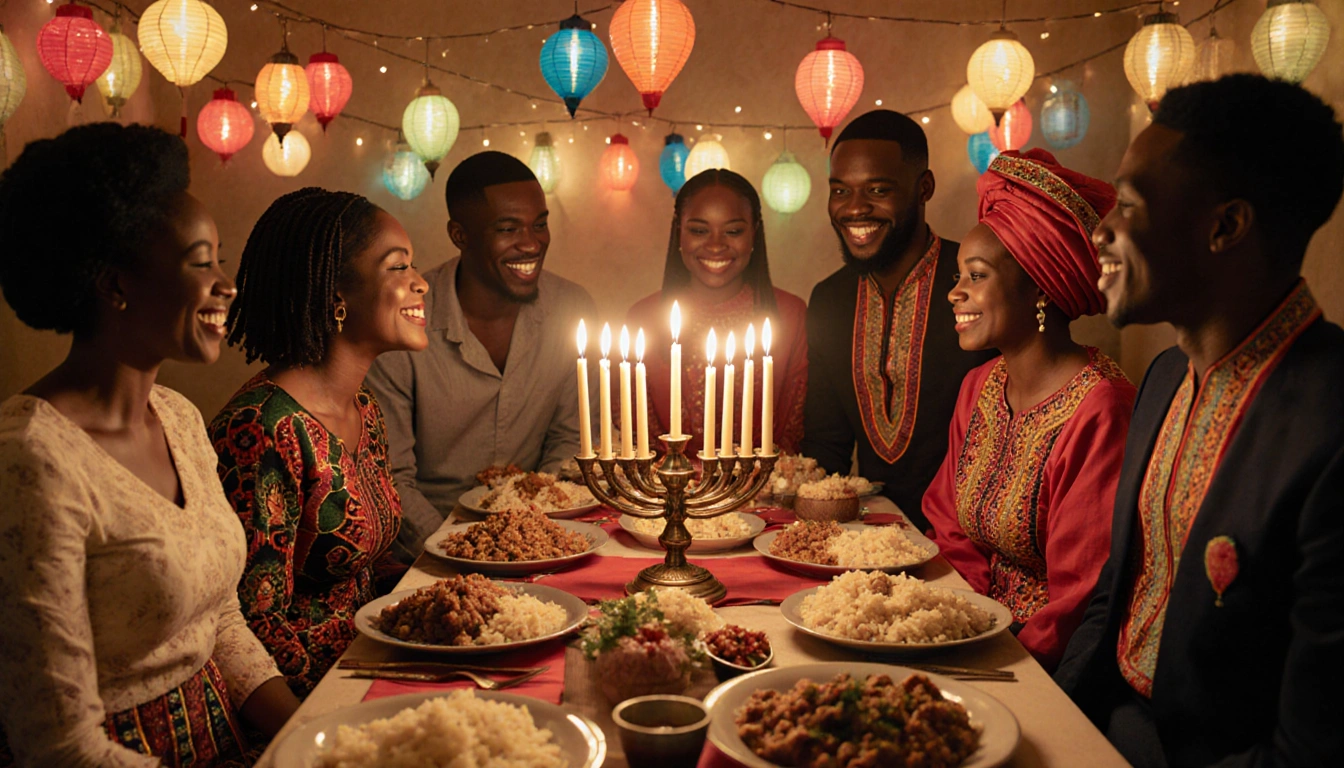
From the day after Christmas to New Year’s Day, a growing 3% of Americans light a seven-candle fire and share a feast that traces its roots back to 1966. The holiday, known as Kwanzaa, has become a nationally recognized celebration of African culture and community in the United States, and it is also observed in countries with large populations of African descendants. Each year, city-sponsored events in places like Los Angeles, Atlanta and Detroit draw thousands, while smaller gatherings in homes and neighborhoods echo the same spirit of unity and self-determination.
Kwanzaa was founded in 1966 during the Black Freedom Movement of the 1960s. It emerged as a way for Black communities in the U.S. to reconnect with African cultural traditions that were severed by the trans-Atlantic slave trade. The holiday also promotes unity and liberation. Following the Watts Riots-also known as the Watts Rebellion-in Los Angeles in 1965, Maulana Karenga, an African American author, activist and professor, created the celebration to honor those struggles.
In his 2023 annual Kwanzaa address, Karenga wrote, “It was also shaped by that defining decade of fierce strivings and struggles for freedom, justice and associated goods waged by Africans and other peoples of color all over the world in the 1960s.” He continued, “Kwanzaa thus came into being, grounded itself and grew as an act of freedom, an instrument of freedom, a celebration of freedom and a practice of freedom.” Karenga later described the holiday as a “political-motivator holiday” in an interview with Henry Lewis Gates Jr. for PBS, emphasizing its role in mobilizing community action.
The name Kwanzaa derives from the Swahili phrase “mutanda ya kwanza,” meaning “first fruits” or “first harvest.” The final “a” was added to accommodate the seven children who attended the first celebration; each child received a letter that represented one of the holiday’s seven principles. These principles, known collectively as the Nguzo Saba, are celebrated one per day:
- Umoja (Unity)
- Kujichagulia (Self-Determination)
- Ujima (Collective Work and Responsibility)
- Ujamaa (Cooperative Economics)
- Nia (Purpose)
- Kuumba (Creativity)
- Imani (Faith)
A candleholder called a kinara holds seven candles, one for each principle. Each night, a candle is lit, and the colors-black, red and green-mirror those of the Kwanzaa flag: black represents the people, red their struggle, and green their hope. Lighting the kinara is a daily ritual that reinforces the community’s shared values.
Large Kwanzaa celebrations feature storytellers, music and dance, while smaller observances in homes often focus on children, who are seen as key to preserving culture and fostering community. This focus is symbolized by corn, a staple that represents the future and the nourishment of the community. “The idea is for African and African descended people to come together around family, community and culture so we can be in spaces where, in Dr. Karenga’s words, we feel fully African and fully human at the same time,” said Janine Bell, president and artistic director at the Elegba Folklore Society in Richmond, Virginia.
Family celebrations also involve gift-giving and sharing African American and Pan African foods. The week culminates in a Karamu, a feast featuring dishes from across the African diaspora. Typical meals include Southern staples such as sweet potato pie and African favorites like jollof rice. “The intention is that it’s 365 (days a year),” Bell said. “The need for the principles and the strengthening value of the principles don’t go away on January 2nd.”
Activities over the seven days are designed to reaffirm community bonds, commemorate the past and recommit to important African cultural ideals. Participants may dance, read poetry, honor ancestors and light the kinara each night. These practices keep the spirit of Kwanzaa alive beyond the holiday’s official dates.
According to a 2019 AP-NORC survey, 3% of the U.S. population celebrates Kwanzaa. Former Presidents Bill Clinton, George W. Bush and Barack Obama have all released statements commemorating the holiday, and in 1997 the U.S. Postal Service began issuing Kwanzaa stamps. Despite its widespread observance, Kwanzaa is not recognized as a federal holiday.
Kwanzaa continues to grow in popularity and remains a powerful reminder of the resilience and unity of African-descended communities across the United States. By celebrating shared principles and cultural heritage, the holiday strengthens bonds that endure well beyond its seven days.
This story was first published on Dec. 19, 2024.