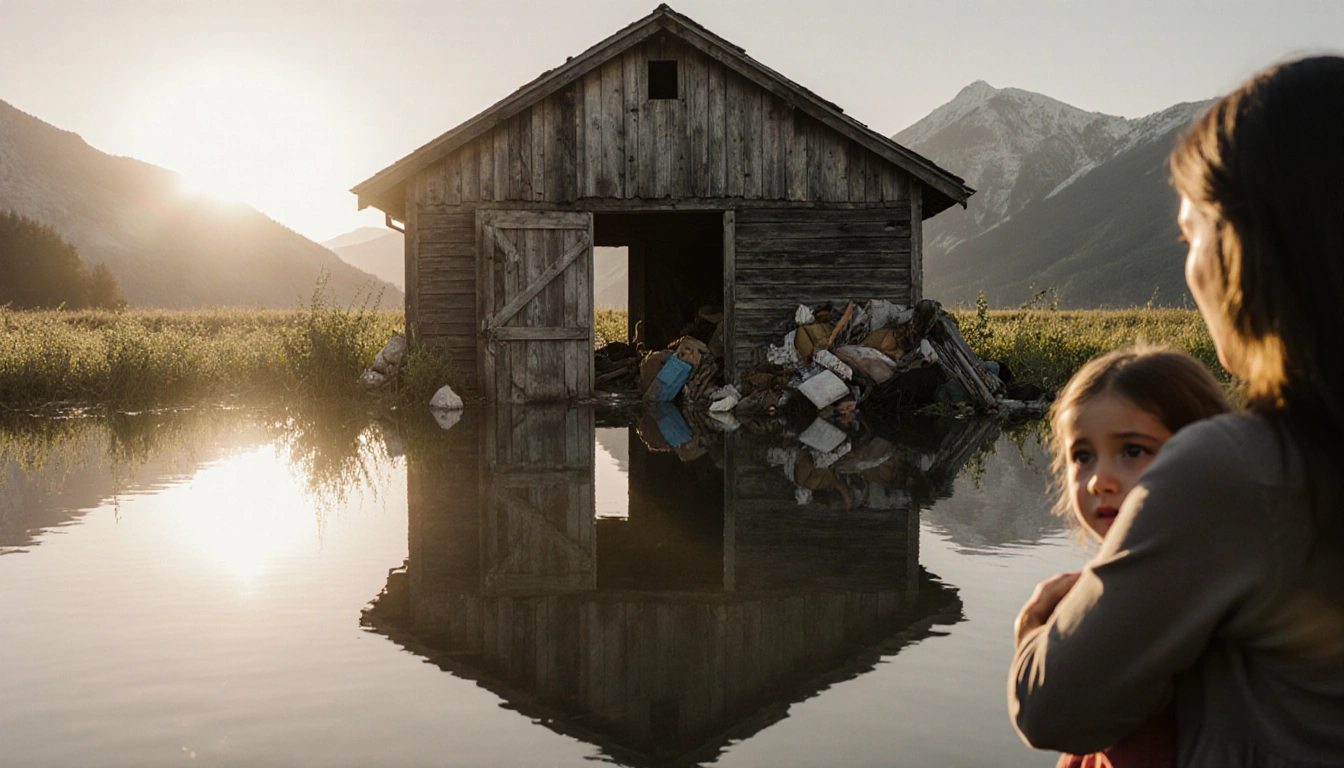
In a dramatic turn of events, a Kenyan family woke up to find their home and farm submerged beneath Lake Naivasha’s rising waters. The Ngome family, who had leased a 1.5-acre plot in 2008, were only 2 km from the shore when they first settled there, but by late October 2024 the lake had risen a foot overnight, swallowing their house and fields.
Rising Waters
The lake’s levels have been creeping closer to the shore since 2011, and early rains in September this year did not let up. On a morning in late October, the Ngomes and their four children awoke to find the first floor of an abandoned school flooded. “It seemed as if the lake was far from our homes,” Ngome’s wife, Rose Wafula, told The Associated Press. “And then one night we were shocked to find our houses flooded. The water came from nowhere.”

Impact on Communities and Economy
The sudden flooding displaced about 5,000 people across the Rift Valley. The lake, a popular tourism spot, is surrounded by flower farms that have gradually been swallowed by the water. Kenya’s horticulture sector, worth just over a billion U.S. dollars in 2024, supplies 40% of the roses sold in the European Union. “Lake Naivasha has risen steadily too, engulfing three quarters of some flower farms,” Onywere said.
Scientific Explanations and Historical Context
Researchers point to increased rainfall as a key driver. “There are researchers who come up with drivers that are geological, others with reasons like planetary factors,” Muita said. “The Kenya Meteorological Department found that the water level rises are associated with rainfall patterns and temperature changes. When the rains are plentiful, it aligns with the increase in the levels of the Rift Valley lake waters.” He added that sediment from agricultural activities also feeds the lakes. “From the research I have read, there’s a lot of sediment, especially from agricultural related activities, that flows into these lakes,” Muita said.
A 2021 study on the rise of Kenya’s Rift Valley lakes was co-authored by Muita. A Journal of Hydrology study last year found that lake areas in East Africa increased by 71,822 km² between 2011 and 2023, displacing more than 75,000 households across the Rift Valley by 2021.
Government Response and Future Challenges
Lake Naivasha’s official high water mark, set at 1,892.8 m above sea level in 1906, remains the benchmark used by surveyors. This year’s flooding was still almost a meter (3 ft) below that mark, yet the Ngome family lives on riparian land that can only be owned by the government. Silas Wanjala, general manager of the Lake Naivasha Riparian Association, said the land situation is a “mess established by the government … towards the late 1960s.” He explained that a farmer was given a “temporary agricultural lease” on Kihoto, and after the land flooded the farmer left, but the workers stayed and later applied for subdivisions that were approved.
Nakuru County, which oversees Lake Naivasha, is treating the crisis as an emergency. “We are tackling this as an emergency,” says Joyce Ncece, chief officer for disaster management in Nakuru County. “The county government has provided trucks to help families relocate. We have been helping to pay rent for those who lack the finances.”
Scientists like Onywere and Muita hope for longer-term solutions. Onywere asked, “Could we have predicted this so that we could have done better infrastructure in less risk-prone areas?” Muita wants a global effort to combat climate change and local, nature-based solutions such as “conservation agriculture, where there is very limited disturbance of the land,” to reduce sedimentation.
Key Takeaways
- Lake Naivasha’s rising waters have displaced 5,000 people and threatened the flower industry.
- Scientific studies link the rise to increased rainfall and sediment runoff.
- Government and local authorities are providing emergency aid, but long-term solutions remain uncertain.
The Ngome family remains in the abandoned school, uncertain when, if ever, their farm will return to dry land as Lake Naivasha continues to rise over the past 15 years.