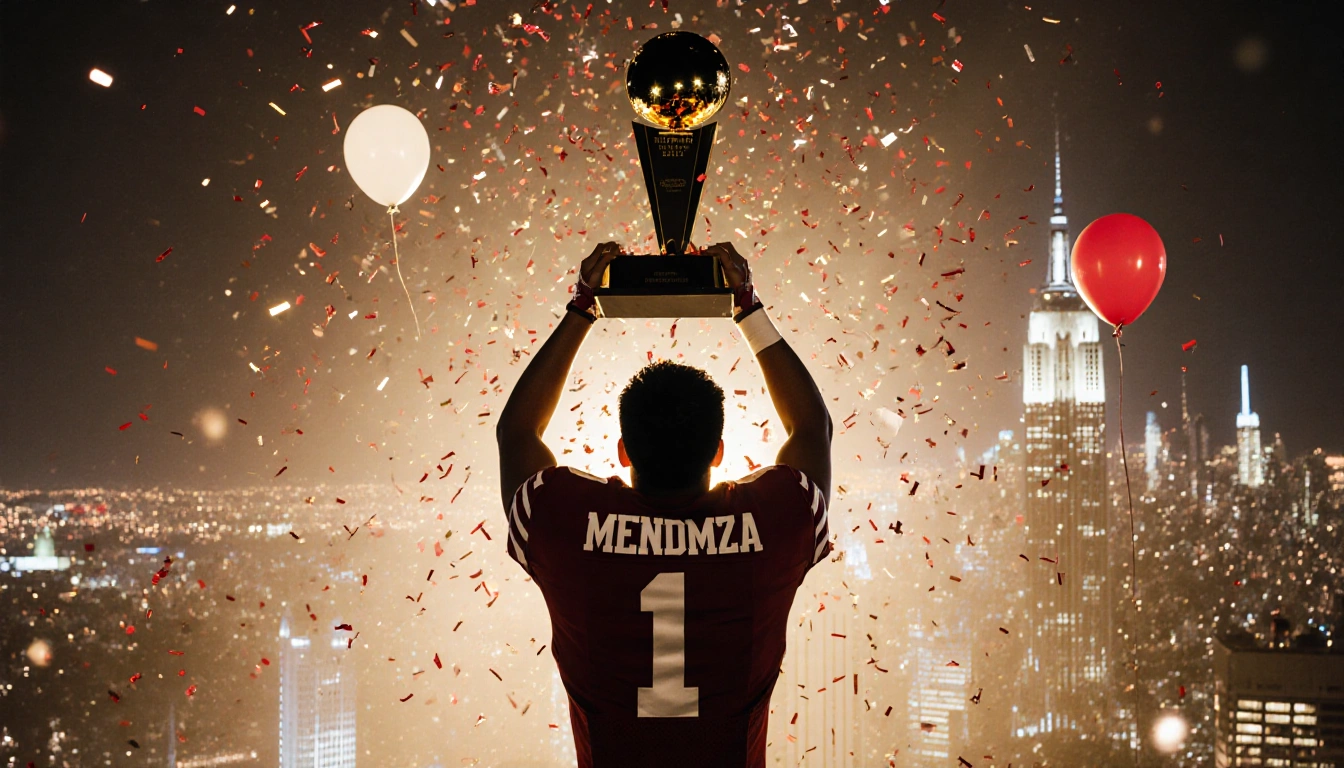
In a dazzling display that lit up New York City, Fernando Mendoza, the spirited quarterback of No. 1 Indiana, secured the Heisman Trophy on Saturday night, becoming the first Hoosier to claim the award since its inception in 1935.
A Record‑Breaking Performance
Mendoza amassed 2,362 points, earning 643 first‑place votes, and finished ahead of Vanderbilt’s Diego Pavia (1,435 points), Notre Dame’s Jeremiyah Love (719 points) and Ohio State’s Julian Sayin (432 points). He was named on 95.16% of all ballots, tying Marcus Mariota for the second‑highest percentage in the award’s history, and received 84.6% of the total possible points, the seventh‑highest in Heisman history.

“I haven’t seen the numbers yet,” Mendoza said. “But it’s such an honor to be mentioned with these guys (Pavia, Love and Sayin). It’s really a credit to our team. It’s a team award.”
He also finished first in all six Heisman regions, the first player to do so since Caleb Williams in 2022.
Indiana’s Historic Run
Mendoza guided the Hoosiers to their first No. 1 ranking and the top seed in the 12‑team College Football bracket. He threw for 2,980 yards and a national‑best 33 touchdown passes, while also running for six scores. Indiana remains the last unbeaten team in major college football and will face a College Football Playoff quarterfinal in the Rose Bowl on Jan. 1.
Mendoza, a redshirt junior and the Hoosiers’ first‑year starter after transferring from California, led an offense that surpassed program records for touchdowns and points set during the previous season’s surprise CFP run.
He is the second Heisman finalist in Indiana history, joining 1989 runner‑up Anthony Thompson. He is the seventh Hoosier to earn a top‑10 finish in Heisman balloting and marks another first for the program—having back‑to‑back players in the top 10, with Kurtis Rourke finishing ninth last year.
A Personal Journey
The once lightly recruited Miami native is a redshirt junior and the second Heisman finalist in school history. He grew up in America but has Cuban heritage; “Although I grew up in America, my four grandparents are all from Cuba,” he said. “I had the opportunity to go there and that was important to me. I credit the love to my grandparents and the Hispanic community.”
Mendoza’s teammates chanted “HeismanDoza” as he addressed the media, recalling how a realistic chance of winning the award seemed to appear after the Hoosiers routed No. 19 Illinois 63‑10 on Sept. 20. “At that point my boys said we might make it to New York (for the award ceremony),” he said. “It was lighthearted at the time, but that’s when it started.”
The Finalists
Diego Pavia – Vanderbilt
Pavia finished second with 189 first‑place votes. He threw for a school‑record 3,192 yards and 27 touchdowns, leading the Commodores to a 10‑win season and six wins against SEC foes, including four over ranked programs. Vanderbilt reached No. 9, its highest ranking in the AP Top 25 since 1937. Pavia is the first Heisman finalist in Vanderbilt history and the third school for him, having moved through junior college, New Mexico State and finally Vanderbilt via the transfer portal. He will play in the ReliaQuest Bowl against Iowa on Dec. 31.
Jeremiyah Love – Notre Dame
Love, a junior from St. Louis, finished fourth in the FBS in rushing yards (1,372), fifth in per‑game average (114.3) and third with 18 rushing touchdowns. He produced a 98‑yard run against Indiana in the first round of last year’s playoffs and a 94‑yard run against Boston College earlier this season. Love is the first player in Notre Dame history to record multiple 90‑plus‑yard rushing touchdowns.
Julian Sayin – Ohio State
Sayin led the Buckeyes to a No. 1 ranking for most of the season, throwing for 3,329 yards and tying for second in the country with 31 touchdown passes. The sophomore arrived at Ohio State after committing to Alabama and entering the transfer portal following a coaching change. He played four games last season before winning the starting job and helped the Buckeyes stay atop the AP Top 25 for 13 straight weeks, tying the program’s second‑longest run.
Awards and Accolades
Mendoza was named Associated Press player of the year earlier this week and received the Maxwell and Davey O’Brien awards Friday night. Love won the Doak Walker Award. The Heisman Trophy presentation followed these accolades.
Mendoza is the 43rd quarterback to win the Heisman and the second winner of Latin American descent, after Stanford’s Jim Plunkett in 1970.
The Transfer Portal’s Impact
Mendoza and Pavia illustrate the changing landscape of the transfer portal in college football. Mendoza is the seventh transfer to win the award in the last nine years. Vanderbilt’s Pavia is the third school for him. Their success highlights how the portal has become a strategic tool for programs seeking talent.
Key Takeaways
- Fernando Mendoza becomes the first Indiana player to win the Heisman Trophy, securing 2,362 points and 643 first‑place votes.
- Indiana remains unbeaten, will play the Rose Bowl CFP quarterfinal on Jan. 1, and has set new program records for passing yards and touchdowns.
- The transfer portal continues to shape college football, with Mendoza and Pavia both exemplifying its impact on player careers.
The Heisman Trophy’s latest chapter underscores the rise of Indiana football and the growing influence of the transfer portal in shaping the sport’s future.