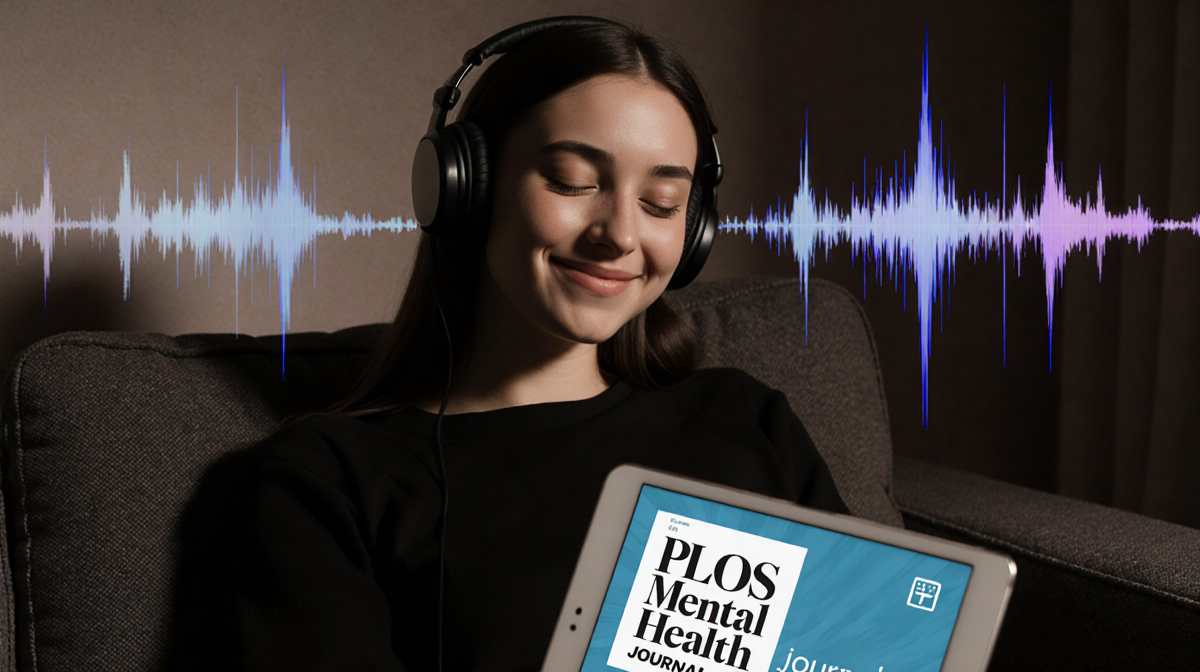
A recent clinical trial suggests that a short session of music combined with auditory beat stimulation can lower anxiety symptoms in patients already taking medication. The study, published this month in PLOS Mental Health, involved 144 participants from Toronto and the UK and compared music plus beat stimulation to pink noise control.
At a Glance
- 144 participants in a randomized trial
- Music + auditory beat stimulation cut anxiety more than pink noise
- 24-minute sessions were the most effective
- Results support music as a low-cost adjunct to anxiety treatment
Why it matters: The findings give clinicians a potential, inexpensive tool to help patients manage anxiety when other options are limited or costly.
Study Design
The researchers recruited adults who were already taking at least one medication for anxiety. They randomly assigned participants to one of four groups:
- Control: 12 minutes of pink noise
- 12-minute music + ABS
- 24-minute music + ABS
- 36-minute music + ABS
Pink noise- a steady, waterfall-like sound-served as a neutral auditory stimulus. The music sessions used soothing tracks paired with auditory beat stimulation (ABS), a technique that plays two slightly different low-frequency tones to create a pulsing beat.
The trial followed a within-subject design, so each participant’s anxiety levels were measured before and after their assigned session. The study’s aim was to see whether the length of music + ABS exposure affected the magnitude of anxiety reduction.
Findings
Participants who listened to music plus ABS reported a significant drop in anxiety symptoms compared with those who heard pink noise. The 24-minute group showed the greatest overall improvement, while the 36-minute group also benefited, though not as markedly.
“This study provides further support for the contention that music listening can be used to reduce state anxiety in individuals with a clinically significant level of trait anxiety,” the authors wrote. They noted a clear dose-response pattern, with 24 minutes emerging as the sweet spot.
Frank Russo, a professor of psychology at Toronto Metropolitan University, explained, “What we’re seeing is a dose-response pattern where about 24 minutes of music with ABS seems to be the sweet spot. It’s long enough to meaningfully shift anxiety levels, but not so long that listeners need to carve out a large block of time.”
Implications for Treatment
The researchers caution that music + ABS is not a cure. The effect size is medium-level, and more extensive trials are needed to confirm the results. Nevertheless, the technique could become a valuable, low-cost adjunct to existing anxiety treatments.
Current anxiety interventions-such as medication side effects and the high cost of cognitive behavioral therapy-often limit accessibility. In contrast, a 24-minute music session can be delivered in a clinic, at home, or even on a smartphone app.
“These findings support music with ABS as a possible addition to existing anxiety treatments, especially when access to common behavioral health interventions is limited,” the authors added.
Future Directions
The team plans larger studies to validate and quantify the early results. Future research could explore:
- Different musical genres and tempos
- Long-term effects of repeated sessions
- Integration with digital health platforms
The study also builds on a 2022 investigation that found 24 minutes of music + ABS reduced anxiety. Replicating those results in a larger, international sample strengthens confidence in the approach.
Key Takeaways
- A 24-minute music session with auditory beat stimulation can reduce anxiety in patients on medication.
- The effect is medium-level and needs confirmation in larger trials.
- Music + ABS offers a low-cost, accessible adjunct to traditional anxiety treatments.
Clinicians and patients may consider incorporating short music sessions into treatment plans, especially where other options are limited or expensive.