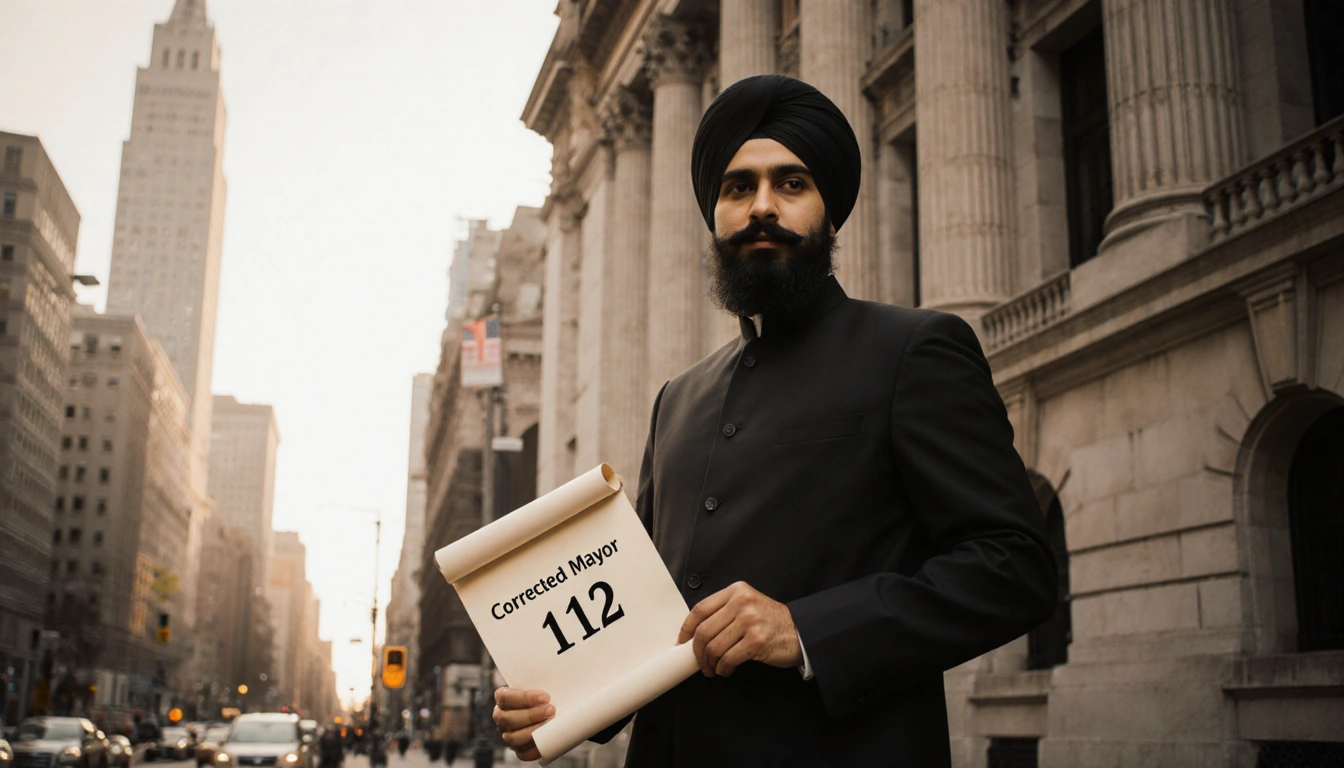
When Zohran Mamdani takes the oath on Jan. 1, he will not only become New York City’s first Muslim mayor but also the 112th mayor-a number that has been corrected only after a historian uncovered a centuries-old miscount.
The Unexpected Number
The unexpected number comes from a long-standing omission in the city’s official list of mayors. The list, which has been used by city officials, historians, and the public for over a century, omitted the second term of Matthias Nicolls, who served as mayor in 1671-72 and again in 1674 after a brief Dutch invasion. Because Nicolls was counted only once, every mayor who followed him has been numbered one lower than their actual position.
The Historian Behind the Correction
If the correction is applied, the numbering of every mayor since William Dervall, who would become No. 9, is shifted. The current mayor, Eric Adams, would be renumbered as No. 111 instead of No. 110, and Mamdani, who was expected to be No. 111, would become No. 112.
The discovery was made by Paul Hortenstine, an independent historian who specializes in the early history of New York City. Hortenstine, who once worked on Michael Bloomberg’s 2009 reelection campaign, noted that the omission had been “much more difficult than it appears at first glance.” He has been advocating for a more accurate record of the city’s leadership.
Hortenstine’s research also highlighted that other mayors who served nonconsecutive terms were counted twice, but Nicolls was not given the same treatment. He believes that the debate over the numbering will spark renewed interest in the city’s colonial past and its entanglement with slavery.
The City’s Response and Archival Findings
The issue first drew public attention when the online news site Gothamist posted about the apparent miscount. The city Department of Records and Information Services responded by reviewing the archival material and consulting with experts.
Archivist Michael Lorenzini, who wrote a blog post on Dec. 11, traced the gaps in the city’s records. He explained that when the city began printing lists of past mayors in the mid-1800s, Nicolls’ second term was omitted. Lorenzini wrote that on Jan. 1, 2026, Mamdani should be mayor number 112, adding that the numbering of New York City “mayors” has been somewhat arbitrary and inconsistent.
Lorenzini also pointed out that the list does not include the burgomasters-mayor-like officials who served in pairs during some periods of Dutch governance-or any Native American leaders who lived in the area before colonization. He noted that some acting mayors are mentioned but not awarded numbers, except in a more obscure version of the list found in a 2015 city archives document.
The city’s leadership has acknowledged the oversight. Mayor-elect Mamdani told reporters Wednesday that he was “excited to be whichever mayor” after learning about the counting contretemps. He said the situation shows how tricky history’s arithmetic can be.
Lorenzini said, “In some ways, it is a sort of academic exercise,” but added that “history is still alive.” He believes that the existence of these records allows people to continue exploring and debating the city’s past.
The Broader Implications
The correction also highlights how the definition of a mayor has changed over time. The first mayor led a city that consisted only of Manhattan, whereas the modern mayor oversees all five boroughs. This evolution complicates the task of assigning a single number to each leader.
The city’s Department of Records and Information Services is expected to update the official list of mayors to reflect the corrected numbering. The updated list will likely be used in future official documents, commemorations, and historical publications.
While the change may seem minor, it underscores the importance of accurate historical record-keeping and the ways in which small errors can influence public perception of civic history.
Key Takeaways
- Zohran Mamdani will be New York City’s 112th mayor, not 111th, after a record-keeping error was uncovered.
- The omission stemmed from Matthias Nicolls’ second term being left out of the official mayoral list.
- Historian Paul Hortenstine’s investigation prompted the city’s Department of Records to revise the numbering and highlight gaps in the city’s historical record.
The city’s 112th leader will welcome a new era, but the corrected numbering reminds residents that even the most established institutions can still have gaps in their chronicles, inviting scholars and citizens alike to revisit the city’s past and ensure its leaders are accurately remembered.