
At a Glance
- Prism is an AI-native workspace that lets scientists write, collaborate, and search literature in one place.
- It is built on the cloud LaTeX platform Crixet and powered by GPT-5.2 Thinking.
- The service is free for individual ChatGPT users and will expand to paid plans with more AI features.
Why it matters: It could streamline research workflows but raises concerns about data usage and scientific quality.
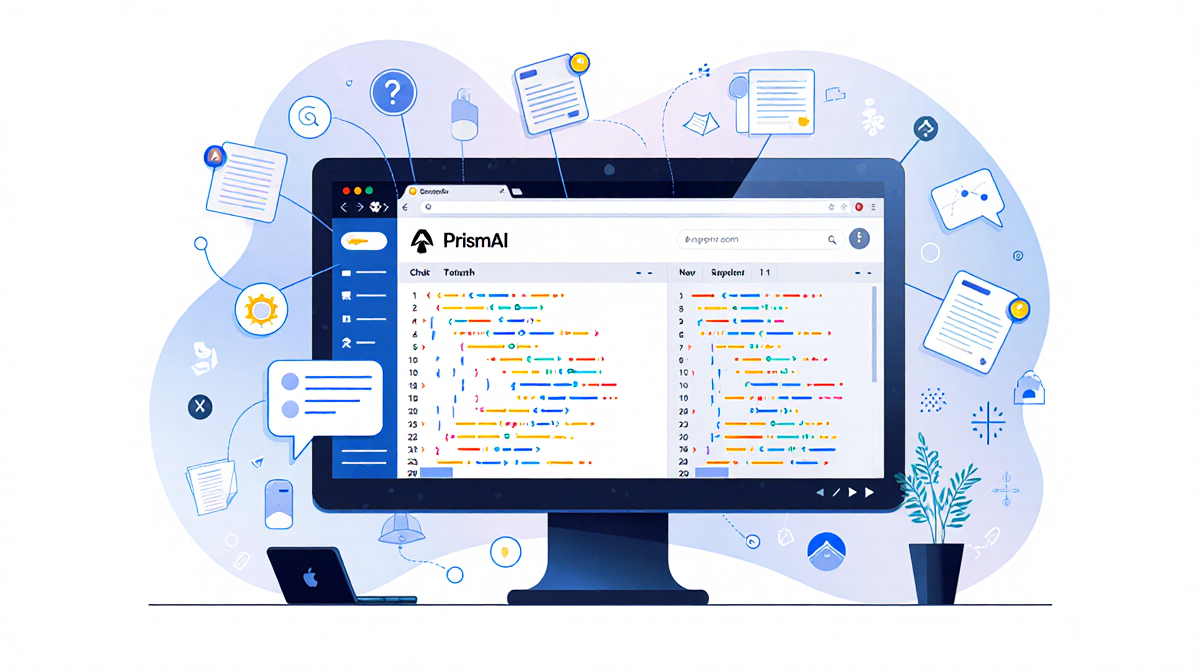
Prism, announced on Tuesday, is OpenAI’s answer to the fragmented tools that researchers currently juggle-PDF readers, LaTeX editors, reference managers, and chat services. The goal is a unified platform that keeps scientists focused on science instead of software.
What Prism Offers
OpenAI says the workspace lets researchers draft and revise papers directly, search for relevant literature, and use AI to create, refactor, and reason over equations, citations, and figures. Multiple users can edit and comment in real time. The experience is designed to feel like a natural extension of existing research habits.
Key features include:
- Integrated LaTeX editing powered by the Crixet cloud platform.
- AI-assisted literature search that surfaces context for citations.
- Real-time collaboration with comment threads.
- AI tools for equation generation and figure creation.
The platform is built on GPT-5.2 Thinking, the model OpenAI calls its most advanced for extended tasks and reasoning.
How It Works
Prism runs in the browser and connects to OpenAI’s API. Researchers with a personal ChatGPT account can create unlimited projects and invite collaborators. The service will roll out to organizations using ChatGPT Business, Enterprise, and Education plans soon. Over time, more powerful AI features will be added to paid plans.
OpenAI’s FAQ explains that Prism does not currently use the Zero Data Retention (ZDR) API option. The company states:
> “Prism does not currently use the ‘Zero Data Retention’ (ZDR) API option and maintains logs for a period after requests to improve the product.” – OpenAI
Additionally, OpenAI claims:
> “Prism does not train on API-provided data by default for many API customers.” – OpenAI
A roadmap for a mode that stores no text or human-reviewed data exists, but no timeline is available.
Potential Risks
The promise of AI-powered writing has not come without controversy. A study by UC Berkeley Haas and Cornell University found that scientists using generative AI see output increases of up to 50%, but the papers they publish often have marginal scientific merit. The research also showed that human authors produce better work as complexity rises, whereas LLM-written papers deteriorate.
Earlier this year, the journal Frontiers in Cell and Developmental Biology published a paper that included an AI-generated image of a rat with an unusually large penis and multiple testicles. The incident highlighted how AI can flood the literature with dubious content.
Moreover, the platform’s free nature raises questions about data ownership. Researchers may worry that their unpublished work is being used to train models or improve OpenAI’s services.
Data and Privacy
OpenAI’s FAQ clarifies that Prism keeps logs after requests to improve the product. The company also notes that it does not train on API-provided data by default. While a future mode that does not store data is planned, there is no release date.
The concern is that the platform, while free, could still be collecting valuable research content. Users are encouraged to review the privacy policy and consider whether their data should be shared.
Availability and Pricing
- Individual users: Free, unlimited projects, and collaborators.
- Organizations: Upcoming rollout to ChatGPT Business, Enterprise, and Education plans.
- Paid plans: Will offer more powerful AI features over time.
Prism’s free tier aims to attract early adopters and gather feedback before expanding to paid tiers.
Takeaways
- Prism is OpenAI’s attempt to centralize the research workflow, integrating LaTeX editing, literature search, and AI-assisted content creation.
- The platform is powered by GPT-5.2 Thinking and built on the Crixet cloud LaTeX platform.
- While free for individuals, data retention policies raise privacy concerns.
- Studies show that AI can boost output but may reduce scientific quality, especially as complexity increases.
- OpenAI plans to expand Prism to organizations and add paid AI features in the future.
The launch of Prism underscores the growing role of AI in research but also highlights the need for careful consideration of data practices and scientific integrity.