At a Glance
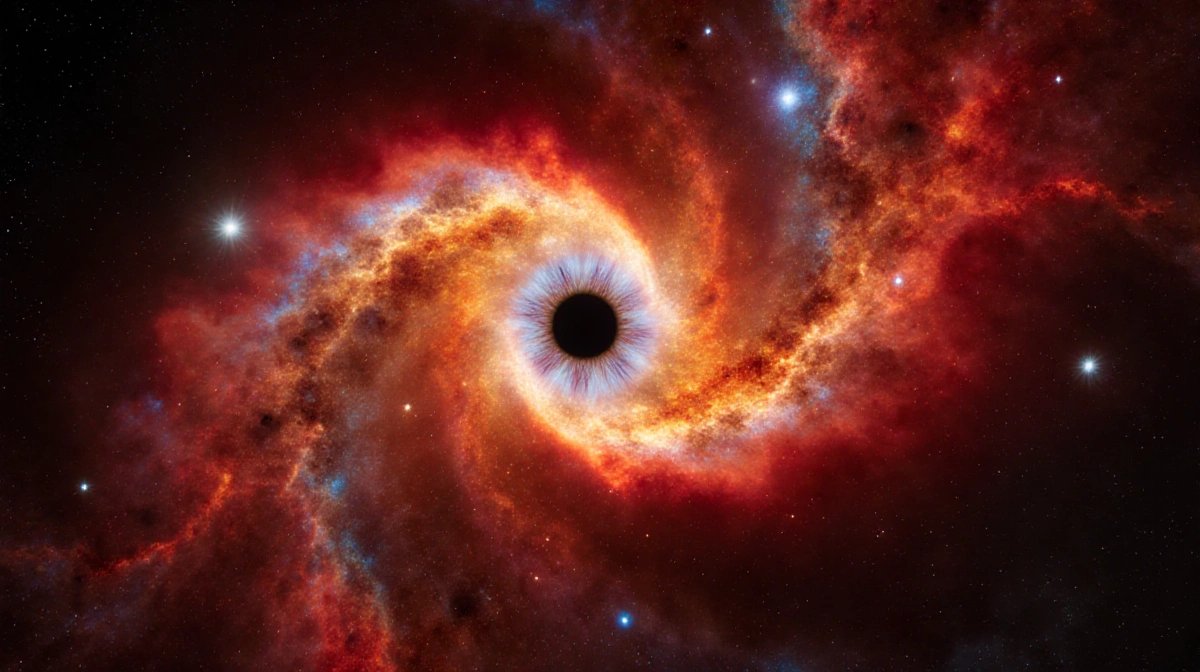
- The James Webb Space Telescope captured a zoomed-in image of the Helix Nebula, revealing comet-like knots and stellar winds.
- The nebula sits 650 light-years from Earth in Aquarius and is one of the closest bright planetary nebulae.
- The image shows a clear transition from hot ionized gas near the white dwarf to cooler molecular hydrogen and dust farther out.
Why it matters: The photo gives astronomers a detailed look at how a dying star releases material that may seed future planetary systems.
The James Webb Space Telescope’s newest image of the Helix Nebula offers an unprecedented view of the final stages of a dying star. The photograph shows layers of gas and dust that are being reshaped by intense winds and radiation. Astronomers can now study how the star’s material will disperse into the galaxy.
What the Image Shows
The image was taken with Webb’s Near-Infrared Camera (NIRCam), which provides high-resolution views in wavelengths that penetrate dust clouds. The close-up focuses on a small portion of the nebula, revealing structures that were previously unresolved.
Comet-like knots appear as bright, elongated features that trail behind the central star. They are likely dense clumps of gas that resist the star’s outflow.
Blazing stellar winds, visible as bright blue filaments, are the result of fast, hot gas rushing from the white dwarf. These winds collide with slower, cooler material that the star shed earlier.
The interaction between fast and slow winds creates the nebula’s distinctive shape. The collision zones are where the hottest gas meets the coolest, producing shock fronts.
- Comet-like knots: dense, elongated gas clumps.
- Stellar winds: hot, fast-moving gas.
- Layered shells: alternating hot and cool gas.
- Dust pockets: protective clouds where complex molecules may form.
The Structure of the Nebula
At the heart of the Helix Nebula lies a white dwarf that is the remnant core of the original star. The white dwarf emits strong ultraviolet radiation that ionizes the surrounding gas.

The radiation lights up the gas, creating a series of concentric layers that resemble a cosmic lasagna. Each layer has a different temperature and chemical composition.
The innermost layer consists of hot, ionized gas that is directly exposed to the star’s radiation. Moving outward, the gas cools and becomes molecular hydrogen.
Farther still, dust forms in the coolest regions. These dust grains can shield molecules from harsh radiation, allowing more complex chemistry to develop.
- Hot ionized gas: closest to the white dwarf.
- Cool molecular hydrogen: found in the middle layers.
- Dust clouds: outermost, where temperatures are lowest.
Color Coding and Temperature
Webb’s imaging system uses color to represent temperature. The blue hue marks the hottest gas, energized by intense ultraviolet light from the white dwarf.
Yellow regions indicate gas that has cooled enough for hydrogen atoms to pair into molecules. The reddish tones at the outer edges show the coolest material, where dust begins to form.
| Color | Temperature | Description |
|---|---|---|
| Blue | >10,000 K | Hot ionized gas |
| Yellow | ~5,000 K | Molecular hydrogen |
| Red | <2,000 K | Dust formation zone |
The color mapping allows scientists to quickly assess the physical conditions throughout the nebula.
Historical Context
The Helix Nebula was first spotted in the 1800s by early astronomers. Its distinctive eye-shaped appearance earned it nicknames such as the Eye of Sauron and the Eye of God.
Located in the constellation Aquarius, the nebula is one of the brightest planetary nebulae visible from Earth. Its proximity-just 650 light-years-makes it a prime target for detailed study.
Over the decades, ground-based telescopes and space observatories have examined the Helix Nebula, but Webb’s resolution brings new clarity to its inner workings.
What This Means for Stellar Evolution
The image provides a glimpse into the future of stars like the Sun once they reach the end of their life cycle. The material shed by the dying star is recycled into the interstellar medium.
The comet-like knots and dust pockets may serve as the raw material for new planetary systems. Complex molecules can form within the protective dust clouds, potentially seeding future chemistry.
By studying the Helix Nebula, astronomers gain insight into the processes that recycle stellar material and how new stars and planets may eventually arise from the remnants of old ones.
In summary, Webb’s image of the Helix Nebula offers a detailed look at the interplay between a white dwarf’s radiation, stellar winds, and surrounding gas. The photograph deepens our understanding of how dying stars enrich the galaxy and lay the groundwork for future generations of stars and planets.