
Ski jumping is a sport where athletes glide down a ramp, launch into the air, and aim for distance and style. A recent scandal has shown that the outcome can hinge on a few extra centimeters of fabric. The world’s top athletes and governing bodies are now tightening rules to keep the sport fair.
At a Glance
- A Norwegian team was caught adding extra material to the crotch of ski-jumping suits.
- New FIS rules now require 3-D measurements and tamper-proof microchips.
- The cheating cost Norway a world-championship silver and led to 18-month bans for three officials.
- Why it matters: The sport’s reputation and athletes’ careers are on the line.
The scandal erupted when video evidence showed Norwegian officials sewing extra fabric into the suits of two male jumpers before the men’s large-hill event. The added material was designed to stiffen the suit and increase surface area, giving the jumpers a measurable advantage.
The extra fabric was not detected during normal inspections because it was sewn into the crotch area. Only after the contest were the seams examined, revealing the tampering.
The cheating had a direct impact on the competition. Defending Olympic large-hill champion Marius Lindvik, who had won gold in 2022, was stripped of a world-championship silver medal. The incident also brought shame to Norway, the country that invented ski jumping.
The three officials involved-head coach Magnus Brevik, assistant coach Thomas Lobben, and staff member Adrian Livelten-were banned for 18 months. They were charged with tampering with the suits.
“We regret it like dogs, and I’m terribly sorry that this happened,” Brevik said at the time of the ban.
The two jumpers who wore the altered suits-Marius Lindvik and Johann André Forfang-accepted three-month suspensions. They were not charged with knowledge of the alterations, but the FIS said they should have questioned the changes made at night.
The discovery sparked outrage in the ski-jumping community. Former German Olympic champion Jens Weissflog called the act “doping” in a German newspaper, adding that it was a different form of cheating.
In response, the International Ski Federation (FIS) overhauled its rules. They hired former Austrian ski jumper Mathias Hafele as an equipment expert and appointed a new coordinator to oversee gear screening.
“He used to make a living off of trying to make the most out of the rule book,” said FIS spokesman Bruno Sassi. “Now he’s on our side putting together the new rule book.”
Before each competition, two FIS controllers and a doctor will use improved 3-D measurements to evaluate athletes’ uniforms. The new suit shapes make it harder to tamper with cuffs and reduce the ability to lower the crotch for extra surface area.
After a suit passes the control checkpoint, tamper-proof microchips are affixed throughout the suit. Scanners can then confirm that the chips are in place before and after the jump.
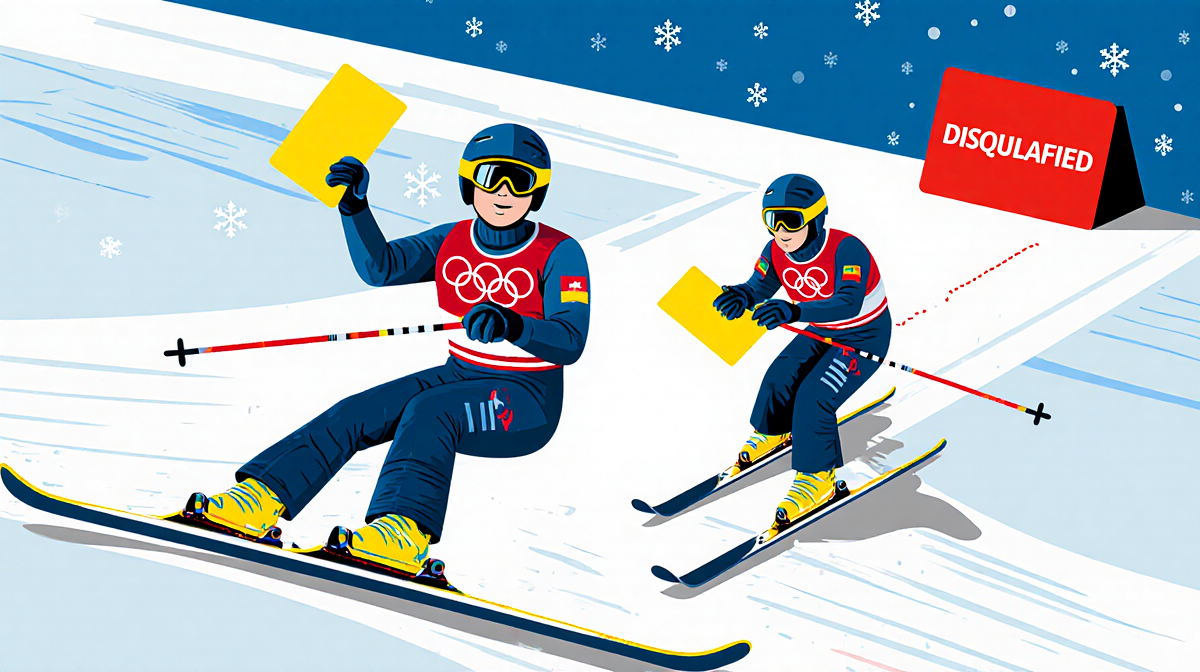
A disciplinary system similar to soccer will be applied: a first equipment violation results in a yellow card, a second leads to a red card and disqualification from the next event. Teams also lose a slot for a skier in the competition.
The new rules were introduced ahead of the Milan Cortina Winter Games, where the sport’s regulations were tightened after the scandal rocked the sport in March.
The scandal also prompted a leadership change in Norway. Rune Velta, a former Norwegian team ski jumper, was named head coach in June. He has the task of restoring Norway’s reputation.
“It’s the hardest thing I’ve ever done,” Velta said. “We are building everything around the athletes from scratch. We started five months ago with zero and now we have a team around them to make them perform.”
Velta, who had publicly criticized the cheating last year, feels that Norway is under more scrutiny this season. During the summer ski-jumping season, competitors slid down ceramic tracks and landed on plastic mats. The team had to adjust to the new suit dimensions.
“Acceptance for a kind of minor error and mistakes are really low,” Velta said. “We needed this summer to understand the standards and to learn kind of the line of the control and execution of the rules.”
A study published in October in the journal Frontiers in Sports and Active Living showed that adding 1 cm of fabric to the circumference of the suit could increase a jump by 2.8 meters-enough to separate a winner from an also-ran.
Co-author Sören Müller, head of ski-jumping research at the Institute for Applied Training Science in Leipzig, said that enlargement of the suit is generally beneficial. “However, the area stretched by the V-position of the legs in the crotch area is the most noticeable and also offers the greatest advantage,” he added.
The new regulations aim to preserve the sport’s integrity while allowing athletes to push the limits of aerodynamics safely. With the FIS now enforcing stricter inspections and tamper-proof technology, the hope is that the sport can move past the scandal and focus on clean competition.
The incident has sent a clear message: any attempt to cheat by altering equipment will be met with swift and decisive action. The world’s ski-jumping community now watches closely as athletes and officials navigate the new rules and the heightened scrutiny that comes with them.
The scandal has also raised questions about how other sports handle equipment violations. The FIS’s approach-combining technology with a clear disciplinary framework-may serve as a model for other governing bodies.
The stakes are high. A single centimeter of added fabric can change the outcome of a world championship, and the reputations of athletes and nations hang in the balance. The sport’s future now depends on whether it can enforce fairness while maintaining the excitement that draws fans worldwide.
Key Takeaways
- Norwegian officials were caught adding fabric to ski-jumping suits.
- The FIS introduced 3-D measurements, tamper-proof microchips, and a card system.
- Norway’s leadership changed, and the country faces intense scrutiny.
- Research confirms that even 1 cm of extra fabric can add 2.8 meters to a jump.
- The sport’s integrity now hinges on strict enforcement and technology.