At a Glance
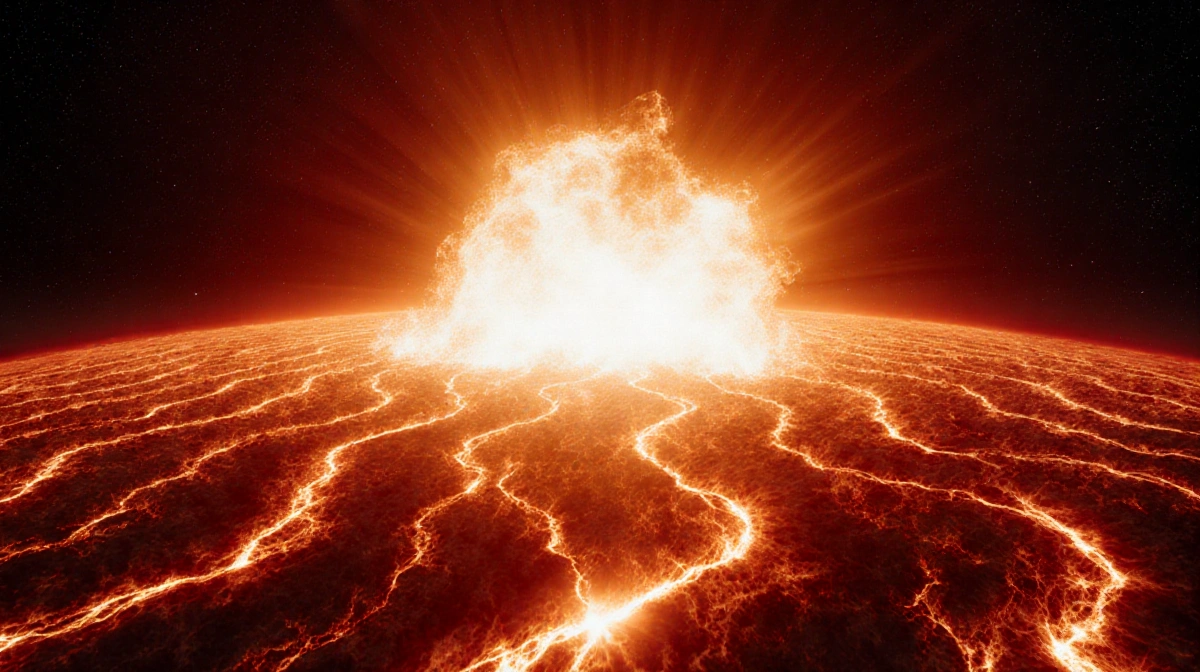
- On September 30, 2024, the Sun released a powerful explosion that broke and re-connected magnetic field lines in a cross-shaped pattern.
- The European Space Agency’s Solar Orbiter captured the event in unprecedented detail, revealing a magnetic avalanche that triggers solar flares.
- The study shows that tiny disturbances grow into violent eruptions, producing plasma rain that continues after the flare subsides.
- Why it matters: Understanding the avalanche mechanism helps predict flares that can disrupt Earth’s technology.
Solar flares are colossal explosions that spew energy, light, and particles into space. On September 30, 2024, the Sun unleashed a powerful flare that the European Space Agency’s Solar Orbiter watched unfold in real time, offering scientists a new window into how these eruptions start and evolve.
The Explosion
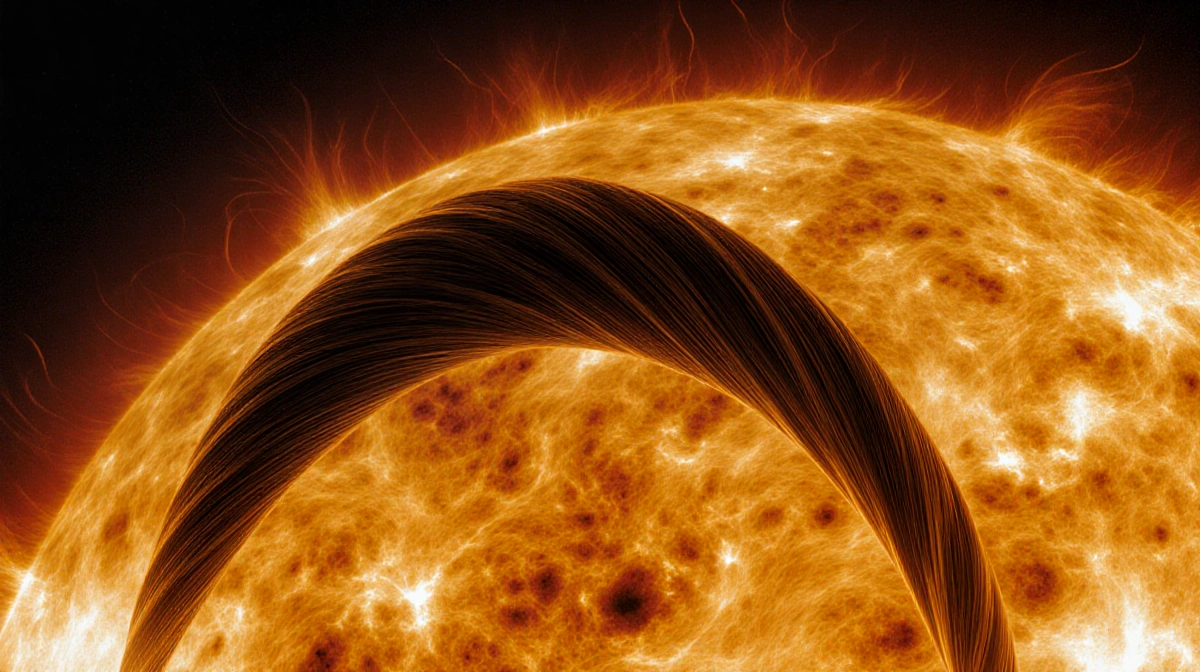
Solar flares occur when energy stored in twisted magnetic field lines is suddenly released. The event on September 30, 2024 began with a dark, arch-like filament of plasma that was linked to a cross-shaped brightening structure. Roughly 40 minutes before the flare peaked, the spacecraft’s Extreme Ultraviolet Imager (EUI) focused on the region, capturing every frame with a cadence of two seconds or less.
Observations revealed new magnetic strands appearing in each image. Each strand was magnetically contained and twisted like a rope, and the region became progressively less stable, much like an avalanche. The strands began to break and reconnect, triggering a cascade of further instability.
- The reconnection events appeared as increasing brightness in the images.
- A sudden brightening was followed by the filament disconnecting from one side, launching into space while unrolling at high speed.
Scientists first recorded the unwinding at 155 miles per second (250 km/s), rising to 248 miles per second (400 km/s) at the disconnection site. Bright sparks of reconnection appeared along the filament in stunning high-resolution images as the flare erupted.
> “We were really very lucky to witness the precursor events of this large flare in such beautiful detail,” said Pradeep Chitta, researcher at the Max Planck Institute for Solar System Research and lead author of the paper.
> “Such detailed high-cadence observations of a flare are not possible all the time because of the limited observational windows and because data like these take up so much memory space on the spacecraft’s onboard computer. We really were in the right place at the right time to catch the fine details of this flare.”
Magnetic Avalanche Mechanics
The study demonstrates that the flare is driven by a series of smaller reconnection events that spread rapidly in space and time, creating a cascade of increasingly violent events. Before the flare erupted, emissions from the Sun were slowly rising when the spacecraft first began observing the region.
During the flare itself, particles accelerated to speeds of 40 to 50 % the speed of light. The observations also revealed that the energy was transferred from the magnetic field to the surrounding plasma during these reconnection events.
> “We saw ribbon-like features moving extremely quickly down through the Sun’s atmosphere, even before the main episode of the flare,” Chitta added. “These streams of ‘raining plasma blobs’ are signatures of energy deposition, which get stronger and stronger as the flare progresses.”
Even after the flare subsided, the rain of plasma blobs continued for some time. This lingering activity shows that the magnetic avalanche mechanism can sustain energy release beyond the peak of the flare.
Aftermath and Implications
Miho Janvier, ESA’s Solar Orbiter co-project scientist, highlighted the broader significance of the findings:
> “Solar Orbiter’s observations unveil the central engine of a flare and emphasise the crucial role of an avalanche-like magnetic energy release mechanism at work,” Janvier said.
> “An interesting prospect is whether this mechanism happens in all flares, and on other flaring stars.”
The detailed footage provides a new benchmark for testing models of solar flare initiation. By linking the tiny, early disturbances to the large-scale eruption, scientists can refine predictions of flare timing and intensity.
Key Takeaways
- The Solar Orbiter captured the entire life cycle of a powerful solar flare, from precursor disturbances to post-flare plasma rain.
- Magnetic strands broke and reconnected in a cascade, demonstrating an avalanche-like release of energy.
- Particles accelerated to 40-50 % the speed of light, and plasma rain persisted long after the flare subsided.
- These observations improve our understanding of flare mechanisms and help assess risks to Earth-bound technology.
Future Directions
The study opens several avenues for further research:
- Comparative studies of flares on other stars to determine if the avalanche mechanism is universal.
- Improved modeling of magnetic reconnection sequences based on the high-cadence data.
- Operational forecasting enhancements for space-weather alerts, using the new insights into flare initiation.
Solar physics now has a richer dataset to test theories, and the next generation of instruments may capture even finer details of the magnetic dance that powers our star’s most dramatic outbursts.