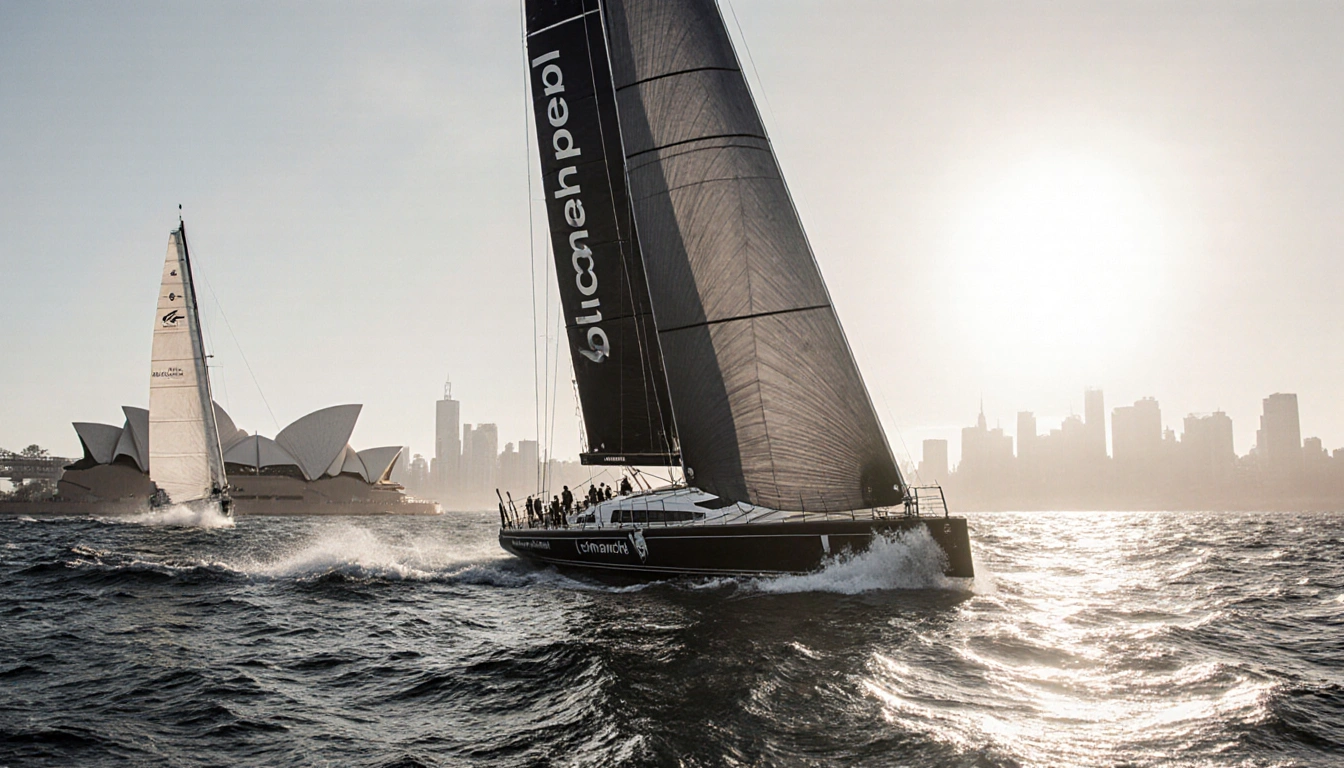
Just over 24 hours into the 80th running of the Sydney to Hobart yacht race, the Australian supermaxi LDV Comanche was a four-nautical-mile leader over its nearest rival, the defending champion LawConnect. The race, which launched Friday from Sydney Harbour and will finish in Hobart, Tasmania, has already seen a dramatic duel between the two fastest boats in the fleet. Comanche, skippered by Matt Allen and James Mayo, has maintained its advantage despite rough overnight conditions that tested the resilience of the entire fleet. Meanwhile, LawConnect has battled a broken mainsheet and halyard, but has repaired both before setting off again in pursuit.
LawConnect’s crew faced a broken mainsheet and a fractured halyard during the night. The team worked through the stormy conditions, cutting and splicing new lines and re-rigging the halyard before launching the next leg of the race. Their effort kept the vessel within striking distance of Comanche, and the skipper, Christian Beck, remained optimistic about the boat’s prospects despite the setbacks. “We had a few things slow us down and Comanche’s obviously done quite well,” Beck said Saturday. “It’s mildly disappointing for us, but you win some, lose some. Everything’s good, we’re still in the hunt.”
With nearly half the race completed, the Hong Kong-based SHK Scallywag 100 took third place, followed closely by the 88-footer Lucky, a New York Yacht Club entry skippered by Bryon Ehrhart. These two vessels, though not in the immediate lead, have demonstrated strong performance in the challenging early stages of the race. Their positions indicate that the race remains competitive beyond the front two, and the crews are prepared to take advantage of any opportunity that arises in the coming days.
The leading yachts approached Gabo Island, located off the east coast of Victoria and marking the entrance to the often treacherous Bass Strait. Their proximity to the island suggested a likely arrival at Constitution Dock in Hobart later on Sunday afternoon. Current weather and wind projections point to a steady, if not brisk, downwind run that would allow the front two to maintain their advantage. The finish, however, is expected to occur more than two days after the start, well beyond the race record that has stood for years.
The race lost its first supermaxi when Wild Thing 100 retired. All crew were safe as the vessel began its return journey to Sydney overnight on Friday night after reporting rigging damage. The decision to withdraw was taken early in the night, and the crew were able to secure the boat and head back without incident. The retirement underscores the difficulty of the route and the high stakes involved for even the most powerful yachts.
Skipper Robert Large aboard his yacht Inukshuk was also among the retirements after becoming entangled in a fishing net. The crew could not move the vessel, and Large said it took them probably 45 minutes to clear the thing. After finally pulling the net off, Large expressed concern that his boat might have sustained rudder damage, which would have made it risky to continue sailing. Large, an Australian resident for nearly 20 years and Canadian-born, has sailed in six previous Sydney-Hobarts.
LawConnect, owned by Australian tech millionaire Beck, led the fleet out of Sydney Harbour in search of its third straight line honours win. Overnight conditions on Friday night were rough on the fleet, but not as dangerous as last year when two sailors died in storms on the first night. On Friday, the fleet paid tribute to the victims of the Dec. 14 terror attack by scattering rose petals off the coast of Bondi Beach off Sydney as they passed the area early in the race.
LawConnect won last year’s event in 1 day, 13 hours, 35 minutes and 13 seconds for the 628-nautical-mile (722 miles, 1,160 kilometers) race. The race record set by LDV Comanche – 1 day, 9 hours, 15 minutes, 24 seconds – has stood since 2017 and only comes under threat in very strong downwind conditions. The current race, with its challenging weather and distance, continues to test the limits of the fleet and the skill of its crews.
At this point, the race has entered its second day, and the lead is held by a single supermaxi. The narrow four-nautical-mile gap between Comanche and LawConnect reflects the intensity of the competition and the high level of performance from both vessels. With the rest of the fleet still several hours behind, the focus shifts to the remaining legs, where the weather is expected to stay favorable for downwind sailing. The crews will need to balance speed with caution as they approach the final stretch toward Hobart.
With the race still more than 48 hours from its finish, the competition remains open and unpredictable. The front-rankers will continue to battle for the coveted line honours, while other crews will aim for the overall victory that rewards the best overall time. As the fleet barrels toward Hobart, the story of the 80th Sydney to Hobart will unfold, adding another chapter to the race’s rich history of endurance, skill, and resilience.
The Bass Strait, which separates mainland Australia from Tasmania, is notorious for its unpredictable weather, sudden squalls, and strong currents. The stretch between Gabo Island and Hobart has seen numerous incidents over the years, including capsizes and retirements. For the 80th edition, the forecast calls for a steady breeze from the south-east, which should favor the downwind legs but still requires crews to maintain vigilance. The combination of distance, sea state, and the sheer number of competitors makes the final leg one of the most demanding in the sailing calendar.
Since its inception in 1945, the Sydney to Hobart has grown into a benchmark for offshore racing. The event’s record time, set by LDV Comanche in 2017, has become a target for every supermaxi entering the race. While the current weather conditions are favorable, the 2025 edition will test whether any of the new entrants can close the gap to the record or even surpass it. The race’s legacy of pushing the limits of design, crew endurance, and tactical decision-making continues to captivate sailors and fans alike.