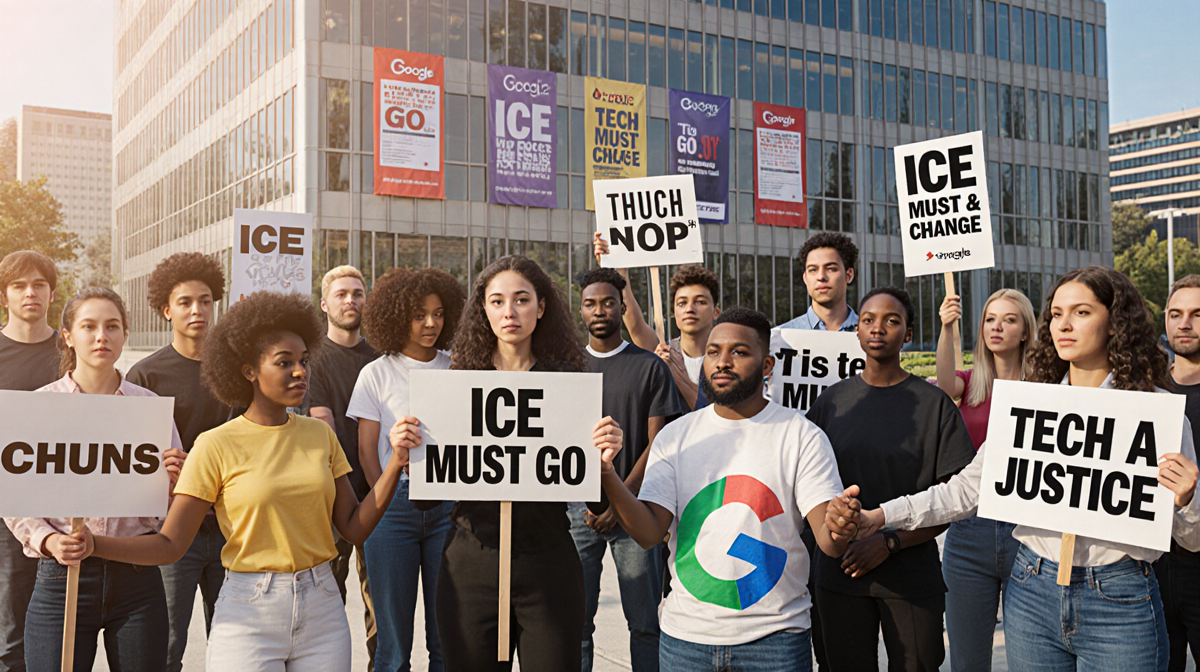
Hundreds of tech industry workers are asking their CEOs to stand up to the Trump administration’s weaponization of immigration forces and the subsequent violence that’s ensued. In a letter signed by more than 400 employees from Apple, Meta, Google, Amazon, Microsoft, Salesforce, OpenAI, Nvidia and more, tech workers are demanding that their employers cancel all company contracts with Immigration and Customs Enforcement, speak out publicly against the violence carried out by the agency’s officers, and use their leverage to call the White House and demand an end to the crackdown. Protests against ICE’s brutal immigrant crackdown have been surging across the country over the past few months, but things have been especially intense in Minneapolis, Minnesota, where both Renee Good and Alex Pretti were murdered by ICE officers just three weeks apart.
At a Glance
- Hundreds of tech industry workers have signed a letter urging action against ICE violence.
- The letter calls for contract cancellations, public condemnation, and a direct appeal to the White House.
- ICE has detained more than 68,000 immigrants as of mid-December, with 32 deaths in custody last year – the deadliest year since 2004.
- Why it matters: Tech leaders wield unprecedented influence, yet many have stayed silent on the crisis.
Why the Letter Matters
The letter represents a collective plea from a sector that has historically aligned closely with the Trump administration. By asking CEOs to use their “leverage” to end violence, the workers highlight a tension between corporate interests and human-rights concerns. The demand for contract cancellations signals a potential shift in how tech firms engage with federal agencies.
Background on ICE Violence
The violence that prompted the letter escalated after the murders of Renee Good and Alex Pretti. The deaths, occurring only three weeks apart, drew national attention to ICE officers’ conduct. The agency’s 2004-era crackdown has been described by critics as a “weaponization of immigration forces,” leading to widespread protests across the United States. The letter notes that 32 people died while in ICE custody last year, underscoring the severity of the issue.
| Metric | Number |
|---|---|
| Immigrants detained (mid-December) | 68,000 |
| Deaths in ICE custody (last year) | 32 |
| Years since 2004 (deadliest year) | 2004 |

Tech Industry Response
The letter is signed by employees from a broad spectrum of tech giants. It calls for:
- Cancelling all contracts with ICE.
- Publicly condemning ICE’s violent actions.
- Directly contacting the White House to demand an end to the crackdown.
“Today we’re calling on our CEOs to pick up the phone again,” the letter from tech industry professionals said. “We want to be proud to work in tech. We want to be proud of the companies we work for. We can and must use our leverage to end this violence.”
Historical Context of Trump and Silicon Valley
Silicon Valley has had unprecedented access to President Trump. Big tech CEOs have accompanied the President at almost every significant event in his second term, from the inauguration to trade meetings with foreign governments. In the first year of his second term, Trump made Silicon Valley interests a part of his trade approach and ensured a heavily pro-industry regulatory environment. While being promised a more friendly regulatory environment, CEOs have mostly avoided commenting on Trump’s actions in his second term and readily appeared at public events to promote the President’s agenda.
Specific Company Actions
Apple, for example, removed an app that allows users to track ICE activity at the behest of Attorney General Pam Bondi. Palantir, whose CEO Alex Karp has vowed to use his “whole influence to make sure this country stays skeptical on migration,” built a $30 million surveillance platform for ICE. Six Apple employees have signed the letter, but no current Palantir employees have lent their endorsement as of Monday afternoon. There has at least been one instance in which tech CEOs have used their immeasurable influence to actually urge Trump to stand down. Back in October, Trump walked back his previous threats to increase the federal force in San Francisco after talking to his “friends,” aka tech executives, including the likes of Nvidia CEO Jensen Huang and Salesforce CEO Marc Benioff.
Future Implications
If tech CEOs heed the letter, it could signal a broader corporate shift toward prioritizing human-rights issues. A withdrawal of contracts would strain ICE’s funding and operational capacity. Public condemnation could influence public opinion and pressure the White House to reassess its immigration policies. The letter also underscores the power of employee activism in shaping corporate policy.
Tech workers’ collective voice may force a reckoning between corporate influence and the moral responsibilities of the tech sector. The outcome will likely reverberate through the industry’s relationships with federal agencies and its public image.