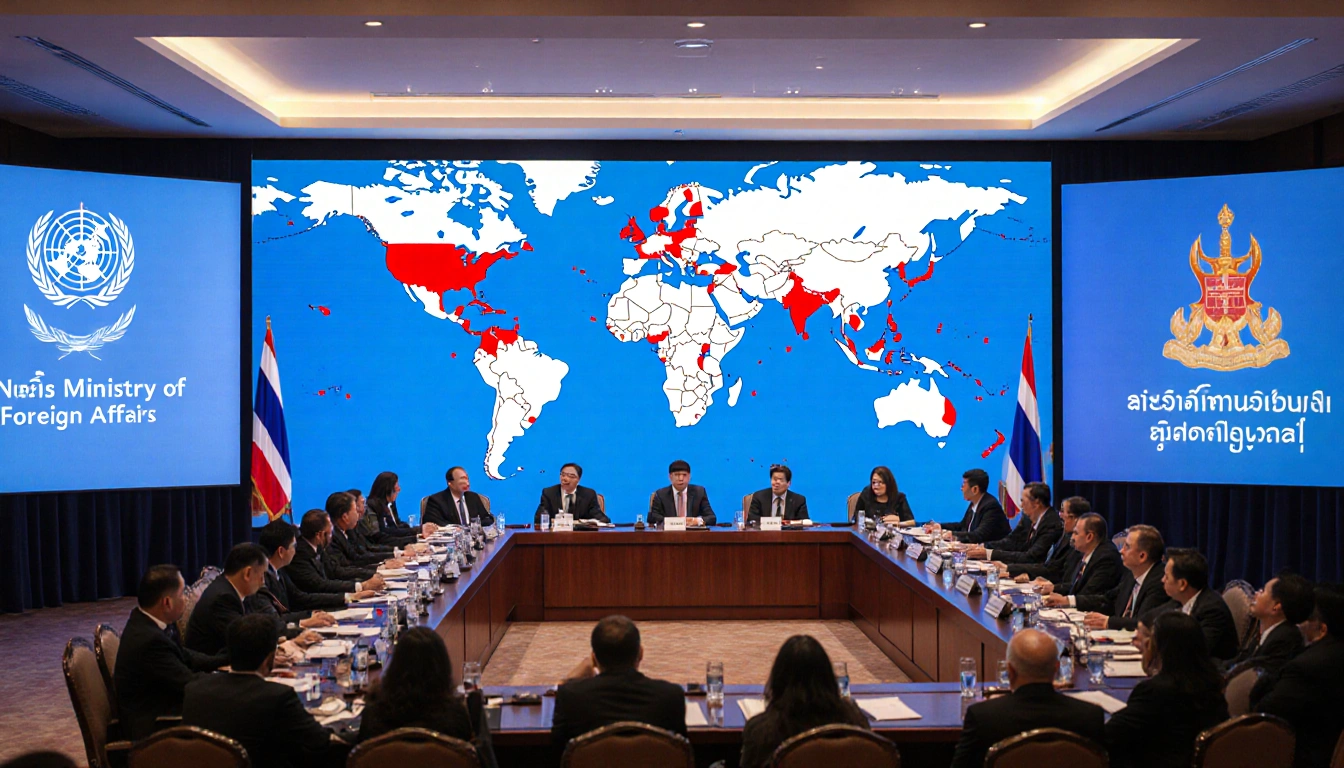
In a move that could reshape the global fight against cybercrime, Thailand’s Ministry of Foreign Affairs and the United Nations Office on Drugs and Crime opened a two-day conference in Bangkok on Wednesday and Thursday. The event culminated in the launch of the Global Partnership Against Online Scams, an initiative that brings together governments, law-enforcement agencies, victim-protection bodies, and the private sector to tackle a problem that costs billions of dollars each year.
The partnership, formally signed by representatives from Thailand, Bangladesh, Nepal, Peru and the United Arab Emirates, pledges political commitment, cross-border collaboration, law-enforcement cooperation, victim protection and public awareness. The agreement was announced during the conference’s closing ceremony, marking the first time a coalition of this size has committed to a coordinated anti-scam strategy.
Thai Prime Minister Anutin Charnvirakul delivered the keynote speech on Wednesday, stating that online scams “reveal a deeper problem – a collective vulnerability that no country can address alone.” His remarks underscored the need for a united front against criminal enterprises that operate across borders and platforms.
Private-sector participation was a key feature of the conference. Internet giants Meta and TikTok provided assistance, with Meta presenting a threat report that highlighted the growing use of artificial intelligence by scam networks. TikTok, which signed the conference’s closing statement, became one of the first private-sector members of the partnership and announced new agreements with major investors to form a TikTok U.S. joint venture.
Scam centers that exploit victims through bogus investment schemes and fake relationships have proliferated across Southeast Asia. The United Nations Office on Drugs and Crime estimates that victims lost between $18 billion and $37 billion in 2023 alone, a figure that underscores the urgency of the partnership’s objectives.
Recent events have further spurred regional action. Raids on scam centers in Myanmar, challenges with victim repatriation in Thailand, and the death of a South Korean student forced into scam work in Cambodia have highlighted the human cost of these operations. Cambodia, a known hub for scam compounds, was not represented at the conference due to ongoing armed conflict with Thailand.
Similar commitments were made by members of the Association of Southeast Asian Nations in the months leading up to the Bangkok conference. The United Nations Convention against Cybercrime, signed by more than 70 countries in October in Vietnam, was also referenced. U.N. Secretary-General António Guterres described the convention as “a vow that no country, no matter their level of development, will be left defenseless against cybercrime.”
Brian Hanley, Asia-Pacific director of the Global Anti-Scam Alliance, emphasized the importance of broad stakeholder involvement. He said, “Scams are exploiting, not only transnational boundaries, but also the seams across various platforms from banks, telcos, to social media platforms.” Hanley added, “TikTok is the one that we’re talking about today, but hopefully tomorrow everyone’s joining,” and noted that the alliance is “starting to get critical mass and momentum as everyone realizes it’s affecting their bottom lines and consumer trust.”
TikTok’s participation marks a significant shift in the fight against online scams. The platform, one of the world’s most popular short-form video services, has faced scrutiny from governments over issues ranging from Chinese ownership to data sharing in Indonesia. Its inclusion in the partnership signals a willingness to collaborate with governments and law-enforcement agencies on a global scale.
Meta’s threat report, presented during the conference, detailed how scam networks increasingly employ artificial intelligence to craft convincing messages and automate phishing campaigns. The company also outlined protocols it is using to counter scams on its social media platforms, including Facebook, Instagram and WhatsApp, illustrating a coordinated approach between public and private sectors.
Key Takeaways
- The Global Partnership Against Online Scams unites five countries, the UN, and private tech giants to combat cybercrime.
- Victims of online scams lost an estimated $18 billion to $37 billion in 2023, highlighting the scale of the problem.
- Recent regional incidents and international conventions have accelerated the push for a coordinated global response.
The Bangkok conference represents a milestone in international cooperation against online fraud. By bringing together governments, law-enforcement agencies, victim-protection organizations and the private sector, the partnership aims to create a more resilient global ecosystem that can protect victims and dismantle the criminal networks that profit from deception.