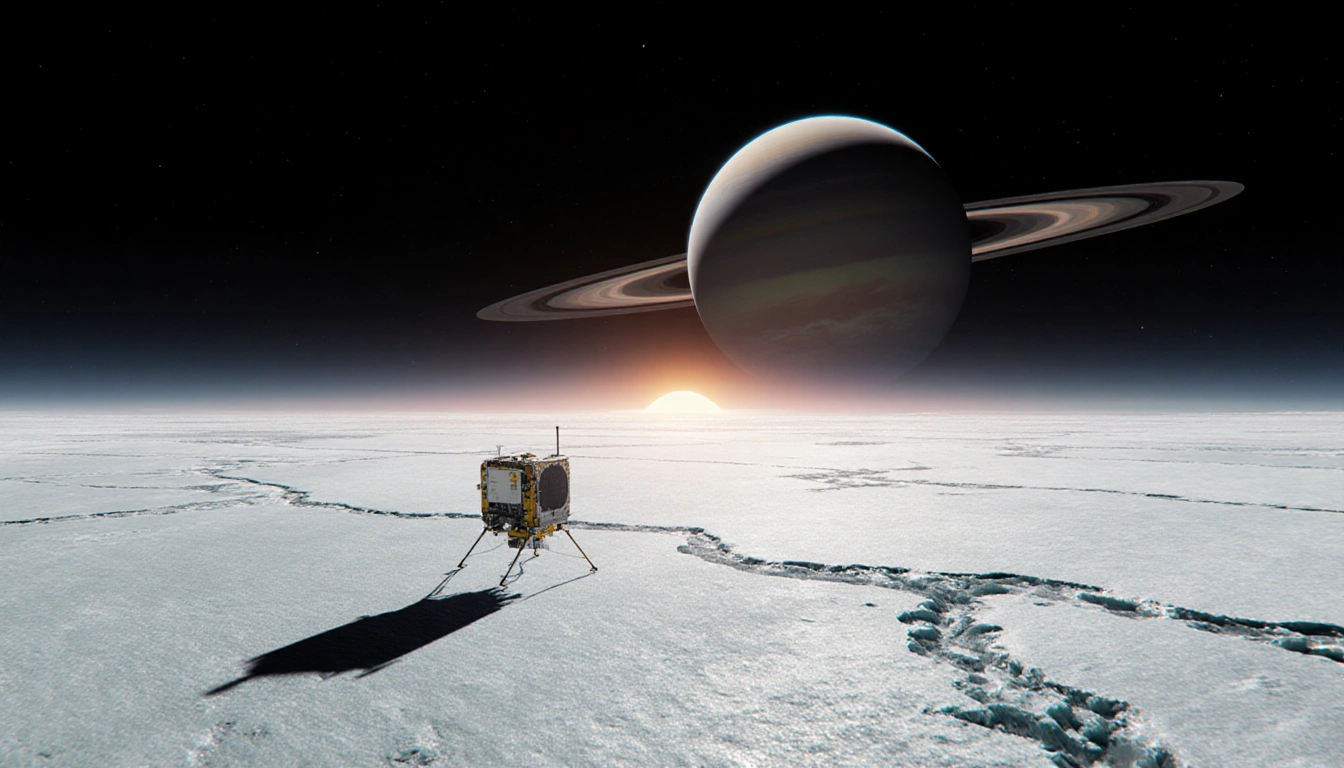
Titan may not have a vast underground ocean after all.
A team of scientists at NASA’s Jet Propulsion Laboratory has re-examined data from the Cassini spacecraft and concluded that the moon’s interior is more like a deep, slushy ice layer than a hidden ocean.
The study, published in Nature, challenges a decade-long assumption that Titan is an “ocean world.”
The new findings suggest pockets of liquid water could exist beneath the ice, offering a potential habitat for life.
## Background on Titan
Titan, Saturn’s largest moon, spans 3,200 miles (5,150 kilometers) and is covered by lakes of liquid methane.
It has long intrigued astronomers because of its dense atmosphere and the possibility of an underground ocean.
Cassini, launched in 1997, visited Saturn in 2004 and studied its moons until its mission ended in 2017.
The data collected over that period formed the basis for many theories about Titan’s subsurface.
## The New Analysis
Researchers led by Flavio Petricca at JPL re-processed Cassini’s observations with improved techniques.
They focused on the timing between the peak gravitational tug from Saturn and the response of Titan’s surface.
If Titan had a liquid ocean, the surface would react almost instantly.
Instead, they found a 15-hour delay, indicating a lagged response consistent with a slushy interior.
## Structure of Titan’s Interior
Computer models suggest that ice, slush, and water layers extend more than 340 miles (550 kilometers) below the surface.
The outer ice shell is estimated to be about 100 miles (170 kilometers) thick, covering layers of slush that could reach another 250 miles (400 kilometers).
In these layers, water could be as warm as 68 degrees Fahrenheit (20 degrees Celsius).
The moon’s tidal locking to Saturn creates bulges up to 30 feet (10 meters) when the two bodies are closest.
## Implications for Life
“There is strong justification for continued optimism regarding the potential for extraterrestrial life,” said Baptiste Journaux of the University of Washington, who participated in the study.
He added that “nature has repeatedly demonstrated far greater creativity than the most imaginative scientists.”
The presence of liquid pockets could provide environments where life might survive, although no signs of life have yet been detected.
## Skepticism from the Scientific Community
Luciano Iess of Sapienza University of Rome, whose earlier work suggested an ocean, expressed caution.
“Certainly intriguing and will stimulate renewed discussion … at present, the available evidence looks certainly not sufficient to exclude Titan from the family of ocean worlds,” he wrote in an email.
Iess’s stance highlights ongoing debate about Titan’s subsurface.
## Future Exploration with Dragonfly
NASA’s planned Dragonfly mission, a helicopter-type craft slated to launch later this decade, aims to study Titan’s surface and atmosphere in detail.
Journaux is part of the Dragonfly team, hoping the mission will provide more clarity on the moon’s interior.
Dragonfly will land on Titan’s methane lakes and rocky plains, collecting data that could confirm or refute the slushy interior hypothesis.
## Titan in the Context of Ocean Worlds
Saturn currently leads the solar system’s moon inventory with 274 moons.
Ganymede, Jupiter’s moon, is slightly larger than Titan and is thought to have an underground ocean.
Enceladus and Europa, moons of Saturn and Jupiter respectively, also exhibit geysers that suggest subsurface water.
These comparisons underscore Titan’s significance in the search for extraterrestrial life.
## The Role of Cassini Data
Cassini’s instruments measured gravity, topography, and surface composition, providing the raw material for the new study.
By applying advanced data processing, the JPL team was able to isolate subtle timing differences that reveal interior structure.
The 15-hour lag is a key piece of evidence distinguishing a liquid ocean from a slushy layer.
## Conclusion
The study reshapes our understanding of Titan’s interior, shifting the focus from a global ocean to a complex, partially melted ice system.
While the possibility of life in these pockets remains speculative, the findings keep Titan at the forefront of astrobiology research.
Upcoming missions like Dragonfly will be crucial in testing the slushy model and exploring Titan’s unique environment.
## Key Takeaways
– Titan’s interior may consist of ice, slush, and pockets of liquid water, not a global ocean.
– A 15-hour delay between gravitational tug and surface response supports the slushy hypothesis.
– The new model places Titan among the solar system’s intriguing ocean-world candidates.
The moon’s secrets continue to unfold as scientists refine their analysis of Cassini data and prepare for future exploration.