At a Glance
- Trump says a CT scan, not an MRI, during an October Walter Reed visit sparked health questions.
- He disclosed routine checks and long-term aspirin use.
- Doctors confirmed the scan was normal and “advanced imaging” was routine for his age.
- Why it matters: Public interest in presidential health and transparency.
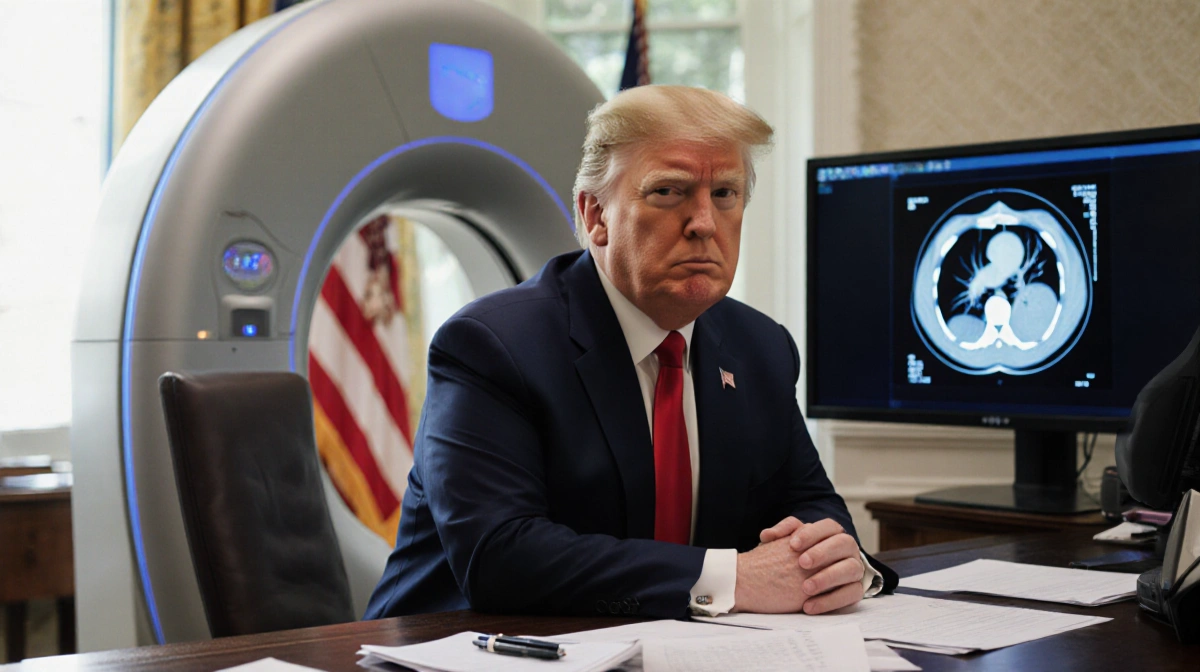
President Donald Trump explained in a Wall Street Journal interview why a CT scan, not an MRI, during an October visit to Walter Reed National Military Medical Center sparked public questions about his health. He detailed the imaging, routine checks, and his long-term aspirin use, while doctors confirmed the results were normal.
The Imaging Debate
President Trump stated:
> “In retrospect, it’s too bad I took it because it gave them a little ammunition. I would have been a lot better off if they didn’t, because the fact that I took it said, ‘Oh gee, is something wrong?'”
Navy Capt. Sean Barbabella, the president’s doctor, explained that the scan was part of a preventative screening for a man his age and was recommended to rule out cardiovascular issues. He said the results were “perfectly normal and revealed absolutely no abnormalities.”
- The scan was a quick CT, not an MRI.
- It was done during an October visit to Walter Reed.
- Results showed no abnormalities.
Health Routine and Aspirin Use
Barbabella said the president had an annual physical in April and a routine evaluation in October to “ensure continued optimal health.” Trump also discussed chronic venous insufficiency, compression socks, and a daily aspirin regimen of 325 milligrams.
Karoline Leavitt, White House press secretary, said:
> “The President’s doctors and the White House have always maintained the President received advanced imaging, but additional details on the imaging have been disclosed by the President himself because he has nothing to hide.”
- Chronic venous insufficiency diagnosed in summer.
- Compression socks tried, then stopped.
- Daily aspirin: 325 milligrams, more than doctors recommend.
President Trump added that he sometimes blinks or rests his eyes during meetings, not sleeps, and that he has never slept much at night. He said he starts his day early in the White House residence, moves to the Oval Office around 10 a.m., and works until 7 p.m. or 8 p.m.
President Trump said:
> “I’ll just close. It’s very relaxing to me.”
President Trump added:
> “Sometimes they’ll take a picture of me blinking, blinking, and they’ll catch me with the blink.”
President Trump said:
> “I only struggled to hear when there’s a lot of people talking.”
President Trump said:
> “I want nice, thin blood pouring through my heart.”
Key Takeaways
- Trump clarified the imaging was a CT scan, not an MRI, and the results were normal.
- He highlighted routine health checks, aspirin use, and a diagnosis of chronic venous insufficiency.
- The president’s comments aim to reassure the public about his health and transparency.

President Trump’s interview provides a detailed look at his health routine and the imaging that prompted public scrutiny, underscoring the importance of transparency for a 79-year-old president.