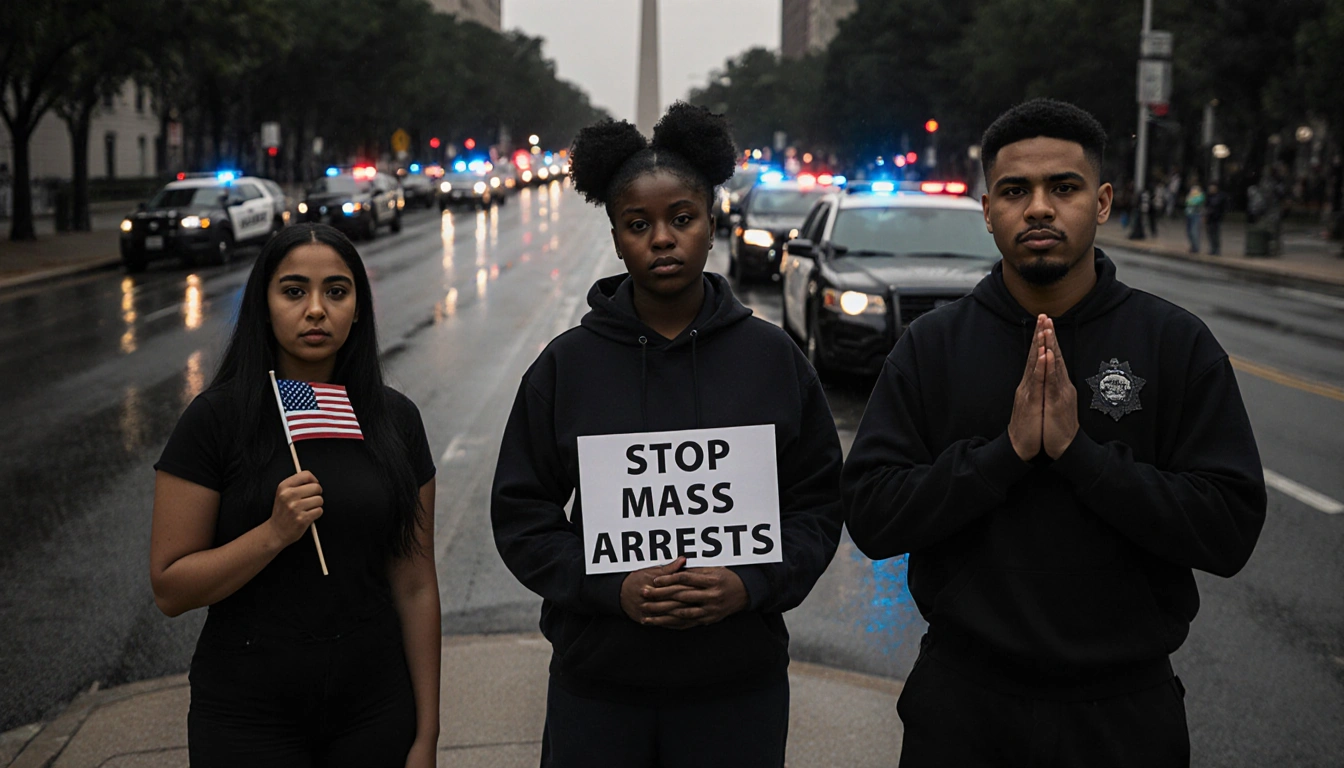
When President Donald Trump launched a federal law-enforcement operation in Washington, D.C. in mid-August, he called it a mission to curb crime. The reality that has unfolded, however, shows a different focus.
A Mission That Became a Mass Arrest Campaign
Official data reviewed by the Associated Press reveals that of the more than 7,500 arrests made since the operation began, roughly 33 percent were immigration-related. In September, an AP analysis found that 40 percent of the 2,400 arrests that month involved immigration violations. The numbers indicate that a significant portion of the city’s policing effort is directed at immigrants.
White House spokesperson Abigail Jackson explained the administration’s stance: “The focus of President Trump’s highly successful D.C. operation has been to address crime committed by anyone, regardless of immigration status,” she said. She added that many of those arrested were committing crimes, had outstanding warrants or had prior convictions.
The statistics also show a wide range of charges, including homicide and drug offenses. Yet, data from the University of California, Berkeley Deportation Data Project shows that of the roughly 1,130 immigration arrests made up to October 15, 947 involved individuals with no criminal record or pending charges.
Community Voices and Legal Challenges
During a more than 10-hour municipal hearing earlier this month, residents recounted ongoing concerns. Witnesses described detentions by masked, unidentifiable law-enforcement agents in school drop-off zones, food distribution sites, and apartments with large Hispanic populations. The Metropolitan Police Department’s continued collaboration with ICE, despite Mayor Muriel Bowser’s pledge, was a point of contention.
Bolivian immigrant Nadia Salazar Sandi shared a personal story: “Multiple family members have been detained over recent months, leaving what I said were empty seats at Thanksgiving dinner.” She added, “This is terrifying. I’m a citizen now, and I walk with my passport.”
City resident Leah Tribbett expressed frustration: “Every single day my neighbors are being harassed, assaulted and kidnapped,” she said. “I could talk for probably the entirety of this hearing and still not recount every single instance of brutality that I’ve seen.”
A medical professional testified that a family was considering opting out of speech and occupational therapy for their autistic children out of fear that authorities would be waiting for them at the clinic.
In court, a federal judge recently blocked the Trump administration from making widespread immigration arrests in the capital without warrants or probable cause. The American Civil Liberties Union and plaintiffs’ attorneys argued that federal officers had been patrolling and setting up checkpoints in neighborhoods with large Hispanic populations, stopping and arresting people indiscriminately.
Plaintiff José Escobar Molina recounted his experience: “I was walking from my apartment building to my work truck when two cars pulled up next to me. Unidentified federal agents grabbed and handcuffed me without asking for my name, identification or any information about my immigration status. They also did not ask where I lived, how long I have been in the area or whether I had ties to the community.”
The Trump administration defended the arrests as lawful, citing probable cause. Department of Homeland Security Assistant Secretary Tricia McLaughlin said, “Arrests in Washington and beyond are carried out lawfully and all detainees receive due process.”
Associate counsel Madeleine Gates of the Washington Lawyers’ Committee, one of the plaintiffs’ attorneys, said, “What we’ve actually seen in practice are officers arresting people without seeming to know who they are.”
No End in Sight
Trump has not announced when he will draw down the federal law-enforcement surge. Following the shooting of two National Guard members allegedly by an Afghan national in the city last month, Trump said he planned to bring in hundreds more troops to support the operation.
Local leaders hold hearings and raise alarms, but acknowledge that in a federal district with limited autonomy, there is little they can do to push back. Council member Brooke Pinto said, “The frustrating truth is that we do not have the same levers of power and control, nor the same rights, as a district that every one of the 50 other states have to protect our residents.”
Key Takeaways
- One-third of arrests since the August operation began are immigration-related, with 40 percent of September arrests tied to immigration.
- Courts have blocked nationwide immigration sweeps without warrants, citing lack of probable cause.
- The federal surge continues, with no announced draw-down, and community members report ongoing detentions and fear.
The Washington operation, intended as a crime-fighting mission, has become a routine immigration enforcement campaign, leaving residents and legal advocates demanding clearer boundaries and accountability.