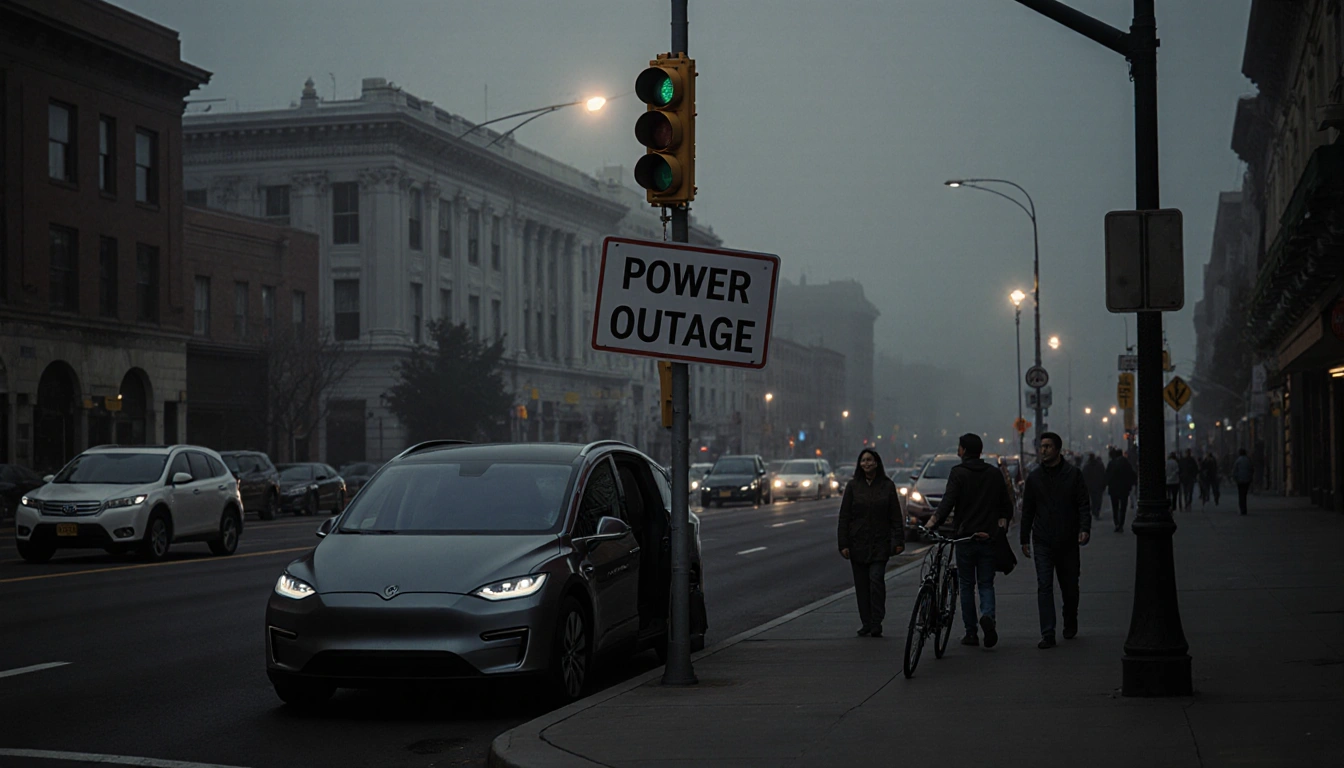
During a city-wide blackout on Saturday, Waymo’s autonomous vehicles clogged San Francisco intersections, forcing the company to halt service until the power was restored.
The Outage and Its Impact
A fire at a power substation knocked out electricity for 130,000 homes and businesses, nearly one-third of Pacific Gas and Electric’s San Francisco customers. The outage began on Saturday and continued into the following day, leaving traffic lights dark and emergency services scrambling.
Social media videos showed dozens of Waymo cars standing in traffic, some with hazard lights blinking and others stopping abruptly in the middle of intersections. Drivers reported that the autonomous vehicles “seemed extremely frustrated” by the situation.
Waymo’s Response
Waymo’s spokesperson said the company’s vehicles are programmed to treat non-functioning traffic signals as four-way stops. “While the failure of the utility infrastructure was significant, we are committed to ensuring our technology adjusts to traffic flow during such events,” the spokesperson added. The company coordinated closely with San Francisco city officials throughout the outage.
The service pause began Saturday evening and resumed Sunday afternoon. Waymo noted that most active trips were completed before the vehicles were safely returned to depots or pulled over.

Public Reactions and Expert Analysis
Tyler Cervini, a Mission District resident, described how he was forced to call an Uber after the train station stopped operating. At the traffic light outside his apartment, five Waymos crowded the intersection. He said, “He had to swerve through them to pick me up.”
Philip Koopman, professor emeritus at Carnegie Mellon University and self-driving-vehicle safety expert, observed that the scale of the traffic disruption was concerning. “Autonomous vehicles are generally programmed to come to a stop if they are unsure or confused on what to do and ask for remote assistance,” Koopman said. He added that the problem appeared to be an “operational management failure” rather than a software glitch.
Koopman urged that Waymo should have suspended service earlier, noting that “If you have thousands of robotaxis that stop, you have a problem.” He compared the scenario to an earthquake, where many autonomous vehicles blocking roads would pose a serious hazard.
Shane Gusman, director of Teamsters California, criticized the disruption as evidence that autonomous vehicles are premature. “AVs stalled in streets and intersections threaten the safety of AV passengers, and others on the road, and inhibit emergency response when we need it most,” Gusman said in a statement.
Broader Context and Future Implications
Waymo began as a secret Google project in 2009 and has since expanded its fleet in San Francisco, Los Angeles, San Jose, and other U.S. markets such as Texas, Arizona, Florida, and Georgia. The company’s robotaxis are on pace to complete more than 14 million rides this year, tripling its previous total.
In the months leading up to the state’s Public Utilities Commission approval in August 2023, San Francisco transportation and fire department leaders flagged dozens of reports about robotaxis coming to standstills and blocking traffic. These incidents raised concerns about the potential impediment to emergency response.
California is currently considering expanding approval for heavy-duty autonomous trucks and vehicles carrying up to 15 passengers. The proposal faces opposition from unions representing truck drivers.
Key Takeaways
- Waymo’s autonomous vehicles blocked intersections during a Saturday power outage that affected 130,000 San Francisco customers.
- The company paused service Saturday evening and resumed Sunday afternoon, coordinating with city officials.
- Experts cited an operational management failure, not a software bug, and called for earlier suspension of service.
The incident underscores the challenges of deploying autonomous vehicles in unpredictable real-world conditions, especially during widespread infrastructure failures.
Closing
As California and other states explore broader autonomous vehicle approvals, the San Francisco outage serves as a reminder that robust contingency plans and rapid response capabilities are essential for safe integration of robotaxis into everyday traffic.